United StatesSri Chinmoy Marathon Team

  • About us
  • Our races
  • Results

Search form

Founded by Sri Chinmoy in 1977, the Marathon Team is one of the world's largest organisers of endurance events.
read more »

Media Coverage

Articles & TV clips

History

From 2 to 3100 miles

Sri Chinmoy

Marathon Team Founder

Marathon Training

Our seven-step guide

Next Event:

6 June - Seattle
Self-Transcendence 2-mile race Seattle, Race 6
Details »

More events:

New York
San Diego
Seattle
View all events »

Worldwide:

View full list »

Latest results:

23 May - Seattle
Results for the Sri Chinmoy 7 & 13-Hour Races May 23, 2026
Details »

Previous races

View all results »

Worldwide results

Full list »

Galleries and Video from 3100 Mile Race

By Anonymous
7 September
Photo Galleries Video
Finish Galleries:
Asprihanal, Michael, Smarana, Madhupran, Arpan
 
Day 37 - July 19 Asprihanal final 24 hr
Day 22 - July 4 Oleg Chat with Matt
Day 18 - June 30 Sri Chinmoy meditates
Day 10 - June 23
Stefan Abichal
Day 2 - June 14 Smarana and Michael Music video
Day 1 - June 13 Matt July 3
Abakash's photos from the start Arpan Video of the Start
  Virendra Abichal Matt
   

Sri Chinmoy Marathon Team articles - more articles

5 Borough Run honouring Sri Chinmoy, 1978

By Rupantar LaRusso author bio »
14 February

About the author:

Rupantar has been the race director of the Sri Chinmoy Marathon Team since 1985, having been asked by Sri Chinmoy to serve in that capacity. As well as working on the big races the US Marathon Team organise each year - the 3100 Mile Race and the Six and 10 Day Race - he also spends a considerable amount of time archiving the Marathon Team's 40 year history on this website.

queens relay 1978.jpg"38 Runners Set to Honor Queens Guru" (Press Release). December 9, 1978. Retrieved 2013-02-15. Archive copy at Sri Chinmoy Marathon Team office, Queens, New York.

"New York (December 9) - A 48 hour borough-wide relay run, the Queens Culture Run, will kick off on December 14 to honor Sri Chinmoy of Jamaica, for his achievements in music, art, poetry and athletics..."

View full article »

Sri Chinmoy 13 Mile Race, December 9, 1979

By Rupantar LaRusso author bio »
11 February

About the author:

Rupantar has been the race director of the Sri Chinmoy Marathon Team since 1985, having been asked by Sri Chinmoy to serve in that capacity. As well as working on the big races the US Marathon Team organise each year - the 3100 Mile Race and the Six and 10 Day Race - he also spends a considerable amount of time archiving the Marathon Team's 40 year history on this website.

"Sri Chinmoy 13-Mile Race...A Running Duel." Runner's Gazette. February 1980.

A running duel dominated the December 9 Sri Chinmoy 13-Mile Race in Flushing Meadow Park as 20 year old John Doyle of St. John's University, Queens and 28 year old Rejean Gauthier of Ottawa, Canada quickly moved out from the pack of 400 runners...

Partial Race Results...

1. John Doyle, 20, St. Johns Queens: 1:09:08

2. Rejean Gauthier, 28, Ottawa, Canada: 1:09:42

3. Roger Sheldon, 32, Flushing Meadow Track Club: 1:11:06

40-49 age category:

1. Cahit Yeter, 44, Cahit's Pacers: 1:15:12

2. Richard Gazda, 40, Port Washington: 1:18:05

3. Charles Kennedy, 41, New York: 1:18:52

Women's Division

1. Kathy Naughton, 25, College Point Track Club: 1:32:05

2. Lucille Corva, 28, Bronx: 1:34:08

3. Margaret Greco, 29, College Point: 1:38:51

start 13 mile 1979.jpg

Over 400 runners crowd the start of the Sri Chinmoy 13-Mile Race

at Flushing Meadow Park on December 9, 1979.

Partial Scanned Results...

results 10 mile dec.jpg

View full article »

Salutations to America: A 1,300 Mile Non-Stop Relay Run

By Rupantar LaRusso author bio »
9 February

About the author:

Rupantar has been the race director of the Sri Chinmoy Marathon Team since 1985, having been asked by Sri Chinmoy to serve in that capacity. As well as working on the big races the US Marathon Team organise each year - the 3100 Mile Race and the Six and 10 Day Race - he also spends a considerable amount of time archiving the Marathon Team's 40 year history on this website.

Extract from "Salutations to America" (Brochure), 1981:

The vision of the early patriots, based on deeper humanitarian and spiritual values, inspired the young nation to reach out to new horizons and achieve the pinnacle of technological and material development. The day is fast approaching when this selfsame vision will carry the mature nation  to new moral and spiritual horizons. It is this vision, drawn from a source deep within the American spirit, that we are paying homage to in our 1,300-mile 'Salutations to America' relay run...

Day and night, the runners will be carrying a flaming torch, symbolizing our hope for and faith in America. The team will be joined along the way by some of the best marathoners from each state, as well as runners from local clubs...

Corbitt, Ted. "New York - Home of Ultramarathoners." New York Running News. November/December 1980.

There were at least two other positive developments for ultramarathoners in 1980...The six day running race surfaced again...The second significant thing was the Sri Chinmoy Marathon Team's staging of the 'Salutations to America' 1,300 miles nonstop relay run from Concord, New Hampshire, passing through the original 13 United States of America, ending at Atlanta, Georgia. Local runners on the route were invited to run along with the torch bearing relay runners...

Ayres, Ed. "Lighting the Way." Running Times. June 1981.

In an age of trouble, trouble, and more trouble, a refreshingly different world-view is being promulgated by Sri Chinmoy, an Indian guru whose adopted homeland is the U.S., and who has attracted thousands of American followers. These followers place higher value on the achievement of spiritual harmony than of material acquisition, which may explain why, in the midst of a deteriorating economy and declining standard of living, they remain placidly optimistic about America's future...Sri Chinmoy and his followers do productive work for a living, and have their feet planted firmly, and literally, on the ground. The guru is an avid long distance runner and road race organizer, and his followers have formed a running team (the Sri Chinmoy Marathon Team), an outgrowth of the group's passionate belief that physical fitness is an integral part of spiritual well-being.

In keeping with their proclivity for seeing the good in things while cheerfully refusing to become emotionally bogged in the bad, the Sri Chinmoy people have become indefatigable celebrators. One of their most recent celebrations was a 1,300-mile non-stop relay, dubbed 'Salutations to America...'

salutations sunil cahit.jpg Sunil Davidson (l)  and Cahit Yeter on the road in the 1980 'Salutations to America' 13 state relay run. salutations flag.jpg Runners receive Rhode Island State flag during the 1980 'Salutations to America' 13 state relay run. Photo: Richard Hopper. hagen.jpg The U.S. Marines and the Sri Chinmoy Marathon Team run together in the Washington, D.C. segment of the Salutations to America relay run. Leading the Team is General Jerry Hagan, USMC (r).


View full article »

The Run and Become Lecture Series: 1980

By Rupantar LaRusso author bio »
8 February

About the author:

Rupantar has been the race director of the Sri Chinmoy Marathon Team since 1985, having been asked by Sri Chinmoy to serve in that capacity. As well as working on the big races the US Marathon Team organise each year - the 3100 Mile Race and the Six and 10 Day Race - he also spends a considerable amount of time archiving the Marathon Team's 40 year history on this website.

lecture brochure.jpg"The Run and Become Lecture Series" (Brochure). 1980

The 'Run and Become' lecture series has hosted an impressive number of top runners of the world, as well as up-and-coming stars, running experts, editors and authors. Recent speakers have included Ted Corbitt, Gary Muhrcke, Nina Kuscsik, Alan Kirik, Cahit Yeter, Peter Squires and Fritz Mueller...

The series evolved from the Sri Chinmoy Marathon Team's wish to know more about its specialty - long-distance running. It gradually expanded to include sessions on short and middle distance running and ultra-marathoning, and from there to include discussions of sports medicine and running philosophy.

About some of the speakers...

"Craig Virgin Opens Fall Run & Become Lecture Series" (Press Release). September 11, 1980. Retrieved 2013-02-08. Archive copy at Sri Chinmoy Marathon Team office, Queens, New York.

Craig Virgin, first American to win the World Cross-Country Championship (Paris 1980) and holder of the American 10,000M track record, will speak at the free Run and Become Lecture Series...

One of the most versatile of the top US runners, 24 year old Virgin has set numerous records in track, cross country and road running events. He won the 10,000M Olympic Trials in Eugene, Oregon, setting an Olympic course record, was chosen Best US Distance Runner (1979-1980) by Runner's World magazine and won the 1979 NY Trevira Twosome with partner Ellison Goodall.

"The Legendary Ted Corbitt to Speak at Running Lecture" (Press Release). July 8, 1980. Retrieved 2013-02-08. Archive copy at Sri Chinmoy Marathon Team office, Queens, New York.

Ted Corbitt, former Olympian and father of the ultra-marathon in America, chairman of the TAC National Standards Committee, founder and first president of the NYRRC and former president of the RRCA - a runner who is a legend in his own time - will be speaking at the "Run and Become" lecture series...

Ted Corbitt has been called 'the silent Brahmin' of running by the international spiritual leader Sri Chinmoy. The name refers to the peace and wisdom that radiates from this great runner, who has been winning awards and shaping the course of running in America and the world since 1951, when he first ran the Boston Marathon.

In his three decades of work in the running community, Ted Corbitt has won numerous national and international championships and has set records in distances from the marathon to the 24 hour run. A working physical therapist, he has written booklets on nutrition and race training. He began the RRCA newsletter and NYRRC 'Running News' magazine, for which he still writes a running column.

Perhaps most dramatic in shaping the course of road running were the years 1958 to 1964. During this time Ted Corbitt developed a national system of accurate road course measurement. Due to his pioneering work, records set on a certified course anywhere in the country are recognized nationwide.

"Cahit Yeter - 100Km Record Holder - Speaks at Series" (Press Release). July 8, 1980. Retrieved 2013-02-08. Archive copy at Sri Chinmoy Marathon Team office, Queens, New York.

Cahit Yeter, ranked number one in the nation in the 100Km distance and holder of the world masters record for the 100Km, will speak at the Tuesday, July 22 'Run and Become' lecture series.

Cahit was born in Istanbul, Turkey, in 1934 and during his youth competed in many track and field events for the Turkish National Team. During this period he turned in a 2:16 marathon time. Following a serious car accident in 1958 he gave up running, not resuming it again for 16 years. He has been living in America since 1968.

When Cahit returned to running, he focused on the longer distances and, to date, he has run 217 marathons.

"Kathy McIntyre - Metropolitan AAU Athlete of the Year - To Speak at 'Run and Become' Lecture" (Press Release). May 21, 1980. Retrieved 2013-02-09. Archive copy at Sri Chinmoy Marathon Team office, Queens, New York.

Kathy McIntyre, the Metropolitan AAU's Female Athlete of the Year, will speak at the 'Run and Become' lecture series on Tuesday, June 3...

Kathy is nationally ranked as the number 1 sub-vet female runner for all distances from 1 to 15 miles. She has been racing competitively for twenty years now and, along with her good friend Nina Kuscsik, is considered a pioneer of women's running. During Kathy's college days she was twice named All-American in cross country, and she has been on three AAU national teams. This year Kathy was also named the Female Athlete of the Year by the New York Road Runners Club.


"Cross-Country Runner Stan Cottrell To Speak at 'Run and Become' Lecture" (Press Release). May 5, 1980. Retrieved 2013-02-09. Archive copy at Sri Chinmoy Marathon Team office, Queens, New York.

Stan Cottrell, who holds the world record for the 24 hour race, the American record for 100 miles and the '20th century record' for having run 405 miles in 5 days, will be speaking at the 'Run and Become' lecture series...

Cottrell, a resident of Atlanta, Georgia, is in New York to begin a cross-country run in which he will attempt to break the current record of 53 days 7 minutes. His 'Run for America' is scheduled to begin at New York's City Hall on Thursday, May 15...

Stan Cottrell trains an average of 140 miles per week, and in his 25 year career (he is now 37) has run over 108,000 miles...

"Tom Fleming, Top-Ranked Marathoner Speaks at 'Run and Become' Lecture" (Press Release). April 18, 1980. Retrieved 2013-02-09. Archive copy at Sri Chinmoy Marathon Team office, Queens, New York.

Tom Fleming, one of the nation's top marathoners and twice a winner of the New York City Marathon, will speak at the 'Run and Become' lecture series...

In a leading running magazine's time lisiting of the 200 top national marathoners, Flemming is ranked ninth with a time of 2:13:36. His personal record is 2:12:05 at Boston in 1975. The 28-year-old champion has been entering races since he was 17, when a friend advised him to switch from soccer to running to make better use of his outstanding speed. His track and field abilities earned him the title of All-American during each of his four years at William Paterson State College in Wayne, N.J., and he held the American record for the 25K from 1973 through 1979. He has run 43 marathon during his 11 year running career...

"52 Marathons in a Year - Jay Helgerson Speaks at 'Run and Become' Lecture" (Press Release). April 11, 1980. Retrieved 2013-02-09. Archive copy at Sri Chinmoy Marathon Team office, Queens, New York.

Jay Helgerson - the first person to compete in and complete 52 marathons in one year - will describe his running experiences at the 'Run and Become' lecture on Tuesday, April 22...

25-year-old Helgerson, an ex-marine from Wichita, Kansas, began his long distance running career in 1975, and in the next three and a half years ran in almost 40 marathons and 2 ultramarathons. The idea of running a marathon stretch of marathons began building until, in December 1978, he dropped out of his sophmore year at the University of San Francisco to pursue his dream.

In order to find a weekly marathon to run in, Helgerson travelled more than 50,000 miles through 25 states, and at one point during the summer peaked at 9,000 miles in six weeks. In spite of a gruelling schedule, only 5 of his 52 marathons were over three hours, and he finished with a string of 22 sub-three hour races.

'I like to compare this to Pete Rose and his streak of a hit in 44 straight games,' Helgerson said at one point. 'I've got to coax my body each week to go the distance, even to get to each race. If I miss even one there goes the whole string.'

Helgerson has listed the Sri Chinmoy Marathon Team's San Francisco Marathon, held last June 3 (1979), as one of his favorite races, and said it 'was the fastest and best organized.'

"Nurmi Award Winner Allan Kirik Speaks at 'Run and Become' Lecture" (Press Release). February 29, 1980. Retrieved 2013-02-09. Archive copy at Sri Chinmoy Marathon Team office, Queens, New York.

A list of the running world's top awards and records trail behind Allan Kirik's determined footsteps. The energetic ultramarathoner, a Flushing resident, will be giving his second 'Run and Become' lecture this Tuesday, March 11...

Allan's awards and records include, for the 1979 season only: winner of the coveted 'Runner's World' Nurmi award for the Best USA Male Ultramarathoner; winner of the New York Road Runner Club's award for the Outstanding Male Ultramarathoner and their award for the Outstanding Male Performance; first American ever to win the prestigious London to Brighton ultra-marathon - a 55 mile route this year - with a time of 5:32:37; American record holder for the 50 mile distance - 5:00:30 at the Lake Waramaug 50 mile race; winner of the Knickerbocker 60K.

Allan's knowledge of running lore is deep and witty and only equaled by his knowledge of local traffic hazards - culled from the 100 to 130 miles per week training schedule he maintains. His return speaking engagement is by popular demand.

"Award Winning Pete Squires to Speak at 'Run and Become' Lecture" (Press Release). February 22, 1980. Retrieved 2013-02-09. Archive copy at Sri Chinmoy Marathon Team office, Queens, New York.

Winner of the 1979 Finlandia Marathon and this year's recipient of the New York Road Runner's Club 'Big Apple Award' for the Outstanding Male Performer, their award for the Outstanding Male Long Distance Runner, and their award for the Outstanding Open Class Male Performer - Pete Squires is one of today's leading road runners and promoters of running...

"Port Washington Runner Steve Lubar Gives Lecture" (Press Release). February 7, 1980. Retrieved 2013-02-09. Archive copy at Sri Chinmoy Marathon Team office, Queens, New York.

Middle distance road running will be discussed by national-class runner Steve Lubar at the 'Run and Become' lecture on Tuesday, February 19...Lubar, who in 1978 won 43 races and was slected the Metropolitan AAU's 'Runner of the Year'...

"Run and Become Lecture Series Features Bill Sieben" (Press Release). January 28, 1980. Retrieved 2013-02-09. Archive copy at Sri Chinmoy Marathon Team office, Queens, New York.

Long distance runner Bill Sieben will be the featured speaker of the 'Run and Become' lecture series this coming Tuesday...

27 year old Sieben is one of the prominent younger runners in the Northeast area, ranked 88th world-wide by 'The Runner Magazine.' He won the 1977 Jersey Shore Marathon with a personal record time of 2:16 and placed 7th in the 1979 Honolulu marathon...


"Nina Kuscsik and Fritz Mueller to Speak at Runners Series" (Press Release). January 28, 1980. Retrieved 2013-02-09. Archive copy at Sri Chinmoy Marathon Team office, Queens, New York.

Record-breaking long distance runners Nina Kuscsik and Fritz Meuller will speak this month at the free 'Run and Become' lecture series...

Nina Kuscsik, a contributing editor for 'The Runner' magazine, is rules chairman of the AAU national women's long distance running committee. One of America's pioneering women long distance runners, Ms. Kuscsik has run over sixty marathons. In 1972, the first year women were permitted to participate, she won the women's division of the Boston Marathon. She won the 1972 and 1973 women's division of the Boston Marathon, and is a former record holder for the women's 50 mile distance.

Fritz Mueller, the January 29 speaker, is the American Masters record holder for the marathon, having clocked 2:20:47 at Boston in 1978. He is also the American Masters record holder for the 30k, 50k and 50 mile distances. He won the World Masters Championship at the 1978 Berlin Marathon. A member of 'Sports for the People', he is active in advocating the development of sports facilities for the layman within city limits...


View full article »

Sri Chinmoy meets Olympic great Emil Zatopek in Zurich

By Rupantar LaRusso author bio »
1 February

About the author:

Rupantar has been the race director of the Sri Chinmoy Marathon Team since 1985, having been asked by Sri Chinmoy to serve in that capacity. As well as working on the big races the US Marathon Team organise each year - the 3100 Mile Race and the Six and 10 Day Race - he also spends a considerable amount of time archiving the Marathon Team's 40 year history on this website.

"Zatopek and Sri Chinmoy Visit in Zurich" (Press Release). July 8, 1980. Retrieved 2013-02-01. Archive copy at Sri Chinmoy Marathon Team office, Queens, New York.

"Musical performances were exchanged and running philosophy discussed during the informal June weekend legendary Olympian Emil Zatopek spent with athlete and international spiritual leader Sri Chinmoy. The two men, shown greeting each other at the Zurich airport, officiated together at several athletic competitions.

Entertainment at Saturday night's private Sri Chinmoy Centre dinner included musical performances by the two super-stars. Sri Chinmoy performed Indian devotional music on his esraj: Zatopek, with his wife, Dana, on the guitar, countered with a series of folk songs from around the world. The evening was topped off with the surprise viewing of a video cassette of American Sri Chinmoy singers performing 17 songs about Emil and his wife, taken from Sri Chinmoy's new book 'Emil Zatopek: Earth's Tearing Cry, Heaven's Beaming Smile.'

Sunday's activities began with the Zurich 'Sri Chinmoy 10Km Run.' Zatopek, who started the race and presented the awards, also served as a hearty cheering section for his runner-friend Sri Chinmoy. Afterwards Emil and his wife (also an Olympian gold medal winner, in the javelin event) signed copies of the recently published book on Zatopek's life written by Sri Chinmoy student Walter Danzer. Zatopek inscribed Sri Chinmoy's copy 'With the greatest admiration to the Greatest Guru.'

View full article »

The Sri Chinmoy International Two-Mile Run: 50 worldwide races in one day!

By Rupantar LaRusso author bio »
29 January

About the author:

Rupantar has been the race director of the Sri Chinmoy Marathon Team since 1985, having been asked by Sri Chinmoy to serve in that capacity. As well as working on the big races the US Marathon Team organise each year - the 3100 Mile Race and the Six and 10 Day Race - he also spends a considerable amount of time archiving the Marathon Team's 40 year history on this website.

flyer international 2 mile run.jpg"London Wins 5 Divisions in 1st International Race" (Press Release). August 2, 1981. Retrieved 2013-01-28. Archive copy at the Sri Chinmoy Marathon Team office, Queens, New York.

"London's M. Caldwell (age 28) came in ahead of 2,000 runners from 50 cities around the world to win the first annual Sri Chinmoy International 2-Mile-Run, held Monday, July 27. Caldwell finished in 9:00.

Four other London entries also won age division trophies in this first-of-its-kind race, making that city the over-all winner. The remaining division winners came from Toronto and San Francisco (two each); Victoria, Stockholm Edinburgh and Augsburg (one winner each) and Australia (two winners).

The International 2-Mile-Run is the first race ever to be held on the same day in multiple cities located around the world. Each individual race was sponsored by a branch of the international Sri Chinmoy running clubs. The run itself was held in honor of the sports philosopher and United Nations meditation leader Sri Chinmoy, whose 50th birthday is August 27.

Local winners were awarded regional prizes and international winners will receive their awards at ceremonies in their own home areas. Among the participating runners were Kathy Binns, the British cross-country champion (age 23) who completed the London race in 10:15; and the "Running Nun", Marion Irvine, who completed the San Francisco race in 12:30, winning the women's 50-59 division trophy.


View full article »

The Sri Chinmoy Grand Prix: A 31-Consecutive-Day Race

By Rupantar LaRusso author bio »
29 January

About the author:

Rupantar has been the race director of the Sri Chinmoy Marathon Team since 1985, having been asked by Sri Chinmoy to serve in that capacity. As well as working on the big races the US Marathon Team organise each year - the 3100 Mile Race and the Six and 10 Day Race - he also spends a considerable amount of time archiving the Marathon Team's 40 year history on this website.

grand prix.jpg"The Sri Chinmoy Grand Prix: A 31-Consecutive-Day Race" (Press Release). August 28, 1981. Retrieved 2013-01-29. Archive copy at the Sri Chinmoy office, Queens, New York.

"QUEENS --- The Sri Chinmoy Grand Prix - the longest consecutive-day-race in history - concluded Wednesday, August 26 after a 31-day series of 440, 880s and 1 to 5 mile events that totaled 50 miles. The Grand Prix was held to honor the sports philosopher and meditation teacher Sri Chinmoy's 50th birthday (August 27).

The Grand Prix winner was Fernando Castillo, age 27, of Queens, running for the Millrose AA. He scored 247 out of a possible 403 points, picking up most of his points at the shorter distances. Second place went to Harry Austin of Jamaica, with 185 points.

Points were given in a descending sequence to the first seven winners in each individual race (13, 10, 8, 7, 6, 5, 4), with the overall high scorer the victor. The race segments alternated between the Jamaica High School track and Flushing Meadow Park.

Place positions began shifting shortly after August 16, when international members of the Sri Chinmoy Marathon Team arrived in Jamaica for two weeks of birthday celebrations. The runners, especially the Australian and German Teams, began picking up points immediately and were soon knocking local runners out of position. Strongest among the visiting runners was Rejean Gauthier, a champion marathon runner from the Ottawa, Canada Team. He dominated the track once he arrived, winning almost every race over 880 and capturing third place overall with 143 points.

winner 31 day race.jpg

Sri Chinmoy congratulates Fernando

Castelli, winner of the 1981 Sri Chinmoy

31 Consecutive Day Race.

Castillo, an all-around strong runner and former high school star sprinter, was able to retain his lead by coming in consistently in a least 2nd through 4th, with a scattering of firsts. However, Austin, a stronger sprinter than distance runner, and at one time the Grand Prix leader, rapidly lost ground.

First place in the women's division went to Nilima Silver, with 299 points. With the international arrivals, Cathy Cunningham of Melbourne, Australia and Garima Hoffman of San Francisco began moving into the contenders circle, vying with Silver for first place and effectively moving Silver's previous competitor, Barada Weisbrot, of Jamaica, into a firm second.

In the age divisions (where the point system was weighted less) Sri Chinmoy won in the 46-50 age with 90 points and running novelist Zan Knudson, of Sea Castle, LI, won the women's masters division with 130 points.


View full article »

3100 Mile race winner Grahak Cunningham releases new book

By Rupantar LaRusso author bio »
21 January

About the author:

Rupantar has been the race director of the Sri Chinmoy Marathon Team since 1985, having been asked by Sri Chinmoy to serve in that capacity. As well as working on the big races the US Marathon Team organise each year - the 3100 Mile Race and the Six and 10 Day Race - he also spends a considerable amount of time archiving the Marathon Team's 40 year history on this website.

Grahak Cunningham, the 2012 champion, has just released an e-book "Beyond the Marathon: Insights Into the Longest Foot Race in the World." It is the story of his four times competing in the Self-Transcendence 3100 Mile Race, including 2012. This year Grahak won the event and also broke an Australian 1,000 mile record (to be ratified).

Loaded with training tips, anecdotes and race stories, join four-time finisher Grahak Cunningham as he takes you on the journey from his first race in 2007 as a multiday novice to his ultimate victory in 2012, and discover what he learnt along the way. 


About the 3,1Grahak e book.jpg00 Mile Race: Running 18 hours a day, from 6:00am to midnight, for 51 days, runners must average a minimum of 60 miles a day (96.6km) to complete the distance. This involves circumnavigating the block 5649 times. Over the duration of the race, runners wear out fifteen pairs of shoes, and their feet swell an extra two sizes. In a typical New York summer, temperatures can reach 40 degrees centigrade with 85% humidity. Competitors must contend with boredom, fatigue, torrential deluges, extreme pain, injuries and sleep deprivation—but most of all, they have to deal with themselves. Outwardly for their efforts they will receive a plastic trophy and a t-shirt; inwardly, they make a lifetime of progress.

View full article »

Ted Corbitt Honored with Sri Chinmoy Sports and Service Award

By Rupantar LaRusso author bio »
14 January

About the author:

Rupantar has been the race director of the Sri Chinmoy Marathon Team since 1985, having been asked by Sri Chinmoy to serve in that capacity. As well as working on the big races the US Marathon Team organise each year - the 3100 Mile Race and the Six and 10 Day Race - he also spends a considerable amount of time archiving the Marathon Team's 40 year history on this website.

img021.jpg

Sri Chinmoy Marathon Team Press Release. 1983. Retrieved 2013-1-15. Archive copy at the Sri Chinmoy Marathon Team office, New York.

"It was a great spring for the Marathon Team, with ground broken in numerous areas - team trophies a 100-miler for the boys, a cross-Canada run for one of our girls, an assist to the NRRC, and even a venture into the movie world.

This was all topped off on June 21st, when runners from the ultra-distance community and members of the NYRRC and the Marathon Team met over dinner to honor Ted Corbitt, the ‘father of American distance running,’ as he received the fourth annual Sri Chinmoy Sports and Service Award, offered to him for his outstanding athletic achievements and his contributions to the world of distance running. Honors  were also in order for the NYRRC: Sri Chinmoy presented a fruit-filled trophy (yes, Fred, the grapes were real) to a surprised and gracious Fred Lebow in appreciation of the NYRRC’s 25 years of dedicated service to the running community. This congenial assembly was also treated to the New York premiere of the Inner Runner, a 16mm film on self transcendence (starring many audience members) shot on location at the October 1982 Sri Chinmoy 24-our Run in Flushing…"

"Sri Chinmoy Sports & Service Award." img017.jpg(Brochure). 1983. Retrieved 2013-1-15. Archive copy at the Sri Chinmoy Marathon Team office, New York.

"They call him a living legend, the man who envisioned new horizons and crossed them. Ted Corbitt turned long-distance running into an American sport. Not only a remarkable athlete and ultra-marathoning pioneer; he is a pioneer of the spirit who, by his example, taught a generation of runners that there is no limit to human potentiality.

Ted Corbitt was born in South Carolina on January 31, 1920, the eldest son of John and Alma Corbitt. Life was hard in the early days. Since the school bus was restricted to white children, Ted had to run the two miles back and forth to school each day and spend his free time after school helping out on his father's farm.

During the Depression the family moved to Cincinnati, where Ted's running took root in high school and college racing. After serving in the army during World War II, he married and went to New York City, where he began work as a physical therapist at the International Center for the Disabled on Manhattan's lower East Side.

Working at the Center and studying for his Master's degree in physical therapy, there wasn't much time for running at first. But in 1950 he began training for the Boston Marathon and two years later found himself on the U.S. marathon team at the 1952 Helsinki Olympics.

In the Fifties, distance-running was still virtually unknown in America. In New York, the few athletes who trained and raced would work out in Macomb's Dam Park, across the street from Yankee Stadium. In June 1958, a group of these runners formed the Road Runners Club, NY Association, and later as president of the Road Runners Club of America, Ted helped shape the course of distance running in America.

img020.jpgIn the early Sixties he began branching out into ultramarathoning. The Road Runners Club put on its first ultra, a 30-miler in 1959, which Ted won in 3:04:13. In 1962 he ran the famous 52.5-mile London-to-Brighton Road Race and finished fourth with a time of 5:53:37. In 1963 he really got going, winning the A.A.U. 35-mile run, the RRC 44-mile run and the Bronx-Dobbs Ferry 30-miler. 1964 found Ted virtually unbeatable in the ultras, when he ran six of them, won five and placed 2nd in the London-to-Brighton. Throughout the Sixties and early Seventies Ted Corbitt was one of the leading distance runners in the world, winning or finishing near the top in almost every one of the many races he ran.

In 1969, only a month after finishing his fifth London-to-Brighton in his best time, 5:38:11, he ran the 100-mile Walton-on-Thames run in a time of 13:33:06 breaking the American record by over 3 hours. Then in 1973 at the age of 53 he ran an incredible 134.7 miles in a 24-hour race!

During more than two decades of running Ted completed nearly 200 marathons and ultramarathons, was an 1952 Olympian and held U.S. records in 25 miles, the marathon, 40 miles and 50 miles. A recent article by Gerald Couzens said, '...it was Corbitt's amazing endurance and his ability to constantly return to the starting line month after month, season after season, and perform with the same burning intensity, that set him apart from all other marathoners in the country, perhaps even in the history of the sport.'

But Ted Corbitt's greatness cannot be measured in hours and minutes, in medals or trophies. Long after his records are broken, and broken again, this champion will be remembered and honored in the hearts of the countless runners whose lives have been touched by his heroic spirit. As a result of Ted Corbitt's efforts, both on and off the road and tracks, American runners today are among the best in the world.

Ted Corbitt - quiet, unassuming, often described as saintly - but with an indomitable spirit and dynamic will that helped make distance running the sport it is today.

- Thanks Ted.'

Editor's note: in the 2001 Self-Transcendence Six Day Race held on Wards Island, New York, Ted set an 80- 84 age record of an amazing 303 miles!

View full article »

Sri Chinmoy’s Contribution to the V World Masters Games 1983 - by Vidagdha Bennett

By Rupantar LaRusso author bio »
14 January

About the author:

Rupantar has been the race director of the Sri Chinmoy Marathon Team since 1985, having been asked by Sri Chinmoy to serve in that capacity. As well as working on the big races the US Marathon Team organise each year - the 3100 Mile Race and the Six and 10 Day Race - he also spends a considerable amount of time archiving the Marathon Team's 40 year history on this website.

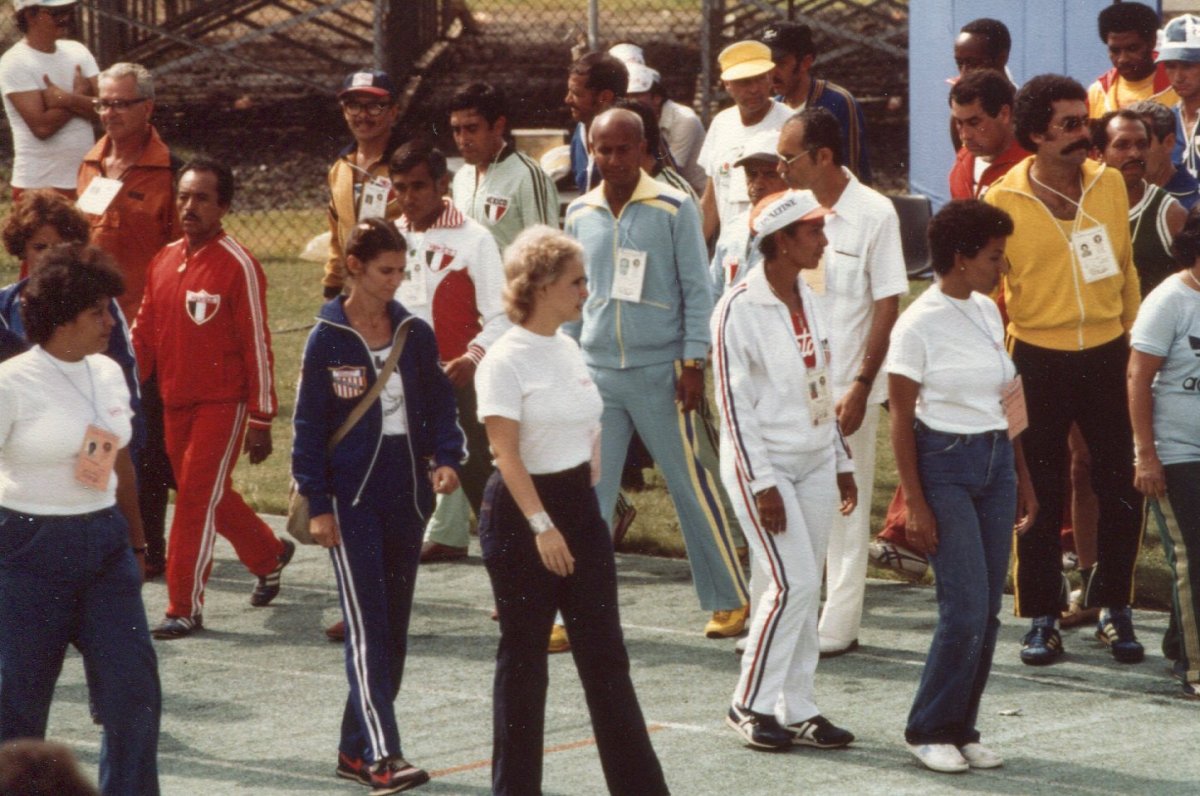
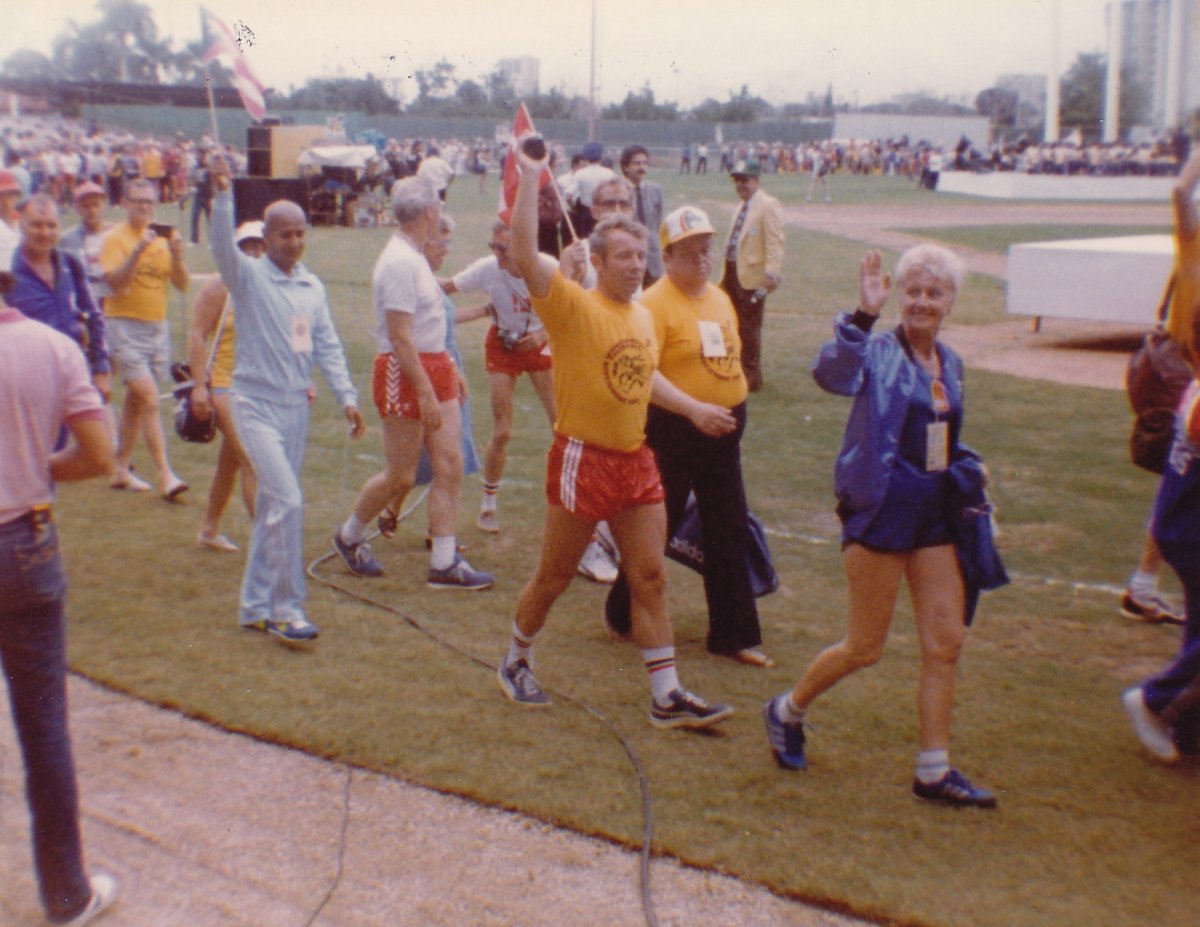
img007.jpg Sri Chinmoy, center in pale blue track suit, marches with the Puerto Rican Team.

During the week prior to the V World Masters Games hundreds of athletes began to pour into the island of Puerto Rico. They came from 47 countries, including New Zealand, Japan, Holland, Malaysia and many other such far-flung places. The largest contingent was that of the USA, with nearly 400 athletes, followed by West Germany with almost 200. But there were also surprisingly large teams from nations such as Australia (68 members) and India (23 members).  The number of competing athletes totaled approximately 3,000 and they ranged in age from 35 to 92 years. It seemed that, regardless of age, each one stepped off the plane with the same eagerness and excitement. They eyed the brilliant Puerto Rican sun and the glow of promise shone on each face.
march past.jpg

The march past of athletes during the opening ceremony of the V World Masters Games in Puerto Rico in 1983. Sri Chinmoy (in the pale blue tracksuit) is holding a Puerto Rican flag and will compete as a member of the Puerto Rican team.

Among the competitors, one in particular was especially dear to the Puerto Rican people. He was the great Guru, Sri Chinmoy, who arrived with his students on Wednesday, September 21st, two days in advance of the competition. Sri Chinmoy felt at home in Puerto Rico. During the twenty years that he had lived in the United States, he had made it his custom to visit the island several times each year. In 1966 the first of his spiritual centres was established there and since then he had received increasing respect and love from Puerto Ricans at all levels of society. An instance of this occurred when Sri Chinmoy first registered for the Masters Games. He submitted his nationality as Indian, but because he was also an Honorary Citizen of Puerto Rico, the officials took the liberty of changing his allegiance. Sri Chinmoy agreed to compete throughout the Games under the flag of Puerto Rico.
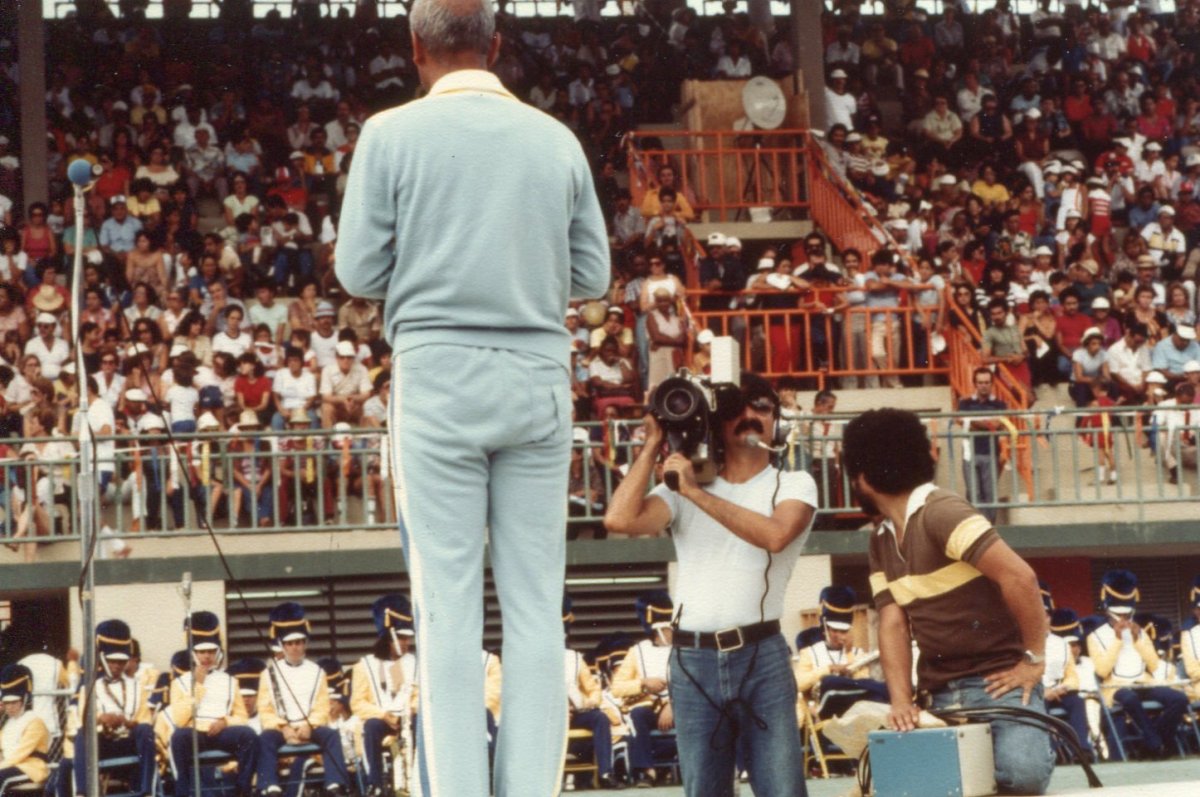
img010_0.jpg Sri Chinmoy opens the V World Masters Games with a silent mediation.

The Puerto Rican officials honoured their adopted son in another unique manner by accepting his musical composition “Juegos Mundiales De Maestros” (World Masters Games) as the official anthem of the Games. This song would be sung during the opening ceremonies in Spanish, English, German and French. In addition, they invited Sri Chinmoy to offer the opening meditation.

The inclusion of Sri Chinmoy as both a guest of honour and a participating athlete meant that the spiritual significance of this international gathering would be more to the fore than in any previous world-sporting event. The V World Masters Games was to be singularly blessed by Sri Chinmoy’s holy presence, for in the course of eight unforgettable days he revealed a new and special dream of God to the world at large. The spirit of competition would be gradually replaced by the urge for self-transcendence and an ever-expanding oneness with all fellow athletes. And, as the Games drew to a close, each athlete would carry home in his heart the trophies of peace, love and satisfaction.

What follows is a daily log of Sri Chinmoy’s activities during the Games. It includes many of his interviews and discussions with other athletes. However, it in no way accounts for his pervasive influence on the Games themselves — something that was tangible, nay magical. It was as if we had been invited to play on a green field of Heaven, where innocent joy filled the air.

Thursday, September 22nd:

Sri Chinmoy goes to the Sixto Escobar Stadium for early morning training. The atmosphere is thrilling. In every corner, there are athletes running, racewalking, jumping and throwing.

Later in the morning, at the Sri Chinmoy Centre, two members of the press call upon Sri Chinmoy. They are Fernando Heydrich of “El Dia” and Siva from “The San Juan Star”. This latter interview is remarkable. Sitting directly in front of Sri Chinmoy, the reporter asks with utmost sincerity, “What is the spiritual significance of sports?” Sri Chinmoy replies:

In order to make progress, we have to be with the world, in the world and for the world. There are many things that the world does which we do not approve of, such as engaging in wars and so forth. We do not like those things, but we do like other things. We like peace, love and the feeling of oneness. Because of our feeling of oneness, because of our love of peace, we are here today. People from various countries have come to the international Masters Games to show their feeling of oneness.

These Masters Games offer us a special message. They make us feel that even though we may be 40, 50, 60, 70, 80 or 90 years old, we are God’s children. When someone is 50 years old, it is very difficult for him to think that he is a child, because he has developed the mind. But the Masters Games help us feel that we are truly children, for it is only children who like to play. People who are advanced in years very often will only stay at home and watch television or read newspapers, but children have boundless energy. They have hope, they have ambition, they have determination. They want to become good, better, best. Elderly people very often feel that they are finished products, that their life is over; so they do not have any hope or promise. But the Masters Games show that elderly people can have hope and promise, elderly people can become inseparably one with children, that is, with the new generation.

We are here to make ourselves feel that we are children, God’s children, for it is children who make progress. They have higher goals, whereas old people have given up their goals and are only waiting for death’s hour to strike. But the people who are participating in these Games are telling death, “We are not ready for you, for we still have many things to accomplish here on earth. You are knocking at our door at the wrong time.”
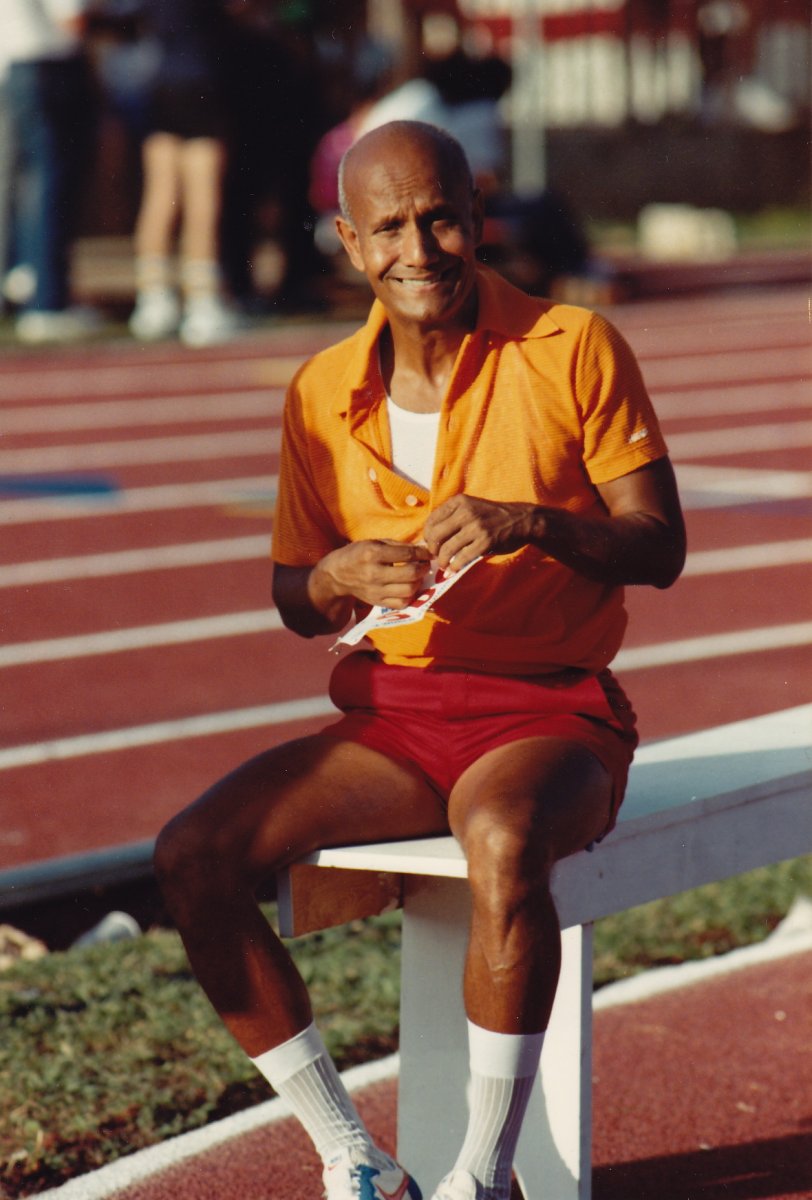
Puerto Rico.jpgSri Chinmoy’s long and meditative answer ends. Smiling gratefully, the interviewer whispers, “Thank you”, and slips out of the room quietly. All her questions are answered in this one answer.

Sri Chinmoy’s message about the inner significance of the Games is timed perfectly, for it enables us to view all the subsequent activities at the Stadium in the context of a spiritual unfoldment.

Sri Chinmoy’s first event, the 100-metre trials, is scheduled for the next day. He examines his information kit with interest and is surprised and delighted to discover a copy of the brochure “Sri Chinmoy and Sports” (translated into four languages) inside the folder. Each competitor has received this same brochure. In addition, the kit contains an invitation to Sri Chinmoy’s special concert for athletes to be held on Monday, September 26th. This unprecedented manifestation is due to the work of Rafael Rubin (Uttama) in his capacity as Minister of Protocol with the Puerto Rican government.

Around mid-morning, as Sri Chinmoy is composing some songs, he receives news that the head of the Indian delegation wishes to bring his entire team to the Centre to meet with him. Sri Chinmoy invites them for 7:30 p.m. and immediately begins to compose a song for the head of the delegation — the famous runner Milkha Singh. Mr Singh competed in the 400 m at the 1960 Olympic Games in Rome and placed 4th in a photo finish. Each of the top four finishers broke the previous world record. Mr Singh’s placing was the highest ever by an Indian and he became a national hero overnight, known as “The Flying Sikh”. Now, in his forties, he has been solely responsible for the growth of the veterans’ movement in India.

Sri Chinmoy had met with Milkha Singh earlier in the year when he attended the Asian Games in New Delhi. In fact, it was through Mr. Singh that he was invited to award the prizes for several events. The words of his song immortalise Milkha Singh’s contribution to Indian athletics:

Milkha Singh — O Flying Sikh
Milkha Singh, Milkha Singh, Milkha!
India’s Everest athlete-shikha.
Sardarji, Sardarji, Sardar!
You climbed the highest tower.

Milkha Singh, Milkha Singh, Milkha!
O Flying Sikh, O Flying Sikh!
You are your oneness-heart-nirvik.
Cheerfully moulding and soulfully guiding
Our beloved India’s age-defying
Evergreen lives and ever-pure race;
Longing for the world’s perfection-face.

When Sri Chinmoy’s composition is complete, he is faced with an unusual dilemma: all of his singer-disciples are in another part of the island rehearsing for the opening ceremonies and cannot be located. As he waits for them to return, some boys bring him the news that his regular starting blocks cannot be used on the tartan surface of the Stadium. At his request, they visit several sports stores searching for special modifiers, and later return with spikes that enable the blocks to be embedded in the track.

Meanwhile, Sri Chinmoy has made arrangements for a huge feast to be prepared for his Indian brothers and sisters. Towards the end of the afternoon, several singers return and he spends time teaching them the song. At some point in the middle of this whirlwind of activity he asks, “Will every day be like his?” It has clearly been an auspicious beginning to his visit.

Shortly after 8:00 p.m. that evening, as Sri Chinmoy sits with his disciples on the outside patio of the Centre, the Indian delegation is announced. Dressed alike in blue team blazers, they file into the garden one by one, led by their captain Milkha Singh. It is an unusual procession. All but one are men, turbaned Sikhs, with ramrod straight, proud backs. That they are old is apparent in their gaunt frames and faces, but they seem to wear age like a medal pinned to their chest. Mr Singh presents each athlete to Sri Chinmoy and acquaints him with their respective ages and events. The pride of the team is 92-year-old Babaji Azzad, the oldest competitor from any country entered in the Games. In India, he is referred to as “the living legend”. It is noticeable that these veteran athletes immediately approach Sri Chinmoy as a spiritual Master, bowing before him respectfully and addressing him as “Guruji”.

To open the evening’s programme, the singers perform the song “Milkha Singh”. In reply, Mr. Singh rises and begins to talk extensively about his own frustrated hopes to win a medal at the Olympics and his wish to see his ambition fulfilled through these veterans. Above all, he desires to bring honour to his country.

Deeply moved by Milkha Singh’s personal revelations, Sri Chinmoy addresses him with utmost compassion. The frustration and sadness this great athlete experienced, being unable to offer his country an Olympic medal, are quenched by the waves of kindness, consolation and hope that emanate from Sri Chinmoy:

I am extremely happy and honoured that you were able to come here, and also that you were able to bring a significant number of delegates from our Mother India. Under your great and able leadership I am sure my Indian brothers and sisters will do extremely well.

We talk of Indian athletics. Nobody, nobody, has brought the kind of name and fame to us that you have brought. You are the only one who showed India’s capacity to the world in the Olympics, in the 400 metres. You are the only one. Before you, nobody was able to qualify for the finals. And after you, also, nobody, nobody, has been able to reach the finals. So you are our India’s unparalleled athlete. And I am also extremely happy that you were chosen to be the president of the Indian Veterans Athletic Association.

These elderly people in terms of age are 60, 70, 80 or 90 years old, but in spirit, in their inner qualities, heart’s qualities, they are eternally young. You can say they are old in terms of the physical body, but as long as the spirit is young and indomitable, the body has to listen to the dictates of the spirit, the soul. To me, these individuals are evergreen.

In my song dedicated to you, dear Mr. Milkha, I have mentioned that you are moulding and shaping a new generation, a generation of hope and promise. And this generation is defying the invitation of old age, decay and so forth. The members of this generation want to remain eternally children. It is children who make progress, who embody the hope and promise of a new world. And now, under your able leadership, they are here. Mother India’s lofty message is being proclaimed in and through each individual athlete.

To see them, is to feel the heart of our beloved Bharat Mata. And you are supremely chosen to play a most significant role, not only in our India’s athletic world, but also in offering India’s oneness-heart to the world at large. You have brought these great athletes all the way from India, covering thousands of miles, offering the message of peace, the message of oneness: there is only one world, founded upon one heart. So in you, dear brother Milkha, we feel India’s oneness-heart and with you, you have carried India’s lofty message of peace.

Today my students and I are extremely happy, extremely proud of welcoming you and your friends. No matter how we fare in the competition, no matter what we achieve, we love humanity, we love to transcend our capacities, and we love to tell the world, 'There is no such thing as old age. We are all chosen children of the Supreme. He is playing in and through us. We are playing with Him in His Garden of Light and Delight.'

In silence for a minute let us pray to the soul of our Mother India to bless us in a very special way so that India’s perennial message of love, peace and truth can be showered upon all the three thousand athletes who have come to Puerto Rico from all over the world.

Following Sri Chinmoy’s eloquent address, his guests enjoy an Indian feast. Later, sitting among his countrymen, Sri Chinmoy is like a father to them, encouraging them and offering them boundless affection and inspiration. When the evening finally draws to a close, Milkha Singh declares, “If we win, Guruji, it will be with your blessings.”

Friday, September 23rd:

This day begins on a significant note with an excellent article on Sri Chinmoy in the Spanish newspaper “El Dia”. Sri Chinmoy’s 100-metre trials are not scheduled until 4:40 p.m. and so he spends a quiet morning using his exercise machine, being massaged and composing songs. He refrains from taking food in preparation for the race. Early in the afternoon, he leaves for the Sixto Escobar Stadium to begin his warm-up routine.

When Sri Chinmoy arrives at the stadium, it is alive with energy. Long jump and shot put events are being conducted in the centre of the field, while on the track many athletes are sprinting and exercising. It seems that a good number of them, like Sri Chinmoy, have returned to the track after a lapse of 20 or 30 years. Very few of them maintained their fitness throughout those years.

Sri Chinmoy pauses to watch one 85-year-old man practising the high jump. This gentleman is quite stout and each time he runs towards the bar all the spectators become apprehensive. Not so the old man! He has adamantine will-power. Although the height of the bar is quite negligible, it is such a tremendous achievement for someone of his age to perform the high jump. When Sri Chinmoy relates this incident the following day, he concludes by saying, “They are strong, strong people. Strong bodies, strong minds, everything is strong.”
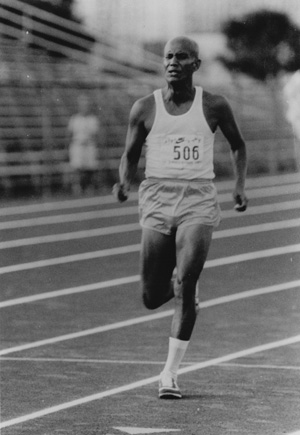
23_sept_1983_100m_2.jpg Sri Chinmoy ran the 100 meter dash in 14.48 seconds, chipping .66 seconds off his previous best time (in the West) of 15.14 set on August 25th, 1983. Photo: Dhananjaya.

The 100-metre sprints begin with the oldest age categories that have sufficient entries to warrant heats. Others advance directly to the semi-finals or even to the finals the following day. In our programmes we check one entry: Category 50-55 years. Number 506. GHOSE, CHINMOY K.

As his heat approaches, we see him loosening up on the far side of the track while a runner-friend watches his form and corrects the angle of his trunk. Sri Chinmoy is dressed in a plain white singlet and yellow running shorts. He looks every inch a champion and we recall that his return to sprinting has only been very recent. In June 1982, after a break of nearly 21 years, he began to mix serious sprint training with his long distance work. From June 1983 until these Games, however, he has concentrated on sprinting alone, trying to regain the speed and form of his early Ashram years. In some areas, he has adopted modern methods to shave valuable fractions of a second from his time. For instance, he wears a mouth guard for his upper teeth. This was designed for him in New York. Although Sri Chinmoy has only been practising with it for a few weeks, he has found that it significantly increases the speed at which he is able to move his legs and arms during the race.

In the area of footwear, he has elected not to wear spikes as most of the sprinters do. Although theoretically they increase a runner’s speed, he has found after much experimentation, that they tend to throw him off balance. His right knee will not go straight and as a consequence there is a zigzag motion in his style. For preference, Sri Chinmoy would run barefoot, as he did in India, but after years of distance running in shoes, the soles of his feet are unused to the wear and tear of direct contact with the track. Again, although he uses Newton starting blocks, which are the best available in the USA, he has had difficulty adjusting to them. The chronic pain in his lower back inhibits his movements in the crouch position, especially when runners are held by the starter in this position for any length of time. In India, at the insistence of his German coach, Saumitra, he tried using starting blocks, but found that he could gain the necessary push by using the left block only.

When using blocks, Sri Chinmoy has discovered that it can take over 20 metres for him to attain maximum speed, whereas without them he can be there in two or three strides — the difference of almost a second. Many of Sri Chinmoy’s friends in the running community have encouraged him to persist with the blocks and concentrate on maintaining sufficient forward lean so that his lead leg can extend fully. Of all the many starting techniques and theories, Sri Chinmoy has derived special benefit from the “rocket” start advocated by American coach Bud Winters. Here the blocks are set further apart (at 23 inches and 33 inches) bringing the knees closer to the ground than in the orthodox start. The back is parallel to the ground and the eyes are kept up. At the gun, the lead leg is driven forwards with a low, fast thrust to trigger the correct leg action. The first step from the blocks is somewhat longer than in the traditional style.

Now, as Sri Chinmoy prepares for the start of the 100 m trial, his months of preparation will culminate in a burst of speed lasting only a few fleeting seconds.

The runners are called to the line and Sri Chinmoy backs into the blocks. His whole concentration is fixed on the sound of the starter’s voice. In sprinting, the slightest error can throw a runner’s timing and make him forego the chance of a good race. In one of the outside lanes, a runner loses his balance and the starter requests them to stand once more. The crowd is hushed and expectant. The runners take their marks again, the gun fires and suddenly they are away. Sri Chinmoy flashes before us. Everything is perfect — he is running high on the balls of his feet, relaxed but not rigid, his arms swinging in line with his body. Because of his extensive practice doing wind sprints, he is able to run the entire distance in just two breaths. Just before the finish, the other runners pull slightly ahead of him, but he maintains both speed and form to cross the line in 14.48 seconds, chipping .66 seconds off his previous best time (in the West) of 15.14 set on August 25th, 1983. To make such a striking improvement in the short span of one month is truly phenomenal. Sprinters must normally train for years to reduce their timing by the merest tenth of a second, but through rigorous discipline and dedication Sri Chinmoy has been able to make extraordinarily fast progress. After so many years, he is beginning to recover his innate speed, the speed that set him apart as a champion from his youth.

That night, some runner-friends join Sri Chinmoy for dinner. All the discussions focus on sprinting and videotapes of the day’s races are examined in detail. During the conversation, Sri Chinmoy talks about the role of the coach with the famous American coach and sprinter Payton Jordan:

Payton Jordan: When you go to the stadium and you take your mark, you are all alone. There is nobody who can come in and substitute for you; nobody can take over if you get in trouble. You have to carry through until the finish.

Sri Chinmoy: But what happens if the runner invokes the soul of his coach? At the time of the start and, if possible, during the run, if he starts invoking the presence of his coach — his style, his encouragement, his inspiration and his dynamic push — then will the runner not draw extra energy, extra force from his coach? Or if he has an idol, a great runner, he can invoke that person’s soul.

Jordan: They do, there’s no question about it. They expect things to happen.

Sri Chinmoy: They get added strength, added inspiration, when they think of the person who is their ideal. Consciously they draw upon a particular runner whom they adore.

As the conversation continues, one of Sri Chinmoy’s disciples brings him the news that he has narrowly missed out on selection for the semi-finals. This gives Sri Chinmoy a day free from competition.

Saturday, September 24th

Sri Chinmoy goes to the stadium before 8:00 a.m. for a practice session and to observe the semi-finals of the 100 m races. The official opening ceremony for the V World Masters Games is scheduled for 3:00 p.m. at the Bithorn Municipal Stadium. This colourful event has been orchestrated by Sri Chinmoy’s disciple Uttama. It is a gala occasion, with 2,000 schoolchildren participating, as well as several different marching bands, dance groups, parachutists and the official lighting of the flame. Sri Chinmoy has been honoured with a most prominent part in the ceremony.

The afternoon begins with a series of visual displays by the schoolchildren. Using cloths of many colours, they form words of greeting to the assembled athletes. This is followed by the traditional marchpast of the competitors. Here we observe something new: the athletes proceed by age category rather than by nation. As the 50 to 55-year-olds pass by, we glimpse Sri Chinmoy smilingly waving the Puerto Rican flag. He is dressed in a pale blue tracksuit and T-shirt.

 After the athletes are seated, the anthems of both Puerto Rico and America are played. Then Uttama escorts Sri Chinmoy to the small stage area in front of the packed stands. The holiness of his presence is immediately transmitted to the crowds, who remain in pin-drop silence. Sri Chinmoy meditates for a few moments with folded hands. Then he moves to the microphone and, speaking slowly and deliberately, delivers his lofty message:

Peace. Our beloved island Puerto Rico is offering her supremely beautiful and soulful oneness-home, oneness-home, to the entire world. Victory to Puerto Rico! Peace.

Sri Chinmoy bows and leaves the stage, while the audience remains utterly transported by his words. Several moments elapse before they burst into spontaneous applause.

As the next few days of competition unfold, we shall see Sri Chinmoy’s vision of a oneness-home being realised as athletes make new friends, encourage and inspire each other, share their victories and defeats, and discover the joy of friendly competition. Above all else, it is this quality of oneness which distinguishes the Masters Games from its Olympic counterpart. Here, everyone is welcome. There are no strict qualifying standards, no restrictions which might exclude athletes from participating. For these older athletes, the supreme achievement is still to be active. Most of them have individually financed their trip. They derive joy simply from being present. The atmosphere of bitter rivalry, of frustration and disappointment, that so often pervades the Olympic Games is altogether lacking in this environment. Here, athletes shake hands before the start and embrace at the finish line. They support each other and take pride in each other’s achievements, often remaining at the stadium long after their own events for the day have concluded. It is an atmosphere in which divine qualities, such as joy, peace, love and heart’s magnanimity, can fully blossom.

The next item on the programme is the hoisting of the flags as Sri Chinmoy’s disciples perform his special anthem composed for the World Masters Games:

World Masters Games! World Masters Games!
Climbing and transcending vision-flames.
World Masters Games! World Masters Games!
Within, without, O newness-speed!
Perfection-hunger completely you feed.
World Masters Games! World Masters Games!
Impossibility-night no more.
Yours is the deathless Golden Shore.

The Mayor of San Juan, who has stepped onto the field to witness the flag raising ceremony, is introduced to Sri Chinmoy. Visibly moved by the meditation and the singing, he places his hand on his heart and says over and over, “Gracias, gracias.”

Sri Chinmoy’s official duties are now over and he chooses to sit alone in a distant corner of the massive grandstand to watch the remainder of the ceremony. Two parachutists spiral onto the field and there are a number of dancing exhibitions. Finally, the Mayor of San Juan, the Honorable Hernán Padilla, mounts the stage to officially open the Games. The flame is lit by the veteran Puerto Rican athlete Gilberto Juliáand the long, eventful afternoon comes to a close as hundreds of balloons are released skywards.

Sri Chinmoy goes to the Sixto Escobar Stadium to watch the finals of the 100 m. Perfectly at home in the ambience of the track, he seeks out some of his runner-friends and offers them a few words of encouragement before their races. Then he waits at the finish line to congratulate them on their performances. As he does this time and again, we come to understand that his encouragement is an added strength to these runners, it enters into them and unconsciously they are able to lift their performance because of it. Sometimes Sri Chinmoy’s encouragement lasts for several days or even the entire duration of the Games. It will remain as one his silent but most significant contributions to the Games.

That evening, a number of runners gather at the Sri Chinmoy Centre to review the highlights of the day. The opening ceremony, together with several feature articles in the local newspapers, have made Sri Chinmoy one of the most well known and respected figures of the Games. One of the key reporters for the “San Juan Star”, Joe Estrella, has become particularly devoted to Sri Chinmoy and his long article on Sri Chinmoy’s philosophy of sport appeared in the morning paper. It reads in part:

Late Friday afternoon, during trials in the 100-meter dash at the fifth World Masters Games at the Sixto Escobar Stadium, the 52-year old Chinmoy lent credence to his belief that eventual world peace may be unalterably intertwined with organized competition, overall physical fitness and a balanced lifestyle, by running a respectable 14.48.

Trim and unquestionably fit, Chinmoy is a walking testimonial to the beliefs he espouses. . .

An avid sports enthusiast since his early years in India, where he was sprint champion for 12 consecutive years, and a two-time decathlon champion, Chinmoy today is a contemporary spiritual teacher who advocates sports competition for many of the world’s shortcomings.

"Games such as these help to bring people together because they are games of innocence," he said, shortly after completing his run in the 100 metres.

"So many people these days use drugs in search of joy. But those joys are false. Only through physical fitness can there be real joy. And it is the contribution of joy to the world family which is the message from these Games."

If there is one area where Chinmoy would like to see the "joys" of meditation embraced, it is in the 'always dangerous' political arena.

"Here,” he says, gesturing towards the assembled athletes and crowd, “you have people from various countries meeting together and making friends. If I come here and make a friend, and that person comes to my country and makes a friend, then how can there ever be a reason for conflict? These types of Games are the world’s best opportunity to become one family.”

Sunday, September 25th

This day finds Sri Chinmoy once more in the thick of competition. His 200-metre trials are due to be held at 4:30 p.m. During the morning, he relaxes and plays his flute and esraj in preparation for his upcoming concert. The Spanish newspaper “El Dia” has carried another photograph of him. It was taken during his meditation at the opening ceremony. His role during that ceremony is also referred to on the front page of “El Mundo”.

Seeing these reports, Sri Chinmoy begins to speak about the receptivity of the Puerto Rican people to his spiritual message:

Yesterday’s message was well received. I was not booed; I was not an object of ridicule. I have been in the West for almost 20 years. No other country has ever loved me and honoured me in this way.

Let us say that love and honour are two different things. They are as different as the finite and the infinite. Love is infinite and honour is finite. Yesterday I felt honour in a very large measure, but the love I felt from the Puerto Rican heart and the Puerto Rican soul was in infinite, infinite measure. No other country has ever loved me and perhaps no other country will ever love me, including my Mother India, in this lifetime, the way my beloved Puerto Rico has expressed her love for me.

This love comes from the inmost recesses of her heart, the Puerto Rican heart. Puerto Rico has accepted me, my realisation, long before other countries have even dreamt of accepting me. Puerto Rico gave me her highest honour, including her citizenship, long before others started to honour me in this way. Now Puerto Rico has again done something unprecedented for me, something on an international scale.

As long as I am on earth and when I will be in Heaven, only one thing I leave behind for my Puerto Rico, this enchanting land, the land that recognised me first as a God-lover and a God-seeker, and that is gratitude and gratitude and gratitude.

Sri Chinmoy then goes on to praise Uttama, the instrument through whom this manifestation has been made possible.

Unfortunately, Sri Chinmoy’s back pain has increased considerably today and he discusses the option of using a standing start. He leaves for the stadium well in advance of the appointed hour so that he can do many stretching exercises for his back and legs.

As Sri Chinmoy’s heat approaches, we fervently pray that he might do well. Some of his disciples station themselves trackside at the difficult turn to urge him on. Running on the inside lane, Sri Chinmoy faces a tight curve. He moves to the line at the starter’s signal and drops into the crouch position. As he accelerates out of the blocks, he returns quickly to an upright stance and continues to drive forward powerfully. The axis of his body has more forward lean than usual as he enters the curve. Here Sri Chinmoy uses the technique that he used formerly in India of dropping the left arm and thrusting with the right arm until he comes out of the bend. Going into the straightaway, he is fractionally behind the leaders but still moving very fast. He crosses the finish line in 31.40 seconds, totally eclipsing his previous best time in the West of 33.60 seconds set on July 31st, 1981.

As Sri Chinmoy takes a few steps to catch his breath, he seems to be swept into another world. Some runners move forward to congratulate him, but retire when they notice his indrawn expression. The race marshal motions him back to the finish line so that the judges can finalise their results. Sri Chinmoy hesitates for a brief moment and then complies. The significance of this scene is not revealed until that evening when runners once more gather to be in Sri Chinmoy’s company. They are at home and at peace in the atmosphere of the Centre and in the compassionate presence of their friend and mentor, Sri Chinmoy.

This evening, Sri Chinmoy regales them with sweet stories from his childhood and youth. They are especially amused when Sri Chinmoy describes how absentminded he used to be when he came down from a high state of meditation. He would forget to wear one sandal; sometimes he would even forget his name and then he would have to ask his friends or consult the flyleaf of one of his exercise books. Then he asks the runners if they would like to hear what he calls “a cock-and-bull story”. They agree, uncertain of what will follow.

Then Sri Chinmoy relates how at the very end of the 200-metre race that afternoon — even before he had properly caught his breath — the soul of Jesse Owens came to him and said how pleased he was with Payton Jordan’s running. Then, concerning Sri Chinmoy, the soul made the prediction that by April 13th, 1984 he would run 27.27 for the 200 m, more than four seconds better than his current best time. Sri Chinmoy observes that the soul could have come at any time, but it had to come right after the race!

The runners and the disciples are all transfixed. Suddenly, we remember his expression after the race and the meaning of that moment becomes clear. A lightning glimpse into Sri Chinmoy’s inner world opens before us. “So that is my cock-and-bull story,” says Sri Chinmoy, disarmingly, leaving us to grapple with a new kind of reality.

This is not the first time that he has invoked the name of Jesse Owens during these Games. A few days previously, in conversation with one of the runners, he had said:

Jesse Owens was my idol. I was so eager to know about him. Anything about him in magazines, newspapers and books I used to read voraciously. Jesse Owens’ words and the words of those who had written about him I used to learn by heart. It was like the gospel, like our Gita, the Indian Bible.

Jesse Owens was great. Not only was he a supreme runner, but he was also a supreme man, a man of the heart. The heart came first for him, then his legs and then came his mind.

Monday, September 26th

At 7:00 a.m. Sri Chinmoy and his disciples arrive at the studios of Channel 7 for a morning show. It goes very well and at 8:15 a.m. fifteen minutes are broadcast. At 10:00 a.m. Sri Chinmoy is to give a concert for runners at La Tapia Theater in Old San Juan. With its vast auditorium and classical décor in deep burgundy, this theater is a haven of quiet for the 200 athletes who begin to filter in. It is a time of stillness and reflection. Away from the hectic activities of the stadium, they plunge into the soul-satisfying inner world that Sri Chinmoy creates. His performances on flute and esraj, together with his all-encompassing meditation, feed this international group in an almost tangible way.

A representative from the Mayor’s office receives a printed copy of the Masters Games Anthem on behalf of the government. A portion of the concert is filmed and later televised on Channel 4 during the news.

When Sri Chinmoy arrives at the track that afternoon to watch the semi-finals of the 200 m, he is immediately surrounded by the media: AP, UPI and FFE wire services interview him for stories to go out that night; then Channel 4 interviews him at length. The far end of the track, where it has become Sri Chinmoy’s custom to station himself, is crowded with cameras and reporters. Sri Chinmoy is undoubtedly the most well known figure of the Games. By carrying the higher life of the soul into the athletic arena, he has become the Games’ spiritual spokesman, the one who can communicate their inner significance to the outside world and to the athletes themselves.

After some time, Sri Chinmoy leaves the crowd of media personnel and waits near the finish line as the races are being conducted. He is alone in his silence-world. Once more, he has only just missed out on selection for the next qualifying round. When one of his friends misses out on selection for the finals, he turns immediately to Sri Chinmoy for consolation and they walk together on the far side of the track. It is a poignant image.

Tuesday, September 27th

An item on Sri Chinmoy appears in “El Dia”. At 7:30 a.m., Sri Chinmoy and some of his disciples are featured live on Channel 2. It promises to be an extremely busy day. After returning from the TV studio, Sri Chinmoy prepares to receive former Governor Rafael Hernández Colón and his wife Lila at 11:00 a.m. Sri Chinmoy has met with this great Puerto Rican soul many times over the past few years and when his old friend arrives, they greet each other with tremendous warmth. Colón’s first term as Governor ended in 1977 and he is determined to rise from defeat and serve his people once more. Sri Chinmoy’s songs about him speak of his “lion-heart” and, as he listens to them, Colón seems to radiate nobility and goodness.

Later, he reveals to Sri Chinmoy that since they last met, he has read the Bhagavad Gita three times, in both English and Spanish, and has found it to be an immense source of inspiration. He questions Sri Chinmoy about the Indian monastic life and Sri Chinmoy replies:

India still believes in austerity, an austere life in the Himalayan caves. The ascetics neglect the outer life, for they feel that the material life is a waste of time. They do not realise that the material life is not bad in itself. If you have to work for God, if you have to manifest God, then how can you neglect the outer life, the outer world? Everything that is inside us, all good qualities, must be manifested eventually. God has given each individual some good qualities, but if you do not reveal your good qualities to me and if I do not reveal my good qualities to you, then how can there be a good world? Each one has something good to offer to the world.

Sri Chinmoy and Governor Colón continue to discuss spiritual philosophy as lunch is served. Both Colón and his wife notice that Sri Chinmoy is not eating. Sri Chinmoy explains that he will be running the 400 m in a few hours. Suddenly, Sri Chinmoy looks intently at Colón and says: “This time you have to win!” He talks about the undivine means the other party is employing and says that Colón embodies the divine forces. Colón considers Sri Chinmoy’s comments and responds, “But doesn’t goodness bring its own reward?”

The influence of the Gita on his outlook is apparent and Sri Chinmoy appreciates his philosophical approach. “Absolutely,” he agrees, “but the time has to be ripe.” Sri Chinmoy then continues by saying:

Eventually, truth will win, but in the beginning there is always darkness. Darkness fights, fights against light, but eventually light has to win because God is all Light.

Similarly, in your case, now the time has come, the hour has struck for you to win. How long can deception and all kinds of corruption win? Divine victory must manifest itself. So this time, in 1984, the hostile forces, the undivine forces, must surrender to the divine forces — and you are embodying these divine forces.

The divine forces sometimes tolerate ignorance, but they never surrender to it. It is because the world is full of ignorance that the people for whom you are going to do something good are not willing to accept your goodness and kindness. Then God has to wait.

Sri Chinmoy explains to Governor Colón that this is essentially the same message he offered him ten years ago when he was first elected Governor. People were not fully ready at that time for Colón’s vision. Now their doubt has disappeared and they are ready to listen to him in every way. “You have to win,” Sri Chinmoy repeats, it is decreed. Our hearts’ prayers are always, always, always with you and for you.”

“This time I will win it for you, Guru,” responds Colón, in a voice of quiet conviction. As he speaks, he looks somehow larger than before, in our eyes already the Governor.[1]
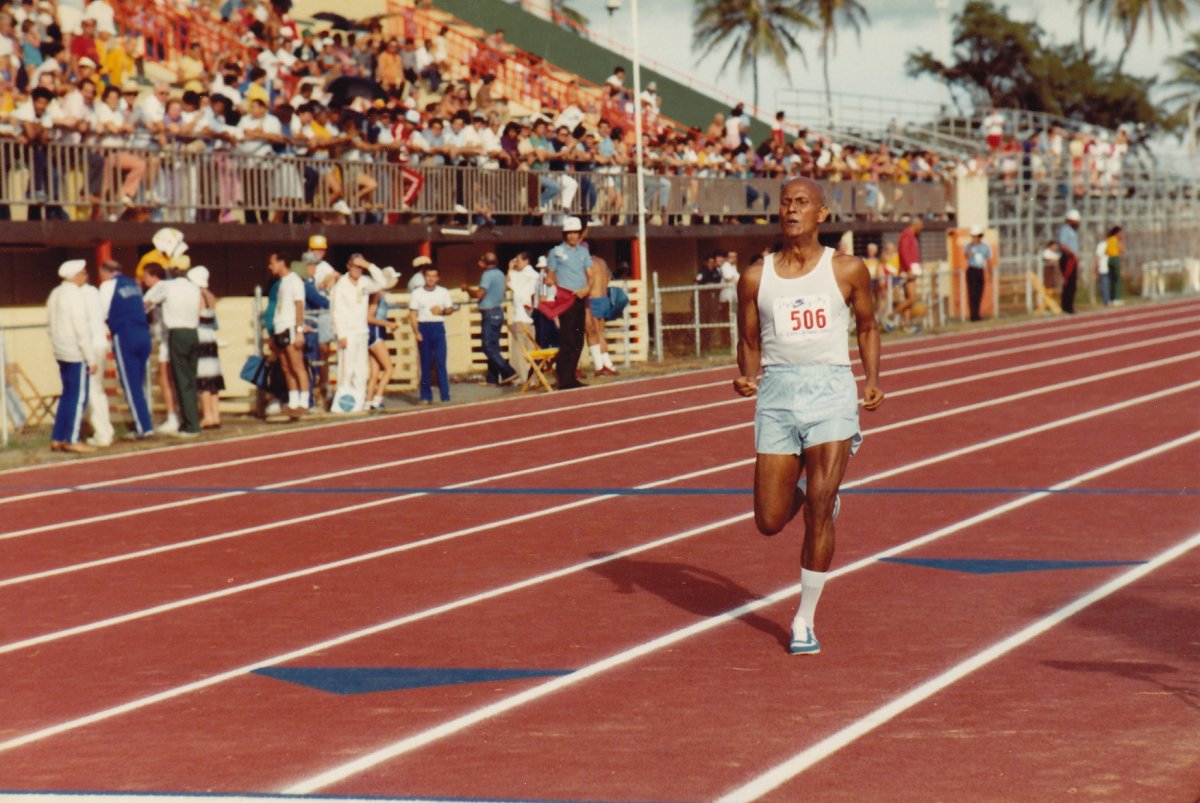
100 metre_0.jpg Sri Chinmoy competing in the 400-metre event.

After Sri Chinmoy’s guests depart, he leaves for Bithorn Stadium. His 400-metre trials are listed for 3:00 p.m. This stadium features a newly laid tartan surface. As Sri Chinmoy arrives, there is a typical Puerto Rican downpour. When the different age categories are called to the check-in gate, it is found that many have insufficient entries to warrant heats and so there are long waiting periods between events. In Sri Chinmoy’s age group, it is decided that the first two in each heat will automatically advance to the semi-finals, along with the next fastest 8 by timing. Sri Chinmoy has been placed in the first heat. By an unhappy stroke of fortune, this heat contains most of the best runners.

The 400-metre event, unlike the 100 m with its explosive burst of speed, has several clearly defined stages. After the initial acceleration, there comes an intermediate stage, in effect a float, in which the runner concentrates on maintaining a good, relaxed form. After the second turn, the runner begins to push harder, applying pressure over the last 70 metres and then driving through to the finish with his final reserves of energy. The sustained effort of the 400 m makes it one of the most difficult track events.

As the starting pistol fires, we see that Sri Chinmoy has got away cleanly. He is running smoothly and has adjusted his style so that there is less body lean and a lower knee lift than in the 100m and 200 m. As we watch him cover the distance on the far side of the track with the other competitors, it seems that there is no freer, no purer, no more graceful form of physical expression than running. The runners’ fluid motion and speed is so beautiful to behold. As Sri Chinmoy rounds the last curve and heads into the home straight, his arms are working with a regular piston-like action and his legs are driving powerfully.

The audience erupts in cheering and applause. It has been an extremely fast heat and Sri Chinmoy has stayed with the main group of runners to cross the line in 72.66 seconds, well inside his previous best time in the West of 74.3 seconds, set on August 14th, 1981.

After the race, Channel 4 interviews Sri Chinmoy again for the evening news. Ironically, Sri Chinmoy has just missed out on selection for the finals, although he would have been guaranteed a place had he run in any other heat.

This evening Sri Chinmoy has planned a special function for outstanding runners, as well as the heads of several delegations and the President of the World Association of Veteran Athletes, Mr. Don Farquharson from Canada. Some of the guests include Ira Davis, a former Olympian in the triple jump; Payton Jordan, world record-holder in many Masters events and former coach to the US Olympic team; Clarence Killian; Bob Watanabe; Jack Newton; and Bernie Hogan from Australia.

After the singers perform several songs that Sri Chinmoy has composed in honour of his guests, many of the athletes speak for a few moments about their participation in the Games and their friendship with other athletes. Sri Chinmoy enters into conversation with the elderly Japanese gentleman who is head of the Japanese delegation. His name is Mika Oda. Sri Chinmoy discovers that Mr. Oda once coached the now legendary Japanese coach and Sri Chinmoy’s personal friend, Kiyoshi Nakamura. Mr. Oda relates how he represented Japan in the triple jump at the 1926 Olympics and stood last. At that time, he made a solemn promise to do well in the next Olympics and, four years later, he placed first in the triple jump. He had come to the realisation that because he was so short, the secret to his success was to strengthen his ankles. He did this by practising vertical jumps.

Sri Chinmoy then requests the representative from Italy, Mr Cesare Becallo, to address the group. Mr. Becallo outlines the plans for the VI World Masters Games to be held in Rome in June 1985.

Following his talk, Sri Chinmoy’s Venezuelan friend, Mr. Hernan Figuaeroa, gives details of the Central American and Caribbean Masters Games to be held in Venezuela in December.

After most of the guests leave, Sri Chinmoy remains with a small group of runners to watch replays of the 400-metre trials. It is his first moment of pure relaxation. He has completed his three events in the competition and is now free for the remaining three days of his trip.

Wednesday, September 28th

Sri Chinmoy spends the morning composing songs dedicated to another former Governor, Luis Ferré, who will come to the Centre in the late afternoon. Sri Chinmoy’s friendship with Ferré spans a number of years and he deeply admires Ferré’s inner nobility of character. To illustrate this quality, he relates an incident that occurred some years ago: one day, quite unexpected and uninvited, Ferré came to call upon Sri Chinmoy in Puerto Rico. At that time, Sri Chinmoy was upstairs preparing to go out. As a matter of fact, he had an appointment to see the then Governor, Ferré’s arch rival in the political sphere, and the Governor was sending his chauffeur to take Sri Chinmoy to the Governor’s residence. One of the disciples innocently informed Ferré of Sri Chinmoy’s plans. When Sri Chinmoy came downstairs, Ferré said to him: “Tomorrow again I will come to see you at this hour.” If Ferré had been an ordinary person, Sri Chinmoy later commented, he could not have shown this kind of heart’s nobility. But he had transcended political barriers. Since Sri Chinmoy was his friend, he was prepared to come again.

After telling this story, Sri Chinmoy concludes: “These are the noble souls we have on earth and because of these noble souls earth still has something to contribute to Heaven.” Not surprisingly, the words of the song Sri Chinmoy composes for him pay tribute to this inner goodness:

Luis Ferré — O magnanimity-heart,

O luminosity-mind, O life-awakening soul,

O lofty divinity-role. . .

Later in the morning, Sri Chinmoy learns that Luis Ferré has been forced to postpone their meeting until the following day, and so he goes to the stadium to observe the events, including the semi-finals of the 400 m. He later recounts with great animation one particularly amusing anecdote:

One of the hurdlers was so brave. From the very first hurdle, he was last. That is not enough. His stride was also horrible. In India, I used to think that my stride was horrible, but his was definitely worse. Dhananjaya took a very nice picture of him after the third hurdle. Then, at the fourth hurdle, he fell down and rolled three times. Then he got up and again he started running! I could not believe it. He is so brave. I thought he would remain on the ground and they would bring a stretcher.

Unfortunately, Sri Chinmoy himself fell victim to bad luck. Some 20 minutes before the semi-finals of the 400 m, another runner told him that the officials had revised the starting list and his name was now there. Sri Chinmoy had not come prepared to run and so he could not compete. Had he been advised in advance that he was now qualified to run, he might have set an excellent new personal record.

 At 8:00 p.m. that evening, Sri Chinmoy offers a public meditation and concert at the Museo del Arte et Histoire, a majestic building in Old San Juan. As he plays upon the flute and esraj with exquisite delicacy, one can only marvel at all the many facets of his spiritual personality that have been revealed over the past few days — athlete, composer, musician, friend, philosopher and spiritual guide.

Sri Chinmoy’s balance of meditation and sport is unique. In one of his interviews, he was asked: “Why do you combine sports with meditation?” Sri Chinmoy replied:

We have the body and we have the soul. Now, a spiritual Master has to give equal importance to both the body and the soul. If he pays attention only to the body, if he becomes physically strong but spiritually very weak, then for him there will be no peace of mind and no inner happiness. Again, if he pays attention only to prayer and meditation and neglects the body, then his body will not become a fit instrument. In the morning he will pray to God — and he will have a headache, upset stomach and so forth. Then he cannot pray. Therefore, fitness and spirituality must go together. It is like having two legs. With one leg, I cannot walk. I need two legs. I need two eyes so that I can have proper vision. I need two arms to toss a soccer ball properly. Spirituality and sports are like two legs — they must walk together, run together, in order to reach the destination.

Thursday, September 29th
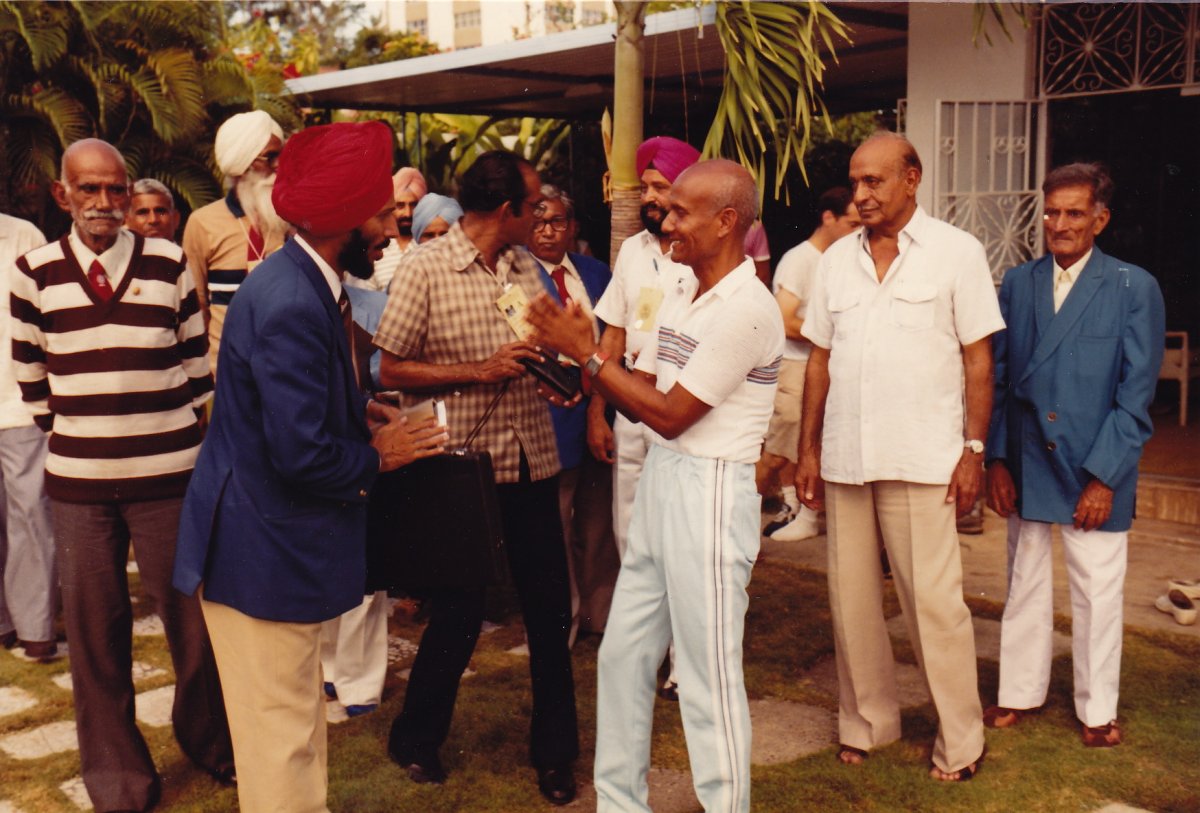
Indian team.jpg

Sri Chinmoy farewells his brother-friend Milkha Singh and the Indian team.

Some runners call into the Centre to say goodbye to Sri Chinmoy on their way to the airport. At 1:00 p.m. the entire Indian delegation returns to take leave of Sri Chinmoy. They are brimming over with pride at having won 19 medals, including 8 gold. Upon their return to India they will be greatly honoured. One champion in particular, Gulab Singh, has won 4 gold, 2 silver and 1 bronze.

Sri Chinmoy requests his disciples to sing “Bande Mataram”, India’s mantric incantation. Sri Chinmoy has set his own stirring tune to these words, which translate as “Mother, I bow to Thee.” He then presents medals to each athlete and to Milkha Singh, saying:

There was a time when we badly needed to free ourselves from the foreign yoke, from the British rule, and we did it. We achieved independence; we achieved freedom. Now we are trying to achieve freedom in our body, with our body. That is to say, we are the limitations of our body and at the same time we are trying to overcome the sad and deplorable limitations of our body.

Here, many of our brothers and sisters have proved to the world at large that India does not have to lag behind in athletics, in sports and in physical fitness. Indians can easily shine luminously in the galaxy of immortal athletes. Because of that, I am extremely proud of my Indian brothers and sisters, and also of Mr Milkha Singh, who is known as The Flying Sikh, for his 400 metres. He has now become a fabled and legendary figure in athletics in India and all over the world. Under his able leadership, you are all here and you have executed your respected roles in athletics most successfully and gloriously. Therefore, I am extremely proud of you and grateful to him.

For us, India is not a piece of land, but it is the living Mother, Mother of our dreams, Mother of our aspiration, Mother of our realisation, Mother of our perfection, Mother of our satisfaction.

Sri Chinmoy’s words seem to ring out with an inner force that projects far beyond the group seated before him. There is a profound silence as each athlete is flooded with thoughts and memories of his Bharat Mata. Then, one by one, even as they filed in on that first day, the Indian team takes its leave of Sri Chinmoy.

That same evening, various delegations and team leaders drop in to say farewell to Sri Chinmoy. They include the Indonesian team, and the captains of the Swiss and Swedish teams. Some of them enchant the audience by performing songs in their own language.

In the midst of this delightful interchange, Governor Ferré arrives and the singers perform the special songs Sri Chinmoy has written for him. Then the two friends talk privately for some time.

Friday, September 30th

This is to be Sri Chinmoy’s last full day of his trip to Puerto Rico. He arrives at the stadium just before 5:00 a.m. to watch the start of the marathon. Even at this early hour the soaring temperature, which has affected so many athletes, is felt. After the runners exit the stadium, Sri Chinmoy is driven along the marathon course.

In the afternoon, he has a tennis appointment with Juan Albors, the former Secretary of State under Governor Colón and Sri Chinmoy’s longtime friend. Mr. Albors is badly beaten by Sri Chinmoy 6-1, 6-0, but the match is one of mutual joy. At its close, Mr Albors tells Sri Chinmoy, “Nothing is more important to me than to be in your presence.”

It is on this note of deep respect from a government official that Sri Chinmoy’s trip to Puerto Rico comes to an end. Over the past eight days, he has offered so much to so many people from all different nations of the world. He has been the friend of all, the one who inspired them with his meditation and songs, who ran alongside them on the track and who waited for them at the finish line to encourage and congratulate them. As he sat cross-legged in the middle of the field on that first day of competition, we never imagined that so many sweet encounters would follow. In these magical Games, the inner light of spirituality encircled the stadium and left a lasting impression on all who participated.

Conclusion

On October 2nd, shortly after he returned to New York, Sri Chinmoy summed up the special significance of the World Masters Games:

It is quite possible that in four or five years the Masters Games will be as popular or even more popular than the Olympics in terms of bringing real joy to mankind. One person has come from an Indian village and another has come from an Australian village. Like that, when they go back to their countries and speak to their children, grandchildren, friends and neighbours, and when others see such joy in the competitors, then this joy will spread like wildfire in their village, town, city and country.

Since the world is crying for joy, I think the Masters Games will give more joy because here the competition is not on the vital plane. Here in the competition there is a psychic touch. People have become mature over the years. They have gone through successes and failures many, many times. When they were young, almost all of them had the same kinds of bad qualities that the young ones have now. So they don’t want to repeat them. They want only to be able to get and give innocent joy to people.


[1] Rafael Hernández Colón went on to win both a second and a third term as Governor of Puerto Rico, serving his beloved island from 1985–1993.

View full article »

Martin Fryer Sets New M50 World Record for a Track Race

By Rupantar LaRusso author bio »
11 December

About the author:

Rupantar has been the race director of the Sri Chinmoy Marathon Team since 1985, having been asked by Sri Chinmoy to serve in that capacity. As well as working on the big races the US Marathon Team organise each year - the 3100 Mile Race and the Six and 10 Day Race - he also spends a considerable amount of time archiving the Marathon Team's 40 year history on this website.

martinfryer.JPGTaiwan, December 9, 2012: Martin Fryer of Australia, in his first race as a member of the Sri Chinmoy Marathon Team, set a new Men's over 50 World Record for a 24-hour track race (pending ratification by the IAU) at the 10th running of the Soochow International Ultra-Marathon 24-Hour Track Invitational. Martin was second overall and his distance of 247.59 km saw him just eclipse the old mark of 247.21 km set by Dave Cooper of Great Britain in Chevilly-Larue, France back in 1985.

(Photo by Prabhakar of Martin Fryer  in the 2011 Self-Transcendence Six Day Race in Flushing, New York, where he won the men's division with a distance of 487 miles).

The following report is from Prachar Stegemann:

"Martin described the conditions as the worst he has ever run in - 23 hours of rain out of the 24, with really strong winds and one inch of water covering the track for most of the race. Nevertheless he says he had one of his best ever races, with his consciousness always focused and clear.

Martin actually didn't realize he had broken the World Record until 90 minutes after the race when we (Prachar) contacted him from Australia. He had thought the World Record was 248 km and he had just missed out!

Martin is looking forward to a good rest now."

(Prachar Stegemann is the main Race Director of the Australian branch of the Sri Chinmoy Marathon Team and whose blogs can be found in CoolRunnning Australia)

For complete race results...

The following  excerpt is from the Bald Runner Website which contains a report and photos of the race:

"After the gun has been fired to warn that the 24th hour had elapsed, only the “best among the bests” stood standing. The top runners were offered chairs on the very spot where they stopped their runs."

View full article »

Samunnati Wins Female Open Division of Toulouse International Marathon

By Rupantar LaRusso author bio »
9 December

About the author:

Rupantar has been the race director of the Sri Chinmoy Marathon Team since 1985, having been asked by Sri Chinmoy to serve in that capacity. As well as working on the big races the US Marathon Team organise each year - the 3100 Mile Race and the Six and 10 Day Race - he also spends a considerable amount of time archiving the Marathon Team's 40 year history on this website.
Toulouse, France, October 29: Samunnati Nataliya Lehonkova of the Sri Chinmoy Marathon Team won the female open division of the Toulouse International Marathon in France on October 29th. Amidst extreme weather conditions including a temperature of 3 degrees Celsius, she set a new personal best in a time of 2.38:22. In a race of over 3,000 runners, she was 16th overall.
 

Samunnati hails from Ukraine and is the fastest female runner in the international Sri Chinmoy Centres. Earlier this year she won the marathon in Edinburgh, Scotland. When running she tries to invoke spiritual energy to help her in the race. Samunnati says she is inspired by Sri Chinmoy’s deep love of running.


The above article was taken from Sri Chinmoy Centre News
 
More information on the marathon including results...
View full article »

V World Veteran's Track & Field Games, September 23 - September 30, 1983

By Rupantar LaRusso author bio »
7 October

About the author:

Rupantar has been the race director of the Sri Chinmoy Marathon Team since 1985, having been asked by Sri Chinmoy to serve in that capacity. As well as working on the big races the US Marathon Team organise each year - the 3100 Mile Race and the Six and 10 Day Race - he also spends a considerable amount of time archiving the Marathon Team's 40 year history on this website.

Sri Chinmoy opened the V World Veteran's Track & Field Games, San Juan, Puerto Rico, at Hiram Bithorn Stadium with a silent meditation. Over 2000 masters athletes from 47 countries competed in the event. He also wrote the Games' official anthem, as well as competing in the Games. Sri Chinmoy met with many of the veteran athletes, including his friend, Payton Jordan:

"Payton Jordan." (Press Release). Sri Chinmoy Marathon Team, New York: "You don't retire; you just step in another direction and do new, exciting things, face new challenges and new opportunities."...Payton Jordan

Payton Jordan, recently retired as Stanford U's track and field coach, finally took part in his first Olympic competition. He joined 2000 other athletes from 47 countries at the V World Masters Games, held in Puerto Rico in September. When he left, it was with a gold medal and a new world record in the 100 meter sprint (12.73); plus silver medals in the 200 meter and 400 meter events.

Jordan was, in his youth, one of America's legendary sprinters, with his athletic portrait appearing as the cover of Life Magazine. He missed the World Olympics his first time around when the 1940 games were canceled because of the War, but in 1941 at a club championship in Jamaica, WI, he established a new world record when he ran 9.5 on grass in the 100 meters. He retired from sprinting shortly after this and began an equally legendary career as a coach. During his 25 years as Stanford U's track coach, he also trained several US Olympic teams and served as meet director for the historic 1962 US-Soviet Union dual meet at Standard U.

At the age of 55 Jordan began running again, taking part in the growing Masters Athletics program. "Youth isn't the only vital thing in this world," he says. "Older people should be dynamic, too, because when we lose that, we lose a lot of the things that are very much a part of being alive in this big world of ours."

By 1982 Jordan had set over 26 age group world records. Never able to shake free from his other love, coaching, he has been responsible for coaching out of retirement a number of his own former Olympic students such as 400-hurdler Josh Culbreath and triple-jump champion Ira Davis.

In fact, a significant number of athletes at the Masters Olympics were taking part as a result of Jordan's encouragement. These included not only medal-winning champions such as Culbreath and Davis but also friends such as Dr. Bill Fairbank, age 65, a renowned physicist from Stanford U; and United Nations meditation leader Sri Chinmoy, age 52. Sri Chinmoy, a medal-winning sprinter during his youth in India, took part in the Olympic sprints and also conducted the Games' opening meditation.

Describing the gratitude Jordan's masters students feel for his training and encouragement, Sri Chinmoy told the champion, "Indeed, you are a river flowing continuously and carrying all those who want to swim towards the sea."

"Sometimes the world looks upon the first-place man as the only winner," Jordan replied. "I believe everybody who takes part is the winner.

img006.jpg"At 51, Josh Culbreath Takes to the Olympic Hurdles the Second Time Around." The New York Voice, Saturday, October 22, 1983.

"At age 51, 400-meter hurdler Josh Culbreath has triumphed over four major auto accidents and a bout with the bottle to win his second Olympic bronze medal.

Culbreath won his first bronze medal at the 1956 Melbourne Olympics: his second came at the recent 1983 World Masters Olympics, held in Puerto Rico. The Games were attended by over 2000 men and women from 47 countries and included over 20 former world Olympians.

'It's a miracle Josh is running at all,' said his former world Olympics coach, the current masters 100 meter world record holder Payton Jordan. 'He's walking around with a 3" metal tube in his lungs and 2" missing from his left hip that they took to repair a paralysis in his spine. He's a true champion in all ways!'

Culbreath himself tells of his steel-willed determination in over-coming the paralysis of his left side that saw him working endless hours relearning how to walk. Pain led to a bout with the bottle, and by the late 1970s he had ballooned from 145 pounds to 180 pounds. Then he read an article on Jordan's success in masters running...

'I solidly back the Masters competitions every chance I can,' Culbreath said. 'The competition gives encouragement, motivation and inspiration to the older runner. It gives longevity to their lives. It gives hope to the younger athletes, too; they see they'll have an avenue for competition as they get older.'

Sri Chinmoy, the masters athlete who conducted the opening meditation at the Olympics, supported and expanded on Culbreath's views. 'The Masters Games are most significant,' he said. 'Look how athletes such as Josh are helping and encouraging each other. Such joy they are both giving and receiving!

'These athletes,' he continued, 'have learned through years of often painful experience that true happiness comes from transcending their own previous limits, and this does not preclude helping others do their best as well...'

View full article »

The Sri Chinmoy 10K Run, April 22, 1984

By Rupantar LaRusso author bio »
30 September

About the author:

Rupantar has been the race director of the Sri Chinmoy Marathon Team since 1985, having been asked by Sri Chinmoy to serve in that capacity. As well as working on the big races the US Marathon Team organise each year - the 3100 Mile Race and the Six and 10 Day Race - he also spends a considerable amount of time archiving the Marathon Team's 40 year history on this website.

app10k.jpg"Borja Wins Sri Chinmoy 10K; Horowitz First Woman" (Press Release). April 22, 1984. Retrieved 2012-09-30. Archive copy at Sri Chinmoy Marathon Team office, Queens, New York.

"Top man in the Easter Sri Chinmoy 10K was Luis Borja, who's decisive 32:22 win anchored a Kangaroo Team victory. Runner-up in a PR of 32:37 was Steve Levinson of Hicksville, NY, who held his own against challenging Virendra Gauthier. Gauthier, running for the Sri Chinmoy Team, clocked 32:38.

Team Trophy went to the Kangaroo Team for the combined times of Luis Borja (1st), Remulus Della Valle, (5th) 33:39 and Fernando Castillo (11th) 34:29.

Adding a first place win of 36:30 to her successful spring season was English-born Gillian Horowitz. Gillian recently took third in the Perrier 10K in Central Park and placed fifth behind Wendy Sly in the Boston Milk Run. Second woman was Nancy Kubasek of Toledo, Ohio in 40:17.

First winner in the Sri Chinmoy Team new Racewalkers category was Mort Malkin, with a time of 58:02. Malkin, who coaches racewalking at 9 am Saturdays in Prospect Park, edged out Trishul Cherns, area ultra runner who recently won the Sri Chinmoy Invitational 12-Hour Walk. Cherns clocked 58:06."


View full article »

The Sri Chinmoy 4-Mile Run, June 24, 1984

By Rupantar LaRusso author bio »
30 September

About the author:

Rupantar has been the race director of the Sri Chinmoy Marathon Team since 1985, having been asked by Sri Chinmoy to serve in that capacity. As well as working on the big races the US Marathon Team organise each year - the 3100 Mile Race and the Six and 10 Day Race - he also spends a considerable amount of time archiving the Marathon Team's 40 year history on this website.

"Gauthier Wins Sri Chinmoy 4-Miler" (Press Release). June 24app4mile.jpg, 1984. Retrieved 2012-09-30. Archive copy at Sri Chinmoy Marathon Team office, Queens, New York.

"Defending champion Virendra Gauthier successfully held off Brooklyn challengers Euchrist Leid and Bill McNerney as he won the Sri Chinmoy 4-Mile Run, Breezy Point, Brooklyn (June 24, 1984). Gauthier, who bettered his '83 time by 27 seconds with his 20:12 clocking, had just one week earlier won the Sri Chinmoy Father's Day Marathon in 2:35+. Runners-up Leid and McNerney both base their running in college track - Leid is a Brooklyn college alum, McNerney currently runs for Hold Cross College.

The tight lead pack remained intact through the first 5:01 mile when Gauthier began picking up the pace. Leid stuck with him through mile three, falling off pace in the heat generated by the dense coastal foliage. Unaffected, Gauthier pressed on to finish 100 metres clear of his challenger. McNerney, trailing in third, barely  missed edging Leid to finish 20:24 to Leid's 20:23.

Recent Brown College graduate Ann Dolan added another win to her already successful summer season in a time of 25:17. Ann recently took second in the Prospect Park summer speed series 5K behind fleet Monica Scarborough. Runnerup for the 4-mile event was 14-year-old Hillary Greene, a promising young athlete from Hancock, MA. Hillary's time was 25:41.

Rusty Lamade, 47, running for Staten Island AC led the vets in 20:09 with Walter Vinson from the Bronx second in 22:34. Al Puma, of Witolds Runners, Brooklyn, took first master in 25:43. Maurice Goldberg, 61, a Flatland resident who manages to train in the offhours of his Brooklyn based business, was first senior in a spry 26:30. Prospect Park TC teammates Joan O'Reilly and Regina Nicora swept the et and masters categories with their respective 30:42 and 33:02 clockings.

Of special note was the friendly competition between ultra runner Trishul Cherns of the Sri Chinmoy Marathon Team and veteran racewalker Mort Malkin of the Metropolitan Racewalkers, Brooklyn. Cherns, in a calculated move to avoid Malkin's awesome kick, pushed hard to  establish an early lead. His reward - a 34:14 clocking over friend Malkin's 36:09.

View full article »

The World's Largest Tennis Racket!

By Rupantar LaRusso author bio »
24 September

About the author:

Rupantar has been the race director of the Sri Chinmoy Marathon Team since 1985, having been asked by Sri Chinmoy to serve in that capacity. As well as working on the big races the US Marathon Team organise each year - the 3100 Mile Race and the Six and 10 Day Race - he also spends a considerable amount of time archiving the Marathon Team's 40 year history on this website.

For several years now Sri Chinmoy’s birthday in August has been an inspiration for Ashrita and others from the Sri Chinmoy Marathon Team to create something extraordinary in honor of their late Spiritual teacher.

lifted-behind.jpg

Last year Ashrita organized the world’s largest floral garland which extended around Flushing Meadow.  This year he decided that building a 50 foot long tennis racket, “was as big as we could do.”

When asked whether or not the Guinness record people ever get amazed at these ideas for new records he says no.  “They have seen it ALLL.  They are serious about it.   They just want to see that it has been done properly.  They gave us permission to use a wooden racket as the model.  That was the conditions.  It has to be made completely to scale, and of the same exact materials.”

For the complete story visit Perfection-Journey...


View full article »

The Sri Chinmoy Marathon Team Responsible for the Scoring at NYRRC 6-Day Race

By Rupantar LaRusso author bio »
24 September

About the author:

Rupantar has been the race director of the Sri Chinmoy Marathon Team since 1985, having been asked by Sri Chinmoy to serve in that capacity. As well as working on the big races the US Marathon Team organise each year - the 3100 Mile Race and the Six and 10 Day Race - he also spends a considerable amount of time archiving the Marathon Team's 40 year history on this website.

sixday5ckg.jpg When the New York Road Runner's Club (NYRRC) - organisers of the New York City Marathon - hosted the 6-Day Race in 1983 (Downing Stadium, Randall's Island, New York), the Sri Chinmoy Marathon Team volunteered to assist their friend and NYRRC President Fred Lebow with the scoring of the race.

The NYRRC hosted the 6-Day race in both 1983 and 1984, and the Sri Chinmoy Marathon Team was responsible for the scoring in both years. Photo: Sri Chinmoy (l) was a frequent visitor to the 6-Day Race. Local runner Nathan Whiting (r) took part in the historic race.

Levine, David. "Hudson sets women's world 100 mile record." New York Tribune, June 20, 1983.

"The Sri Chinmoy Marathon Team was wonderful in the job they did in scoring the race...Fred Lebow notes that they deserve special thanks for their efforts."

sixday1.jpg sixday2.jpg
sixday3.jpg sixday7.jpg
Photos: Sri Chinmoy Marathon Team

Members of the Sri Chinmoy

Marathon Team were responsible

for scoring at the 6-Day race.


View full article »

Statue of Sri Chinmoy Unveiled at London Olympics

By Rupantar LaRusso author bio »
10 September

About the author:

Rupantar has been the race director of the Sri Chinmoy Marathon Team since 1985, having been asked by Sri Chinmoy to serve in that capacity. As well as working on the big races the US Marathon Team organise each year - the 3100 Mile Race and the Six and 10 Day Race - he also spends a considerable amount of time archiving the Marathon Team's 40 year history on this website.

A Moment's Peace

Saturday 28 July, 6pm • University College, London
Celebrating the Vision of the Great Peace Dreamers of Our Time
 

The Unveiling of the World Peace Dreamer Statue

thumbs_841DSC_0573.jpg

On 28 July three great Olympians, nine-time Olympic gold medalist Carl Lewis, Kenyan marathon champion and peace advocate Tegla Loroupe and Russian Olympic gold medalist Tatyana Lebedeva donated a statue entitled World Peace Dreamer to our nation’s capital (London, England).

The life-sized statue depicts the founder of the World Harmony Run, Sri Chinmoy, holding aloft the Peace Torch that runners have been carrying around the globe for the past 25 years, through over 100 nations, on a mission of peace and harmony.

“It is our hope that amidst all the excitement and fast pace of Olympic competition, this statue will remind us of the highest ideals of the Olympic Games : peace and friendship between all nations. Sri Chinmoy was my mentor for more than thirty years – and the most peaceful person I have ever known”. Carl Lewis


For more information on the event, please go to http://www.amomentspeace2012.com/


View full article »

5k

By Atulya Berube
26 July

3.1 MILES (FIVE KILOMETRES)

1.    5 April 1980
    Masters 5km Race
    Prospect Park, Brooklyn
    Time:    22:16
    Pace:    7:11

image

2.    17 May 1980
    Great North Fork Footrace
    Greenport, NY
    Time:    22:12
    Pace:    7:09
    Place:    3rd (Masters)

3.    15 February 1981
    Sri Chinmoy Race
    Phoenix, Arizona
    Time: 22:29
    Pace:    7:15

4.    21 February 1982
    Long Island Road Runners Club Race
    Eisenhower Park, NY
    Time:    25:44
    Pace:    8:18
    Place:    70th/110 starters
        5th in age category 50-54 years

5.    6 August 1982
    Flushing Meadow Park, 7pm
    Time:    22:51
    Pace:    7:22

image

6.    12 August 1982
    Long Beach, NY
    Time:    23:32
    Pace:    7:35
    (Note: Sri Chinmoy ran two one-mile races beforehand, at 4:30pm and 7:00pm)

7.     12 December 1982
    Sri Chinmoy Race
    Ottawa, Canada
    Time:    25:44
    Pace:    8:18

8.    December 1983
    Sri Chinmoy Race
    Caracas, Venezuela
    Time:    40:27
    Pace:    13:01

9.    December 1983
    Sri Chinmoy 10km Race
    Caracas, Venezuela
    Time for 5km:    38:50
    Pace:        12:29

View full article »

4 Miles

By Atulya Berube
26 July

3.5 MILES
l.    23 March 1980
    March Speed Run
    Prospect Park, Brooklyn
    Time:    25:29
    Pace:    7:16

image

FOUR MILES
1.    10 August 1981
    Sri Chinmoy Grand Prix
    Sri Chinmoy's house to the Tennis Center
    at Flushing Meadow Park
    Time:    37:00
    Pace:    9:15

2.    10 August 1981
    Sri Chinmoy Grand Prix
    Flushing Meadow Park
    Time:    47:20
    Pace:    11:50 (racewalking)

3.     10 October 1981
    Sri Chinmoy Race
    Breezy Point, NY
    Time: 31:04 Pace: 7:46
    Splits:    7:14/8:06/7:55/7:49

4.    7 August 1982
    Summer Blahs Race
    Central Park, NY, 9:00am
    Time:    30:33
    Pace:    7:35

image

5.    9 October 1982
    Sri Chinmoy Race
    Breezy Point, NY
    Time:    36:16
    Pace:    9:04
    Bodyweight: 135 pounds

View full article »
  • ‹ previous
  • 8 of 13
  • next ›
More articles under Sri Chinmoy Marathon Team articles »

Books you might find interesting

Guru Marathon Sri Chinmoy
A life and teachings on meditation and athletics
more »

Sri Chinmoy Marathon Team articles

main page »

More in this section

main page »
Sights and Sounds from the 6 and 10-Day Races 2013
List of Runners and Brochure: 6 and 10 Day Races

Stories from around the world

United Kingdom
SRI CHINMOY 5K - Scottish Championship 2026
Worldwide
First Sub-Two Hour Marathon
Latest News
3, 6 and 10 Day Race 2026 Results
New Zealand
28th Sri Chinmoy 6-12-24 Hour Track Races - AUT Millennium Stadium, Auckland
Worldwide
Swimming for Peace
3100 Mile Race
Highlights of 3100 Mile Race 2025
Channel & Open Water Swimming
Swimming 20 Bridges around Manhattan for Peace

About us

  • About the Marathon Team
  • Sri Chinmoy, Team Founder

Our races

  • View all events

Results

  • Previous races
  • Worldwide results
Global homepage »

Country Websites

  • W.Europe
    • Austria
    • Finland
    • France
    • Germany
    • Great Britain
    • Iceland
    • Ireland
    • Italy
    • Netherlands
    • Norway
    • Portugal
    • Switzerland
  • Central & E. Europe
    • Belarus
    • Bulgaria
    • Croatia
    • Czech Republic
    • Hungary
    • Latvia
    • Macedonia
    • Moldova
    • Russia
    • Serbia
    • Slovenia
    • Slovakia
    • Ukraine
  • N. & S. America
    • Brazil
    • Canada
    • Guatemala
    • United States
  • Asia
    • Japan
    • Mongolia
  • Oceania
    • Australia
    • New Zealand

Other sites

  • Sri Chinmoy Cycling Team
  • SCMT Channel Swimming
  • SCMT Climbing
  • 3100 Mile Race

Popular Pages

  • Sport and Meditation - a guide
  • Recent media coverage
  • History 1977-Present
  • 7-step marathon training
  • Our members
  • Books by SCMT members
  • Privacy policy
  • Cookie settings
  • Log in

Contact Information

Sri Chinmoy Marathon Team
New York • 718 297 2556 • Email us
Creative Commons License

Except where explicitly stated otherwise, the contents of this site are licensed under a Creative Commons Attribution-NonCommercial-NoDerivs 3.0 Unported License read more »

SriChinmoyRaces.org is a Vasudeva Server project.