United StatesSri Chinmoy Marathon Team

  • About us
  • Our races
  • Results

Search form

Founded by Sri Chinmoy in 1977, the Marathon Team is one of the world's largest organisers of endurance events.
read more »

Media Coverage

Articles & TV clips

History

From 2 to 3100 miles

Sri Chinmoy

Marathon Team Founder

Marathon Training

Our seven-step guide

Next Event:

6 June - Seattle
Self-Transcendence 2-mile race Seattle, Race 6
Details »

More events:

New York
San Diego
Seattle
View all events »

Worldwide:

View full list »

Latest results:

23 May - Seattle
Results for the Sri Chinmoy 7 & 13-Hour Races May 23, 2026
Details »

Previous races

View all results »

Worldwide results

Full list »

Galleries and Video from 3100 Mile Race

By Anonymous
7 September
Photo Galleries Video
Finish Galleries:
Asprihanal, Michael, Smarana, Madhupran, Arpan
 
Day 37 - July 19 Asprihanal final 24 hr
Day 22 - July 4 Oleg Chat with Matt
Day 18 - June 30 Sri Chinmoy meditates
Day 10 - June 23
Stefan Abichal
Day 2 - June 14 Smarana and Michael Music video
Day 1 - June 13 Matt July 3
Abakash's photos from the start Arpan Video of the Start
  Virendra Abichal Matt
   

Sri Chinmoy Marathon Team articles - more articles

Commemorative Race Honours Sri Chinmoy

By Rupantar LaRusso author bio »
10 October

About the author:

Rupantar has been the race director of the Sri Chinmoy Marathon Team since 1985, having been asked by Sri Chinmoy to serve in that capacity. As well as working on the big races the US Marathon Team organise each year - the 3100 Mile Race and the Six and 10 Day Race - he also spends a considerable amount of time archiving the Marathon Team's 40 year history on this website.

Dignatries at Heart Garden RaceOct. 10, 2009, Queens, New York

U.S. Olympic Track champion legend Carl Lewis (9 time gold medalist) opened the inaugural annual “Sri Chinmoy Heart-Garden” 2-mile race on Saturday, October 10 with a soul-stirring call to action - that we must keep Sri Chinmoy alive, and in so doing, keep his message of peace and oneness alive for the world to share.

The race was held on Sri Chinmoy Street  in Flushing Meadow-Corona Park and began at the Sri Chinmoy Heart-Garden.  The international field of runners from over 50 countries first walked with the Harmony Torch held by NYC Councilman Jimmy Gennaro to the gardens where the race began .  Participants included Renowned Ray Lumpp, past president of New York Athletics and Olympic Gold Medallist in Basketball, St. John’s University track and field Coach Hurt, Russian Olympian Olesya Zykina, Rich Immarato, long-time head of New York’s Broadway Ultrarunners Club as well as several world record holders in ultra-distance running.

To view The Queens Courier story on the race, please click here.

View full article »

Multi-day tips, part 3: Dealing with Achilles injuries

By Smarana Puntigam
27 June

The achilles tendon bridges the gap between the calf muscle and the calcaneus and is the largest tendon in your body. An achilles tendon injury can happen to anyone, whether you’re an athlete or just going about your everyday life.

The range of pain can stretch from a faint pulling pain to a severe burning pain. If the tendon is torn you will hear a loud sound and can dig into the tendon with your fingers without much resistence.

Possible causes of problems:

Cold start
Starting without warming up, in combination with an abrupt acceleration, is very often the cause of a pulled achilles tendon.
Solution: Use a kineo tape and support the tendon. I have found DMSO cream to be exceptionally good in cases of inflamations.

The wrong shoe
The right shoe is very important. Every runner has a different foot. Some are pronating (the foot turns more inward than normal), while others are supinating (foot is rotating outwards), while others have a normal foot. If you are a strong “pronator" or "supinator" and you run for a long time with the wrong shoe, your Achilles gets an extra challenge and you might end up with an irritation. ​
Solution: Get the right shoe! Some shoes have an enforced medial part of their sole and are made for “pronators”, some have it lateral (“supinators”), while others have just a normal sole. It is also good to have different brands of shoe, so that you are not getting the same pressures on your foot every day. A change of shoe model places a slightly different stress on your foot than what went before.

Heelbox pushing against tendon
If you are running in a multiday race so many small issues can build up over days and weeks, culmninating in a problem. For example the upper end of the heel box can push against your tendon. This small irritation does not have any effect if you run your everyday 10km run, but if you run for 50-100km for few days in a multiday race it can cause a problem.
Solution: cut the upper part of the top heel box, removing the two 'peaks' at the top

Not enough drop in the shoe
Some shoes have a zero drop or a a 2-4mm drop. If you are not used to this kind of drop, this can strain the achilles tendon and can create problems.
Solution: If you feel the pull, put something under the heel to lift it up. You can buy silicon wedges or simply use some cardboard, cut into a 'D' shape to fit the heel and then placed under the insole. You may need to use 2 or 3 pieces of cardboard taped together, of different sizes to create a gradual rise towards the back of the heel.  

Calcaneus
The calcaneus can shift during a longer race and can cause an irritation of the tendon. One year, I had Achilles problems for a few days, and I could not figure out what the cause was. One of the other runners asked his chiropractor, who said said that my calceneus was moving and that this was the cause of the irritation of the Achilles.
Solution: Tape your foot starting on top of the foot and continue in a '8' shape around the heel and back to the top. That helps to keep the calcaneus in place.

stretch.jpg
This is probably the best calf stretch for achilles

Cramps
Ongoing cramps in the calves can create a pull on the tendon and cause problems.
Solution: Find the cause of the cramps (for example a lack of Magnesium) and also elevate your heel.

Tension
As the last point I would like to add a story from one of my 700 mile races.

I was 8 days into the race and doing really good according to my standards. Suddenly my achilles tendon started to swell and nearly doubled in size. I went to the medical tent and luckily there was a kineseologist, who checked me out. Suddenly he said, that the problem comes from my bladder. I have too much tension and I have to let go of that tension. He told me that there is an energetic connection from the bladder to the tendon. He gave me a homeopathic remedy and within a few hours the swelling was gone, despite the fact that I had been running the whole time.

The general point here is that our physical well-being is very much connected with our thoughts...the longer the races get, the more importance you have to give to this aspect.

View full article »

Multi-day tips, part 4: What to do about blisters when you get them

By Smarana Puntigam
27 June

Nearly every runner has had the experience of blisters - who really wants to befriend them, but what can you do when they show up? In my years of running I had to deal a lot with liquid filled bubbles on my feet, especially when I embarked into the ultra-running world.

If you run a 10 km race or a Marathon and you get these little or large beasts, you can endure them, rest afterwards and give them time to heal; but once you have embarked into ultra-running, you have to find a way to run on blisters. Some people are very fortunate and they hardly get any blisters, while others are smart and take care of their feet. I had to learn it the hard way; much can be done with prevention. (We discussed how to avoid blisters here.)

Dealing with blisters

The main way of dealing with blisters is draining it, disinfecting it, and dressing it.

Draining: I personally like to pop the blister with a needle and then squeeze it. Pulling the needle with a thread through your blister to drain it is also a very popular solution.

Disinfecting: The traditional way is to use iodine for disinfection, but I prefer tea tree oil. It is natural, is very strong, it dries the blister, plus has a tremendous effect on pus. A blister that is filled with yellow-white liquid is a serious problem, and tea tree oil reacts with pus and heals it. One disadvantage from the oil is its smell, that is very intense and not everybody likes it. Lavender can also be used with the additional benefit of faster healing of the skin and a very pleasant smell. Again there is DMSO cream, a very strong disinfectant that also helps the healing process.

horst-blisters.jpg
During the 3100 Mile Race in 2017, I had quite a lot of blisters - fortunately I had a helper, Horst, who knows everything there is to know about treating them! Here he is using a combination of ribwort and paper tape.

Dressing: 
1) Second Skin: a rather ambivalent solution as far as I am concerned. If it is just for a day it is fine, but if the race goes on for days, it slows down the healing process considerably. Since the broken blister is always kept wet with the second skin, it can hardly heal. If you do use it, it should be fixed with paper tape.

ribwort.jpeg
Ribwort

2) Instead of second skin I have also used paper tape, or ribwort and paper tape. Ribwort grows as a weed pretty much everywhere, even in urban areas. You pluck it fresh, wash it and put it with the smooth side on the skin, after a few hours you can change it. This herb is also anti-inflamatory.

3) Special blister sticking-plasters are getting more and more popular. You cut the skin from the blister and stick the plaster on top of it. You keep it on the blister until the skin is healed. Again from my personal experience, I would not recommend it for a multi-day race, since it can create heat through friction and even worsen the problem.

hole.jpg4) If the blister is really painful and not too big, you can cut a hole into a soft material and fix it to your foot with paper tape, placing the hole over the blister (see picture). This might stop the blister from rubbing against the shoe, as the pressure is now on the adjoining areas.

5) Sheep wool is very useful as an extra cushion on top of the paper tape, to take pressure and friction away from the blister. It is also usefull for hot spots or areas where there is pressure in your shoe.


View full article »

Multi-day tips part 6: dealing with Shin Splints

By Smarana Puntigam
27 June
splint.jpg
I think I might have a shin splint...

Shin splint is a very common injury among ultra runners. At the beginning it may be only recognizable through pain and a slight red spot, mostly starting from the ankle and moving slowly up the shin-bone. However, as it develops the intensity of the pain as well as the coloring increases. In an advanced state also a swelling of the area arises. 

In my running career I myself had the pleasure to enjoy a shin splint twice. Especially at a multi-day race, you have to react quickly once you detect the first signs, otherwise there will be no next running day: very soon, the skin gets irritated, separates further from the bone and fluid enters between bone and skin. Then the bone is unprotected and a exhaustion fracture can take place.

The following measures have proved to be good for me and many friends of mine.
  • Changing your running style If the irritation is still very new, start immediately to change the running style, so as to change the stress on the foot. In every case, shin splints are connected to an overload of the shin-bone muscle.
  • Implement backward walking Walking backwards from time to time stretches the shin-bone muscle and helps to relax the stressed muscle.
  • Bioplasma A combination of "Schüssler" salts, that contain important information for the cells.
  • White cabbage Now you will probably smile, but many people swear by white cabbage to prevent inflammations. It can be eaten or also be applied directly on the affected area. To apply on the area, take one or two leaves of the white cabbage and flatten them (A rolling pin is good if you have it, to help the cells break up a bit), then you place the leaves on the spot and bandage it. Change the leaves every 6 hours. When I had a shin splint during a 3100 mile race, I put this method successfully to work and after 4 days I could run normally again.
  • harita-shins.jpg
    One possible way to tape the shins
    Taping If the shin splint gets worse, it is advisable to tape it, so that the ankle will be limited in its movement and the stress will be reduced.
  • Inflammation inhibiting lotions
  • Massage the liquid out If there is already an accumulation of liquid, then it must be massaged out regularly, or the skin cannot grow on the bone.
  • Socks The band of the socks should not be to narrow, otherwise the liquid can stall.andage/tape

 
View full article »

Multi-day tips part 5: An equipment checklist

By Smarana Puntigam
27 June

Here is a suggested checklist for an ultra race - This is of course not a complete list, but a selection of helpful items. The links below go to suggested pages on Amazon (this is where we ordered them and as such it might be helpful to you)

  1. Helpers - as a rule of thumb, a good helper can save you anywhere from 2 to 4 miles every day during a multi day race. If you are starting for the first time, it is definitely wise to get helpers who have either done multidays before, or have proved themselves in helping others.
  2. Phone + charger: If you are doing a longer multiday, talking to your friends and family is a really good way to keep you cheered up. If you are travelling abroad, make sure you dont skimp on the phone plan, and that it is sufficient to let you call whoever you need to call, even if it is half way around the world.
  3. Money
  4. Earplugs You may be sharing your sleeping quarters, and earplugs can be of great help if your neighbour is snoring
  5. Sun lotion If you are exposed to the sun the whole day, you need a proper protection factor, factor 30 or higher. For longer multidays, . 
  6. hats.jpgCaps to deal with different weather. At least two caps for change and if the sun is beating down all day, it is advisable to have also a cap with neck protection, as the neck is predestined to get over exposed to the sun and here many important nerves run through. Those who get a sunstroke know that you barely can stand on your own feet, let alone run well. You feel a sunstroke even the following day. One such hat can be found here.
  7. Clothing: The amount of trousers, socks, t-shirts etc depends of course on the length of the race.
    - For a 6 day race I would recommend six trousers, 12 t-shirts, two rain jackets, 12 pairs of socks and three pair running shoes.
    - For a 3100 Mile race, compression shorts which might help for chafing
  8. Orthopaedic Inserts: It may happen that the long arch drops after days of running. Therefore it's good to have a support for the middle part of the foot or for the front arch. It's advisable to test the inlays in the training to avoid pressure points in the race. Personally I cannot use inserts, because I get blisters in the front arch, therefore I use metatarsal pillows, which I can stick in the shoe and support the long arch.
  9. Rainclothes and umbrella: An umbrella can be of true help in case of heavy rain. Best to have both a small and bigger umbrella.  
  10. Sunglasses
  11. Mp3 player/ipod - it is good to have more than one, and keep the other one charged. 
  12. Supplements and medicines: As you do more races, you will find out what works for you. It is also very useful to test supplements in training. I found out that the following food supplements are important for me.
    - Iron, Magnesium, Calcium and a multivitamin compound with a big dose of vitamin C - these supplements should be as much as possible from natural origins.
    - I would like also to point out Arnika in homeopathic form. In grade D4 or also C30 it helps to relax the muscles during running, and is also helpful to reduce swellings in the legs. If you sprain your ankle, Arnika is the best choice.
  13. Lotions: Vaseline is good as ointment for friction areas, once these areas are irritated Vaseline must be avoided. There you should use a calendula lotion to alleviate the irritation, a true blessing with healing effects. Horsebalm for the foot are a true refreshment and the feet are pleasantly fresh.
  14. Toilet Articles and Towels
  15. Powder for feet
  16. Medical items - paper tape, surgical tape, hydrogen peroxide or other disinfectant, toenail cutting kit, moleskin squares, epsom salts, magnesium spray, metatarsal pads, massage oil, zinc oxide cream for rashes.
  17. Scissors and duct tape - something always needs cutting or putting together!
View full article »

Step 3: Plan

By
7 September

diary.jpgWhen getting started, it is best to put both your long term and short term goals on paper. I suggest a weekly calendar book with space for each day to record your goals and your workouts, either generally or in detail. The top of each page should have the mileage or time goals you plan to reach for that week with perhaps one or two descriptions about the kinds of runs you plan to do. You can get this information as you read further about the schedule. You can also jot down any cross training activities you would like to do that week, such as weight training, biking or swimming. Having these notes written in your schedule book will remind you and motivate each day to reach these smaller weekly goals on the way to the larger or long range goal.

Stress and Tiredness

The body gradually has to adapt to more and more stress in order to get naturally stronger. This happens to each person at their own unique and individual rate, so it is up to you to gauge your own progress and avoid injury. As you are training, try to always be aware of your level of energy and your physical condition. Consulting another experienced marathoner or coach would help if you are not sure of your recovery rate and level of stress.

     "Who is my coach?
He who inspires me
        Before I run.

      Who is my coach?
He who aspires in the through me
        During my run.

        Who is my coach?
He who corrects and perfects me
          For a better future run."                   

  -  Sri Chinmoy
 

While following this or any other training program, if you feel that by increasing your mileage you are hurting or are exhausted, then take an easy week or a few days off. You should always be aware of your own energy levels and your own body's ability to adapt to stress and recover properly. The following question may thus be appropriate:


Question: Should we run even when we are extremely tired?'

Sri Chinmoy: "As a rule, when we are extremely tired it is not advisable to run, for it will not help us in any way. At that time, running will be nothing but fatigue and self-destruction, and it will leave in our mind a bitter taste. But sometimes, even when we are not extremely tired, we feel that we are. At that time we are not actually physically tired. We are only mentally tired or emotionally tired, but the mind convinces us that we are physically tired. Our human lethargy is so clever! It acts like a rogue, a perfect rogue, and we get tremendous joy by offering compassion to our body. We make all kinds of justifications for the body's lethargy and make ourselves feel that the body deserves rest.

So we have to be sincere to ourselves. If we really feel extremely tired, then we should not run. But we have to make sure that it is not our lethargic vital or our lethargic physical consciousness that is making us feel that we are extremely tired.This kind of tricky cleverness we have to conquer.

With our imagination-power we can challenge the tricky mind and win. We weaken ourselves by imagining that we are weak. Again, we can strengthen ourselves by imagining that we are strong. Our imagination often compels us to think we cannot do something or cannot say something. We often use imagination in a wrong direction. So instead of letting imagination take us backwards, we should use it to take us forward toward our goal."


In your weekly plan book, besides having recorded just what the weekly or short term plans are at the top of each page, it is important to record what you actually did each day in your training. You can include the time you spent training or how far you ran or walked, the type of training you did, how you felt, and anything else which you think will help to remind you of your experience or inspire you in the future. It is an effective method of self-motivation as well as a tool to analyze your training and any problems you may encounter in the future.

Another important feature of recording each workout is that it can help you determine the speed at which you will be able to run the marathon. If you know the speed at which you are training and racing shorter distances, you will be able to determine realistic goals for your marathon time. This is important so that you can plan the long term goals with confidence and enthusiasm. For example, if you have run a half-marathon in 1 hour 20 minutes, you should be confident that with regular distance training you have the capacity to run under 3 hours for the marathon. If you cannot run the half-marathon under a sub-3 hour marathon pace, then you cannot expect to run a marathon at a sub 3 hour pace.

View full article »

Step 4: Start

By
7 September

To determine where to start our training program, we should consider four categories of marathoning. You can decide which one you belong to at the moment, and begin or continue your training from there. The four categories are: Walking, slogging (slow jogging or walk-running), running and fast racing.

If you are in the walking or slow jogging category, you should start to (if you have not already) run or walk five days a week for 20 to 40 minutes each day. This is assuming that your heart is strong and you know you are fit enough to begin a regular training program. If you have a trusted doctor or physiotherapist, make sure they feel that you are fit enough to start a training program.

sri-chinmoy-training.jpg
Sri Chinmoy in training

This basic training period is the time we are building an endurance base and should last for at least two to three months with a slight increase in time or mileage each week if you feel strong. If you increase your mileage each week, the increase should be only 5% to 10% more than the previous week's mileage. It is more important to have the regularity from week to week than to worry about increasing the weekly mileage too much, which could lead to injury or exhaustion. See the upcoming section on schedule to get more information.

To gauge the intensity of the workout, you should take your pulse occasionally, which should be about 70 to 75% of your maximum heart rate during a basic run or walk not involving anaerobic activity such as speedwork. Depending on your age and fitness level, 70% should be around 120 to 140 beats per minute. Your maximum heart rate is approximately 220 minus your age. So if you are 50 years old, your maximum heart rate will be around 170 (beats per minute), or a bit more if you are really fit. 70 to 75% of that is about 120-130 beats per minute which is normal for aerobic training, or jogging at a pace below the anaerobic threshold, as opposed to anaerobic training, or speedwork.  

To determine your heart rate during a session of jogging or walking, stop for ten seconds and count the pulse either on the wrist or the neck for only a ten second interval by your watch. If you multiply that by six, you will get your beats per minute(b.p.m.). For example, if you count 20 beats in 10 seconds, then your heart rate is 120 b.p.m. This is more accurate than counting the pulse for a whole minute which lets the pulse slow down quite a bit as you recover during that minute.


"Just start your inner race, without waiting to see
Who else is ready to run with you.
When others see you have reached your goal,
They will also be inspired to run."

- Sri Chinmoy
 

View full article »

Step 6: Schedule

By
7 September

So now let‟s get a concrete schedule together so you can start manifesting all these inspiring concepts and qualities and begin your journey towards the eventual goal of racing, running, jogging, or walking a 26.2 mile (42 kilometer) marathon. Do not forget to have a schedule book ready to enter the weekly plans and to record your actual daily workouts.
training.jpg

First three months 

(for beginners and those getting back into shape)

The first advice to consider is the advice Sri Chinmoy gave in Hawaii in December 2001 when referring to training for the September Self -Transcendence Marathon. I felt that this meant mostly for those who want to complete the marathon even though they may not have much marathon experience, or are trying to get back into marathon shape. My interpretation of what he said was that you can run 3-5 miles a day on most days and then do a longer run one day a week, about 8 to 10 miles, or more if you are able. Continue this regularly from week to week for as many months as you can leading up to the marathon, then you should be able to run or run/walk the marathon.

I will add that you should give yourself at least four to six months to get into shape. This means you can either start with a little easier schedule if you are totally out of shape right now, and then you can work up to that mileage suggested and even go beyond it if you find it easy after four months or so. You could do a longer run or walk/run of 12- 15
miles if the 8-10 miler has gotten too easy after a few months. It is this gradual progress and regular, steady training that will make the marathon distance easier and more enjoyable to accomplish when the time comes. Whether you increase the weekly mileage or not, I would like to repeat that regularity is more important than just doing two or three runs a week if you have the capacity to do more. This basic training concept is simple and should not be too difficult to follow unless you encounter physical or health problems. You do not have to kill yourself by trying to run.

You dont have to do 50 or 60 or more miles a week if you are aiming at only finishing the marathon and not intending to race or win the marathon. The schedule below can be entered into your calendar book on a weekly basis and followed as much as possible until you feel you have worked up to the maximum mileage you are able to do without breaking down. Try to maintain around that mileage if you do not wish to increase it anymore. You must feel challenged to make some progress but you should not force yourself and over train and risk injury or illness. You can save that experience for the marathon itself (only kidding). If you have trained for and run marathons in the past and want to try to run a personal best, then you should know what kind of shape you have to be in to do that. If you are trying to get to that level or are at that level and ready to train for a faster marathon now, then skip this first schedule below and go down to the second sample schedule below.

First Sample Schedule

(12 week schedule, for beginners and those getting back into shape)

1. Jog/ walk 2 miles per day, 5 days. Walk breaks only if not used to running that far.
2. Jog/ walk 2 miles per day for 4 days, one day 3 or 4 miles.
3. Jog 2 miles per day for 4 days, one day 4 miles.
4. Jog 2-3 miles per day for 5 days.
5. Jog 2-3 miles per day for 4 days, 4 miles one day.
6. Jog 3 miles per day for 5 days.
7. Jog 3 miles per day for 4 days, 4-5 miles one day.
8. Jog 3-4 miles per day for 4 days, 5 miles one day.
9. Jog 3-4 miles per day for 4 days, 5-7 miles one day.
10. Jog 4 miles per day for 4 days, 5-7 miles one day.
11. Jog 4 miles per day for 4 days, 7-8 miles one day.
12. Jog 4 miles per day for 4 days, 8 miles one day

These first three months give you an idea of how to structure your training in such a way that you build up your endurance and stamina without getting injured. You can continue in this fashion depending on how many more months you have before the actual goal race. If this mileage seems too easy for your fitness level, you can adapt it to your own level by increasing the mileage slightly. Be sure always to gauge your own recovery level though. If you are too tired or stressed out to continue your weekly mileage month after month, then you should decrease it for a week or so. If you have to take number of days or even a week off due to health problems, no harm, just get back on the schedule as soon as you feel stronger.

As you approach the marathon, in the last six weeks prior to it, you should have built up to approximately 30 to 40 miles per week for at least a few weeks. This includes a longer run once a week or every ten days or so. That long run should be about 10 to 12 miles or so. It could include some walking breaks, especially if you plan to use walking breaks in your marathon.

conbill_pearl.jpg
Bill Pearl and Sri Chinmoy

During this time it is also essential to be aware of your recovery process from day to day and week to week. You should feel as if you are progressively getting stronger, even though some days you may feel a bit tired, sore or weak. Overall, you should feel a natural ability to gradually increase your mileage without forcing it. Only you can really know how you feel and how you are progressing. Use all the means available to you to speed up recovery. These include: stretching, hot baths, icing if necessary, massage, rest, proper nutrition and drinking lots of water regularly. Drinking at least a half gallon of water (2 litres), per day, is quite essential in recovery and avoiding dehydration even when resting.

For more ideas on nutritional balance and concepts, as well as strength related cross-training, you can visit billpearl.com, the website of 5-time Mr Universe, Mahasamrat Bill Pearl.

Second Sample Schedule

(for those who are trying to run for a faster time)

For those who have more experience and capacity, you can work your weekly mileage up to 50 miles or more if you can fit it into your life both time-wise and physically. Your long runs should be from 16 to 20 miles or more if you so desire. But make sure you recover fully from a long run before intensifying your workouts or mileage again. At this level, recovery is even more important to avoid injuries and consequently stall your training program.

First Six Weeks (Daily mileage depends on how much basic training you have had)
Sunday- Long, easy run (mileage depends on where you are in your training so far)
Monday-Short, easy run or day off (Can replace running with cross-training)
Tuesday- Speedwork (depends on which you prefer, fartlek, interval, tempo)*
Wednesday-short, easy run
Thursday- Hill repeats (always warm up a few miles and go downhill easy)
Friday- Short, easy run
Saturday- Short, easy run, or cross-training

Remember this is just a sample, a guideline for you to create your own program. The number of miles is arbitrary for your own level of fitness. If you have already gotten through the basic type of training as in the first sample schedule, then you can make your weekly mileage in this first six weeks somewhere between 30 to 40 miles per week.

Next Six Weeks
Sunday- Long, easy run, increasing the distance from previous week by a mile or two
Monday- Short, easy run, or day off, or cross-training
Tuesday- Warm-up, then tempo run, or long intervals such as mile repeats*
Wednesday- Medium, long easy run
Thursday- Warm up then shorter repeats such as 10 by 400 or 60 second fartleks*
Friday- Short, easy run
Saturday- Easy run or short race

So now we have covered at least twelve weeks or three months of training. By this time your weekly mileage should be around 40 to 50 miles, or more if you are accustomed to and adapted to that mileage already. If you have more time, depending on how many weeks are left before the marathon and you are not exhausted or hurting from the training so far, you can gradually try to up the mileage a bit for the next few weeks. You could do this by increasing the length of your longer run, adding a mile here and there during the week or running twice in a day when you feel strong enough occasionally. Again, you should only do this if you feel you need the added challenge and feel strong enough to do so. Otherwise, just keep the same schedule and make sure you are recovering enough from week to week. If you feel you are not recovering enough, you should actually cut back the mileage and intensity a bit for about a week.


Types of workouts

Speedwork

Speedwork comes in many forms and preferences. The three main types of speedwork mentioned here are intervals, fartlek(speedplay), and tempo runs. Intervals are relatively short, fast runs usually between 100 meters to 3000 meters with a short interval of recovery in between. Customarily done on a track, they can also be done on a measured course, preferably softer surfaces. They are run at an anaerobic pace, which is about 85-90% maximum heart rate. In other words, you
should be huffing and puffing after each speed interval. Then do a recovery or slow pace for a short interval of time which could be from 200 to 400 meters or so. There are many ways to practice this type of speedwork, but repeating the interval of speed with intervals of recovery is the basic concept to develop top racing speed at any distance.
Tempo runs are slightly longer runs done at a strong, steady pace, usually about 20 seconds slower than a 10k race pace. They help to gain the speed as well as endurance for longer races.

Fartlek

Fartlek (a Swedish word for „speedplay‟) is a less formal type of interval workout. Preferably done on softer surfaces such as grass, a golf course or trails, you speed up to an anaerobic pace ( a fast pace about equal to your short racing speed or 85- 90% maximum heart rate) for an arbitrary distance or time, then recover for about the same time and repeat this as many times as you feel fit to at that particular point in your training. I would suggest doing 30 seconds hard, 30 seconds easy, and repeat that five to ten times, or even more as your training advances. You can eventually increase the time to a minute hard and minute easy, or even decrease the recovery or easy time. You can play around with it and be creative, thus the word „speedplay‟. You can further discuss these and other types of speedwork with any experienced runner. Regardless of which one you practice, the most important thing is not to overdo it in training. Have enough strength left for your racing, trying to stay injury free to keep up your regular weekly mileage. Warm-up, warm down and some stretching are also more important, especially on speedwork days.

For those who are interested in developing their speed to run a faster marathon, it is important to consider that this experience should add a very positive element to your training and racing, making it fun and making you happy, being careful to prevent injury in the process. Also, short to middle distance races run occasionally during this training phase are one of the best ways to speed up your marathon times. Running races from two miles to half-marathons are excellent for increasing your marathon speed. Always be sure to recover well between races though.


“If you regularly do
Your inner speed-work,
Then your outer life
Will be most powerfully fruitful.”

- Sri Chinmoy


Tapering before a marathon

No matter which schedule you have followed so far, in the final two weeks or so before the goal marathon race, you should start tapering. That means gradually cutting back both the mileage and the intensity of the workouts. Your last long run should be no closer than two weeks before the marathon. In the final week before the marathon, especially a few days before it, your daily mileage should be almost nothing, say two to five miles. You may even want to take a day or two off for better recovery. This is all assuming that your training has gone well and you are in better shape than when you first started. If your health has been good and you did not over train or have any major injuries or problems, then you should feel quite comfortable taking it easy for at least a week before. Even if your training did not go as you may have planned, there is nothing you can accomplish except the risk of injury and exhaustion by cramming in miles in the final weeks.

View full article »

Step 7: Race

By
7 September

Needless to say, there are many strategies involved in running, jogging or walking a marathon. No matter how you plan to cover the distance of 26.2 miles, if you were able to follow at least some of the advice offered here, you will be ready both outwardly and inwardly. The confidence and faith in yourself should be strong enough to get to the starting line, to begin and to continue your journey.

“Faith in oneself
And faith in God
Must run together.”

“I do not know
How to run alone.
Therefore my friend, faith,
Accompanies me.”

- Sri Chinmoy

devashishu-marathon.jpgDuring the marathon the most important things to be aware of are: your consciousness, being cheerful and offering gratitude each mile, keeping your physical energy high enough by drinking water regularly and drinking other nutritional replacement drinks that keep your glycogen, or blood sugar level up. Even small amounts of fluids, a few
swallows every so often, will help tremendously in maintaining your energy levels and muscle efficiency. Other ways to do this include taking small bites from an energy bar or some other solid food if you like. Try doing this during your longer training runs to get used to it first. Normally it is not a good idea to eat anything during the race that you have not tried in training.

Another important thing to remember while running is to stay focused on something positive or spiritual. Keeping a rhythm going in your breathing by chanting or repeating a short aphorism, spiritual word or song can help greatly in getting you through each mile, especially if the going gets tough.

“I am running a marathon,
Self-pity, self-doubt, all gone.
The golden Goal is beckoning me.
I am now ecstasy-flood-sea.”

- Sri Chinmoy

No matter how you look at it, the marathon is a great challenge, taking much effort and involving quite a bit of energy and perhaps a bit of pain or discomfort along the way. In any case, it should be a wonderful experience of transcendence, no matter how many times you may have covered the distance before. Regardless of the time it takes you to
reach the finish line, because of your preparation and sincere efforts, you should feel like a winner.


“Who is the winner? Not he who wins but he who has established his cheerful oneness
with the result, which is an experience in the form of failure or success, a journey
forward or a journey backward.
Who is the winner? Not he who wins the race but he who loves to run sleeplessly and
breathlessly with God the Supreme Runner.”

“There are only three winners:
The one who competes with himself,
The one who crosses the finish line first
And the one who finishes the race.”

- Sri Chinmoy

Finally, with a cheerful attitude and a hero-warrior determination, anyone can cover the distance of the 26.2 mile marathon. The result will not matter, whether you consider it victory or failure, because in either case you will have made tremendous progress.


“To make the fastest progress,
Be an absolutely cheerful
Hero-warrior
And take both victory and failure
As parallel experience-rivers
Leading to the sea
Of progress-delight.”

- Sri Chinmoy

sri-chinmoy-marathon79-grey.jpg
Sri Chinmoy running a marathon, 1979

It is my hope that these guidelines will be of some value in getting you across that finish line, cheerfully and safely, and to have fun. Here‟s a little more inspiration from Sri Chinmoy to carry you along:

“O Lord, may each marathon runner run along Your Eternity’s Road to receive from
You Your Infinity’s Love-Light and Your Immortality’s Oneness-Delight.”

“O my poor body,
Your marathon run
Was not a bad mistake.
But your lack of marathon fun
Is, indeed, a sad mistake.”

“Courageously surmount each obstacle
On your spiritual journey
And continue to walk, march and run
Along the sunlit path.”

“Carry on the struggle.
You will eventually win.
Strive with vigour.
You will certainly win.
Depend entirely on God’s Grace.
You will immediately win.”

“Run,
You can easily shake hands
With fleeting time.
Run,
You can easily challenge
The pride of frightening distance.”

“Marathon, marathon, marathon,
Eternity’s dawn.
O kindling, streaming flames
Of great Olympic Games,
O Greece-world vision-height,
Cosmos-oneness-delight!
Humanity’s transcendence-race,
Divinity’s supreme Grace.”

“Twenty-six miles I am running,
Smiling, dancing, no crying.
I am a marathon runner:
Body’s ignorance-hunter.”

“O marathon runner,
God the Smiler-Winner!
Bondage-body’s supreme victory
Challenged life’s summit-glory.
You claim today for every day
In the Captain’s cosmic Oneness-Play.”

View full article »

A Miraculous Dream-Reality

By
1 May
Harita Davies - 6 Day Runner

Harita Davies of Christchurch, New Zealand, describes her experiences as a participant in the Self-Transcendence Six Day Race, 2000, an event which she evocatively calls a shared miraculous dream-reality.

The race was around a 1-mile loop, and runners ate, slept and rested at trackside, attempting to accumulate as many miles as possible within the allotted timeframe. Other competitors amongst a field of 40 athletes included world record holder Dipali Cunningham from Australia, and, most uniquely, 81-year-old Ted Corbitt. In his prime Ted held US records for 40 miles, 50 miles, 100 miles and 24 hours. He is known as the"Father of long distance running in America", and every step he took in this race was a world record, as no one at his age had ever attempted such an event. Whenever I ran past Ted, any feelings of self pity were dissolved in a most humbling wave of gratitude and inspiration.

To run for six days is an endurance test, both physically and mentally. I found that to be able to keep running through physical exhaustion and pain requires tapping into an inner determination and willpower. I found that it was important for me to have inspiration points to focus my attention on, especially when I was particularly exhausted or in pain. The saying,"every treasure is guarded by dragons" is highly applicable to this kind of event, because the sense of inner joy and satisfaction to be experienced is beyond description.

My Sources of Inspiration

My main source of inspiration was the founder of the race, sixty-eight year old Sri Chinmoy, who has dedicated his life to the creative expression of the limitless potential of the human spirit. Sri Chinmoy himself is an artist, musician, author, meditation master and an athlete. He particularly encourages people to run, saying"Try to be a runner, and try all the time to surpass and go beyond all that is bothering you and standing in your way. Be a real runner so that ignorance, limitations and imperfections will all drop behind you in the race."

Sri Chinmoy frequently visited the racetrack to encourage and support the runners throughout the race, taking time out from his own rigorous exercise programme. His recent achievements in the weightlifting world made television broadcasts all over the world, especially his calf raise of 1,050 pounds and an overhead dumbbell lift of 650 pounds in each arm, totalling 1300 pounds! His philosophy of self-transcendence has been an inspiration to thousands of people in their search for inner fulfilment and happiness.

I experienced many different emotions throughout the race, ranging from helpless tears and exasperation to uncontrollable fits of laughter. Yet I always felt such clear-headedness, such simplicity in my mind. The track became my whole world. There was a bond between all of the runners, which was not formed by words; a quick acknowledgement or smile confirmed that we were all running together. I received much joy and strength from running with my friends. Gael Ballantyne, from Auckland, made me laugh with her sharpwitted, down-to-earth sense of humour. I always looked forward to seeing her. Niribili File, also from Auckland, was competing in the 10-day race. I could always count on Niribili to flash me a beaming smile. Dipali Cunningham was the winner of the 6-day race. I loved to run with her as she radiates an incredible life force, which seemed to energise me most powerfully. While running, I often felt the presence of ultrarunner Subarata Cunningham, who recently passed away. When she was alive she was always a tremendous inspiration to me. She lovingly and enthusiastically encouraged me and many other NewZealanders to run. Her inspiration is still very much alive in my heart. Whenever I thought of her, her sleeplessly heroic perseverance and determination seemed to enter into me. I am extremely grateful to have had such an inspiring role model as a friend.

Most runners had a full time helper. My helper, Simona, was an absolute saint. I cannot even begin to image what state I would have been in without her. She took care of the practical side of things, so that all I had to concentrate on was my running.

I ended up completing 337 miles, finishing third amongst the women. It is impossible for me to describe the experience. Now, when I look back, those six fleeting days seem like an entire lifetime. I am so grateful to have had the opportunity to participate in such an event. Any difficult experiences have faded from my mind. All I remember now is a beautiful little world where the most important thing is to be happy and to share your happiness with anyone you can; where everyone is going far beyond the limitations of the reasoning mind; and where everybody- runners, counters, spectators and helpers alike, all belong to one family, each one playing an equally significant role in creating a miraculous dream–reality. I cannot wait for the time when every day is like this.


View full article »

Subarata's Run of Faith

By
1 September

Why would anyone want to run 700 miles (1,126 km) in 13 days? Aucklander Subarata Cunningham explains why, and how, she did it...

Subarata Cunningham - Ultra-Marathoner

I've run marathons before, but the 700 mile race I ran in New York last year (1997) really put me to the test- especially as I had to finish it in 13 days.

The race is called the Sri Chinmoy Ultimate Ultras race and it's held every year at Wards Island Park in New York. I started the race with 24 others but only nine of us crossed the finish line. I was the only runner from New Zealand. The race was very hard and at times I ran so slowly I might as well have been walking, but I never thought about giving up. They would have had to carry me off before I'd have given up.

On the first day I fainted twice from fatigue, but I still managed to cover 112km. It was important to set a strong pace from the start, because anyone who didn't cover at least 565km in the first six days had to pull out- they would never have made the distance because it was only going to get harder the further we ran.

Over the next 12 days I averaged daily distances of 80 to 95km. And in my final running 'session', I ran for 28 hours and had only two one-hour breaks because I was running out of time.

Sometimes I could slip into a rhythm and just run for hours, but other times it was really tough going. I stayed positive by thinking about how good I would feel when I finished and about the positive impact this would have on my life. My mind didn't wander much, especially towards the end of the race, because I was just so tired. I thought about basic things, like how many more laps I needed to do before I could take the next break.

I kept my energy levels up by eating small amounts of food after every 1.6km lap but most of the time I wasn't really hungry. I never left the park and slept each night in a tent for two to three hours. Some days we were running in temperatures of up to 30 °C.

Subarata Cunningham
Subarata running the 700


In those 13 days, I somehow managed to avoid getting any blisters or shin splints, but my feet killed me. They were very tender and swollen. We all cut the toes and heels off our shoes to reduce the pressure on our feet. After the race, all of the skin on my soles peeled off.

I became very close to the other runners. Those of us who ran for the duration were like a family. We ran together, encouraged each other and joked to lighten the situation.

So why did I run this race?

I wanted to discover what was inside me. I'm a student of Sri Chinmoy, a spiritual guide and teacher who has a following of about 5,000 people. His philosophy is that the spirit is limitless, and that, through self-transcendence, people can do anything they want to if they dare to have faith in themselves.

You rise above physical difficulties. The mind tries to stop you constantly- with Sri Chinmoy you reach down into a much deeper part of yourself to find inner strength. I've learned, and am now a teacher of Sri Chinmoy meditation and self-motivation.

I'm not a great runner but I've been doing it for 15 years and it's the perfect partner to meditation. Running clears your mind and so does meditation- you can run inwardly and outwardly towards a goal of inner peace.

I finished the race in 12 days, 21 hours and 20 minutes. I was totally exhausted, but I felt fantastic- very happy, peaceful and calm.

I may run the race again. Even though it's very physically tiring, there's something inside me that wants to do it again. Finishing it has made me feel very good about myself. There are no obstacles that can't be overcome, and nothing is impossible.

Written by Subarata Cunningham after completing the 700 miles in 1998.

On the completion of this race Subarata became New Zealand's second ranked ultra-distance runner, with her times and distance for the 700 mile race bettered only by New Zealand's immortal Sandra Barwick, a world record holder in the 700, 1000 and 1300 mile distance.
 

Related Links:

  • The Outer Running And The Inner Running - by Sri Chinmoy.
  • Subarata's Homepage.
  • Some Reflections on Running - by Jogyata Dallas.
 
View full article »

Lord of the Rings, Down by the Freeways: Jesse Dale Riley's 1300 Mile Race Experience

By Rupantar LaRusso author bio »
5 October

About the author:

Rupantar has been the race director of the Sri Chinmoy Marathon Team since 1985, having been asked by Sri Chinmoy to serve in that capacity. As well as working on the big races the US Marathon Team organise each year - the 3100 Mile Race and the Six and 10 Day Race - he also spends a considerable amount of time archiving the Marathon Team's 40 year history on this website.

ultimate ultra.jpgJesse Dale Riley describes his 1300 Mile Race experience in “The Ultimate Ultra: Lord of the Rings, Down by the Freeways.” Riley, Jesse Dale. Ultrarunning. December 1991. The Sri Chinmoy Ultimate Ultra took place September 16 - October 5

On a slow day in New York City (if there is such a thing), round about late September, down by where the freeways meet south of the East River near the small, murky green slough that is the last survivor of he swamps that once ruled Long Island, where the overpasses shelter the homeless men who gather in the evenings to roast whatever meat the day’s scavenging has brought, amid sounds of explosions from the vehicles above, which tear headlong over the crumbling pavement, seemingly bent on suicide, you can pick out a square of turf, lay out your blanket, and watch a series of haggard runners make slow rings around an inconspicuous section of Flushing Meadow Park. The athletes have gathered here, after long journeys from Europe or Asia or the hinterlands of this country, ignoring threats of divorce from their spouses or termination by their employers, mindful of promises made to sponsors back home, ready to contest a sort of mental marathon, where the numbing repetition of the course lays to rest memories of the world beyond the barricades, until the only reality is the rhythm of slowly increasing pain and fatigue balanced by confidence in the descending mileage left to run.

men 1300 start.jpg

Sri Chinmoy offers his best wishes to men's 1,300 mile runners: (l to r) Emil Laharague, Simahin Pierce, Trishul Cherns, Bruce Hotlman, Ronnie Wong, Marty Sprengelmeyer, Jesse Dale Riley and Al Howie.

The renamed Ultimate Ultra, now in its fifth year as a trio of races 700, 1,000, and 1,300 miles long, kicked off on September 15 and for once you couldn’t tell the competitors apart without a scorecard. Fully 61 people from 13 countries sowed up, including 37 in the 700-mile, which made it the largest multi-day race in the U.S. in years.

Back to defend his 1,300-mile record from 1989 was Al Howie, only 15 days after averaging 63 miles a day for ten weeks in a record run across Canada. New Zealander Sandy Barwick on the women’s side returned after a three-year absence, a much better runner than when she set the 1,000-mile record in 1988 (broken a year later by Suprabha Schecter); last November Sandy ran 549 miles in six days at Campbelltown, Australia. Of the other 12 men and women in the 1,300 all but one had run at least a six-day before, seven had run 1,000 miles.

dan coffey.jpgDan Coffey of London, England.

In the 1,000, however, only 60-year-old Brit, Dan Coffey, the beloved ‘Clockwork Mouse,’ had covered the distance before. Instead, three specialists at shorter distances, Tom Possert, Arpan De Angelo, and Hungarian Istvan Sipos, lined up with neither experience nor fear of running 70 miles a day for two weeks.

Likewise the 700 exhibited only one clear favorite, defending champion Peter (‘The Alien Warrior’) Hodson, who would never have to buy another candy bar if he could only remain in the States through Halloween. However, Peter faced the most talented newcomer of them all, world-class 100-km  man Tomas Rusek of Czechoslovakia. The other men and women in the 700 were an unpredictable potpourri of varying specialties and talents.

The format, staggered starts and a simultaneous finish, had the 1,300-mile women off he line first and Sandy Barwick pushed ahead with 112 miles on Day One. The men began at noon the next day with an 18-day time limit and soon there was trouble. The problem was the heat. The sun was unusually strong, the only shade was the overpasses, humidity was about 70 percent, and the temperature climbed into the mid-90s. By the four-hour mark only four men had made even 20 miles, and the women, already faced with the usual second-day letdown, were sinking into shock. Sandy and Antana Locs persevered and rolled up good mileages, ut by the end of the second day the other four women were already all but out of contention to finish. The men, too fresh to bail out, struggled to first-day totals that averaged 13 miles less than the women’s.

start womens 1300 at banner.jpg

The start of the women's 1,300 mile race. (r to l) Antana Locs, Cristel Vollmerhausen, Renate Nierkens, Sandy Barwick, Suprabha and Helen Westreicher.

Days three and four were more of the same, as even the nighttime temperatures had stayed in the high 70s. ‘One more hot day and I’m out,’ said a disgusted Renate Nierkens in German; her best multi-days had been cold weather affairs. The enigmatic Emile Laharrague, who seems to de-materialize when he’s not scheduled for a race or other adventure, went out slow. His age old malaria, contracted in an African jungle some years ago, re-occurs in hot weather. Suprabha Schecter, winner of the last seven multi-days she’s entered – an incredible feat – was in dire straits. Crawling along at a rate we’d never before seen from her, she seemed unable to comprehend her deteriorating condition, and it took a good deal of persuasion to get her off the track. Once off, though, the disciples really went to work. They laid out her cot in a breezy, shady sot, brought her favorite foods and fruit juices, and coaxed her into a long rest. Twelve hours later she was back on the road, once again the relentless foot soldier that we’ve grown to love.

start womens 700.jpgDay five brought the 1,000-mile men to the starting line and an almost simultaneous change in the weather – rain! Lots of it. By now, we were so crushed by the heat that the chance to shiver in wet clothes seemed like a good thing, but soon we’d grown tired of that as well. The 1,000-mile runners presented a confusing spectacle as they splashed through deep puddles on the course. Istvan Sipos would charge around for 10 or 20 miles at a time, only to stop for long breaks and chat with his family, who had accompanied him en masse from the continent. One gear down was Arpan De Angelo, in a nervous haste to get it over with. Charlie Eidel and Dan Coffey (who caught a late flight from London and started 12 hours after the others) trotted along waiting for something interesting to happen, while Tom Possert took to walking so he could talk to the 1,300 mile runners. Within a couple of days the gossip mill had cranked up, and we had their stories sorted out.

start mens 700.jpgTom, for whom 100 mile is only 14 hours work on a good day, felt that 90 miles a day was a reasonable goal and, since he could walk 12-minute miles easily at the start and run nine-minute ones, he was in no hurry to proceed. Forty hours into the run, however, reality set in. It’s not as easy as it looks! His feet were hurting from all the walking that he wasn’t used to, and he was reduced to three miles an hour. He scoured his brain for an excuse that would allow him to withdraw honorably, but fortunately found none. Like Bruce Holtman and Ronnie Wong in the 1,300 Tom was running for a charity back home. Nothing to do but make the best of it and start jogging 14-minute miles, like everyone else. Istvan continued to pass everyone while he was on the track, but stuck to a conservative plan of 72 miles a day and got plenty of rest. Sponsored by a travel agency (which explained how his whole family had managed to make the trip), he needed only to finish to get an invitation to the Sydney-to-Melbourne Race, and consequently was reluctant to push the pace. Charlie Eidel, who felt he was the rightful favorite after a strong win in the seven-day race in May, waited in vain for Tom and Istvan to fold. Arpan had a great first day and then settled in for a long death-march to the finish. Dan Coffey made decent progress toward a 1,000-mile world over-60 record, but would eventually bail out after 1,000 km.

antana emil.jpgMeanwhile Sandy Barwick and Al Howie and rolled up 50-mileleads in the 1,300 and were well on their way to epic marks. Both passed the six-day split with over 500 miles and plenty of reserve still left, and pulled their challengers along to times hardly thought possible five years ago. Easygoing Marty Sprengelmeyer and road-fried Trishul Cherns were a study in contrasts as they battled it out for second place among the men, while the Baltimore Boys, Bruce Holtman and Ronnie Won, tried hard to remain friends while wrestling for fourth. Antana and Suprabha were well clear of each other and the women behind them, their intensity and apparent fatigue masking great performances.

Day seven brought the 700-mile women and Bihagi Muischneek, a young Swiss disciple of Sri Chinmoy, took control early with 104 miles the first day. Few runners of any ability would care to knock out a distance like that and still continue on for two more weeks, a point that seems lost on those who think multi-days only attract slow runners. Two days later the pack had reeled in Bihagi, and a tight battle ensued over the next four days before she relinquished the lead for good. The men’s 700 was over as soon as it started, or so it seemed. Tomas Rusek dashed off at eight minutes a mile and rolled out an incredible 130 miles the first day, despite four hours sleep. Patrick Cooper, Richard Cozart, and Hodson followed, light year behind.

Once all the races had started and life on the loop settled into a routine, everyone had a different or beating the boredom. Anticipating our parole was the favorite by far. First off, we were going to eat and eat until this great country was one big culinary desert, utterly devoid of pepperoni pizza and Haagen-Dazs ice cream. One of the disciples entertained us by setting a Guinness record for non-stop guitar playing in conjunction with the race. It was worth money to go into porta-johns sometimes and suddenly hear gentle strumming in between certain other sounds coming from the next booth. Sandy’s handler helped keep her awake with a real luxury, steaming towels that she had wet and put in the microwave. Peter Hodson kept on one the park’s homeless men awake. The poor guy probably had nightmares for a week after Peter confronted him over a water bottle the guy had collected off the course and put in his plastic garbage bag, along with several dozen aluminum cans. Peter has very pale skin, keeps his hair prisoner-short, wears faded clothing, and speaks a language that sounds disturbingly like English. The shaken fellow, who looked like he was about to take up running himself, albeit in the opposite direction, handed over Peter’s bottle with some trepidation, hesitated for a second, and then asked, ‘Do you want the cans, too?’

howie and possert.jpg

Al Howie (l) and Tom Possert pass the camp area. Possert went on the win the 1,000 mile race in 13 days, 14 hours, 2 minutes and 52 seconds.

Day ten brought a few changes in the standings. Tom Possert’s handler had to head back to Cincinnati, and his girlfriend wouldn’t be arriving until the following day, so with no one to crack the whip Tom was soon in the sack and in fourth place, after having had a 30 mile lead. Marty passed Trishul in the 1,300 and held onto second the rest of the way, while Suprabha made only 40 miles and fell behind pace to finish the entire distance. True to form, though, Suprabha never gave up and pulled through 60 miles a day the rest of the way to make 1,200 miles. Tomas Rusek in the 700 was beginning to realize that he had badly miscalculated with all those hard early miles, and everyone noticed that he was no longer extending his lead over the chase pack. It seems that Rusek had run with James Zarei at a marathon-a-day stage race in France last June and found out that Zarei, who was no match for him there, had run 1,000 km in six days before, a great mark.  Rusek naturally felt he could o it as well. Apparently, however, Zarei failed to tell the now-chagrined Tomas that he needed to stay on the track almost continuously, sacrificing sleep so as to make the slowest possible pace. Instead Tomas had blitzed the course, and was rapidly being corned by blisters, cramps and swelling.

Dipali.jpg

A rare moment of rest while she soaks her tired feet, Dipali went on the win the 700 mile race with 670 miles.

By day thirteen Al Howie and Sandy Barwick were pulling into the 1,000-mile split pretty hurting, but with huge leads. Sandy had really gone for broke and nearly took the overall masters record from countryman Siggy Bauer, a formed world-record holder who can now claim to be the second best ultrarunnner in New Zealand. Sandy came in 53 hours under the old record, something even Kouros couldn’t hope to do, after lowering it by over 50 hours in 1988. She paid the price, however, as she had to walk it in from there with a puller hamstring and a panicky crew who felt Antana, over 100 miles behind, was still a threat. Howie pulled into the 1,000 with the new masters record and talking abut having a go at Kouros’ mark of ten days, ten hours next year. Far from being shook up by his recent trans-Canada run, Al was in superb condition, and I couldn’t help but think that is here were another multi-day a couple of weeks after the 1,300 he would do better still.

By now were were counting out Tomas Rusek. He hadn’t been seen on the track in almost a day and the only reminders of this great run gone sour were the paper Czech flags he had planted around the course. ‘Look, they’re all flying at half-mast today,’ joked Tom Possert. Tom himself had regained confidence and was running negative splits and leaving the other 1,000-mile runners behind, the only runner in any of the races that still seemed capable of 80-mile days. Bhikshuni Weisbrot jumped the field in the women’s 700 moving from fourth to first on the seventh day out and setting breathtaking PRs across the board. She was the last woman on pace to finish the 700, so it was sad when she faltered a couple of days later. John Surdyk of Chicago missed the cut in the 700 and headed home with the classic remark, ‘I better not miss the Bears game ‘cause of this.’

barwick finishes.jpg

Sandy Barwick's historic finish: the first female to finish the 1,300 Mile Race and a new women's world recordfor 1,000 miles.

Renate Nierkens, like a lot of us, was getting philosophical toward the end. She had performed well in difficult conditions, but the leaders had buried her. Was it worth it? She thought it over for a moment and then brightened when she remembered all the freeway overpasses – we had passed seven on each lap heading out to the turnaround, plus the same seven on the backside, so that gave her just over 15,000 total in 1,100 miles. ‘It’s a German record for running under bridges,’ she said. Even the jaded New York media got in the spirit of things. The Times and several TV stations turned up and filed reports that emphasized, amazingly enough, that an ultra can be a comedy or a tragedy, depending on which scene you walk into, and that people participate for a lot of different reasons that they don’t always understand themselves. By then I was scuffing along in last place in the 1,300 and feeling the effects o the 3,000 miles I’d run in Canada over the summer. I’d eaten 300 PowerBars during the race and my one remaining motivation was to get some publicity for the folks in Berkeley. One of the local news teams was only too happy to oblige, and kicking back after the race to watch myself on TV was the ironic highlight of the whole contest for me. Yes, it was worth it.

riley barwich howie sri chinmoy.jpg

Sri Chinmoy (2nd from r) with new world record holders Al Howie (r), 1,300 mile and world masters 1,000 miles, and Sandy Barwick (3rd from right), women's world record 1,300 miles and 1,000 miles. Author Jesse Dale Riley (l) applauds the two champions.

‘The problem with these eastern Europeans,’ said Peter Hodson, looking on as a rejuvenated Tomas Rusek spun by the lap counting station, ‘it they take everything so seriously.’ Peter had watched and waited, he had pushed himself more than last year, raising his super-efficient gait to a new art form (with arms straight down and no bounce, Peter shifts speeds instantly without breaking stride), all to no avail. Tomas was just too tough. After a 40-hour break, Rusek had rejoined the fray on Day fourteen; walking at first until Peter came within fur miles of him. Then he blasted off, getting stronger and stronger until he cleared mammoth 92 miles on day seventeen, almost doubling Peter’s output for the day.

Tomas finished before everyone else, almost two days ahead of his cut-off, clearly relieved the ordeal was over. The 40-year old librarian from Vinohrady, Czechoslovakia, a 2:22 marathoner, had found that the streets in the U.S. aren’t paved with gold. There’s big potholes that fill with rain and mud, two-foot rats that will steal your dinner if you set it down for a moment, running shoe stores arrayed with gorgeous, high-tech merchandise that costs a small fortune in your native currency. You couldn’t have prepared for what you’d find in New York City, Tomas. We all wanted to believe, though, that you could somehow adjust to your strange new environment and get 700 miles from your lone pair of size 13 Nikes, and when you beat your injuries and the odds to cross the line first, we were all mightily proud to have run with you. Welcome to America, buddy.

sri chinmoy springelmeyer.jpg

Sri Chinmoy (l) congratulates Marty Springelmeyer of Davenport, IA, for completing the 1,300 mile race and establishing a new North American record (2nd in world).

As the other nine finishers shuffled in over the last couple of days, there was a small ceremony for each of them at the start area and recognition of the marks they had made. Beyond the numbers and records, though, they could draw on a sense of mastery over an epic challenge. For the majority who ended the race many miles short o the goals they had felt destined to reach when they set out weeks before, the course would remain in their minds the lord of the rings, along with the little patch of new York City that it encircles, down by the freeways.

results ultra.jpg


men_1300_start_1991.jpgThoughts on the 1991 Sri Chinmoy Ultra Trio: 700/1,000/1,300 Mile Races

Robin Finn, October 3, 1991, The New York Times

"Just like her fellow ultra-marathoners, Sandy Barwick, a New Zealand housewife whose one peculiar avocation has turned her into a world- record holder, is living out of a tent in the midst of a multinational nomad camp along the boat basin at Flushing Meadows-Corona Park.

It is a place where almost everyone moves at a limp, where the tent that contains the MASH unit administers continual treatment to runners suffering ailments ranging from simple blisters to the dementia that comes from running the same one-mile circle, like a gerbil on an exercise wheel, over and over again for two weeks with only a few hours of sleep each day."

For complete article...

Photo: Race Founder Sri Chinmoy greets the runners at the start of the 1,300 Mile Race

View full article »

New York Times: Ultra-Marathoners Limp to An Inner Peace

By Rupantar LaRusso author bio »
1 October

About the author:

Rupantar has been the race director of the Sri Chinmoy Marathon Team since 1985, having been asked by Sri Chinmoy to serve in that capacity. As well as working on the big races the US Marathon Team organise each year - the 3100 Mile Race and the Six and 10 Day Race - he also spends a considerable amount of time archiving the Marathon Team's 40 year history on this website.

Robin Finn gives her thoughts on the 1991 Sri Chinmoy Ultra Trio: 700/1,000/1,300 Mile Races in the New York Times

"Just like her fellow ultra-marathoners, Sandy Barwick, a New Zealand housewife whose one peculiar avocation has turned her into a world- record holder, is living out of a tent in the midst of a multinational nomad camp along the boat basin at Flushing Meadows-Corona Park.

It is a place where almost everyone moves at a limp, where the tent that contains the MASH unit administers continual treatment to runners suffering ailments ranging from simple blisters to the dementia that comes from running the same one-mile circle, like a gerbil on an exercise wheel, over and over again for two weeks with only a few hours of sleep each day."

For complete article...

Photo: Race Founder Sri Chinmoy greets the runners at the start of the 1,300 Mile Race

View full article »

The Ultimate Challenge - Nathan Whiting on the 1300 mile race, 1991

By Rupantar LaRusso author bio »
1 September

About the author:

Rupantar has been the race director of the Sri Chinmoy Marathon Team since 1985, having been asked by Sri Chinmoy to serve in that capacity. As well as working on the big races the US Marathon Team organise each year - the 3100 Mile Race and the Six and 10 Day Race - he also spends a considerable amount of time archiving the Marathon Team's 40 year history on this website.

images.jpgWhiting, Nathan. "From the Big Apple: The Ultimate Challenge. Ulrarunning. September 1991.

The marathon has been called ‘the ultimate challenge.’ Most of us laugh at a Saturday workout distance being so honored. If pressed, we might each name our own ultimate goal or achievement: a Rocky Mountain trail race, six days on a track, the local romp through the swamp and over he ridge, or perhaps across the United States. A few of us may have even tougher ideas hidden back in our minds, which have yet to be tried. While there are many hard goals, I would like to suggest a different idea of ‘the ultimate challenge.’

Perhaps you have heard of the Marathon Monks of Mt. Hiei in Japan. John Stevens has written a book by that title, published by Shambhala Press in Boston. They began with a ninth-century monk named Soo who had a vision to visit all 300 shrines on Mt. Hiei every day. To do this he had to run the 25- mile course. In the 1380s a practice of 1,000 days over seven years was established. The hardest 100-day session was to run the route twice each night over mountain trails, praying at each shrine, after which the monks would perform their daily duties. In 1583 the first monk completed this regimen. It is easier now. About 50 monks have finished in the last 150 years.

100miler start.jpgWhat interests me is that it was 200 years before there was a finisher. This challenge seems a little more ultimate, a goal we can’t reach or our children or their children…yet someday in another age it will be done. No T-shirt for 200 years, no trophy. A great thing about ultrarunning is the patience. We resist the American tendency for quick and obvious gratification. We look for the task somewhere close to the limits of our endurance. ‘What can be done?’ We combine the conservative idea of sticking to our goals. With a radical, almost rebellious urge to do the unthinkable, to defy the rules, at a time most Americans are splitting these ideas apart.

‘Set reasonable goals which are still challenging,’ we were told in high school. Maybe it’s time t question this cliché. Let the ultimate challenge be unreasonable, some frustrating task that takes over our imaginations, yet we can’t do it. It lures us on. It has meaning. It’s hovering near the impossible gives it meaning. To work it out, it will have to be passed to other generations.

Can any of us give seven years? We aren’t monks. We aren’t pros. The religious dedication to visit many shrines, to separate ourselves and explore our internal possibilities to such a degree is not in our culture. The Judeo-Christian tradition requires no such sacrifice. We don’t have the Asian concept of reincarnation, of our soul needing all the experience it can get to escape the cycle of rebirth. Why would we want to take our sport beyond weekend races or a summer-long journey run?

The point is we do do more. Some of us have run every day for years. Some of us train more than 25 miles a day and pause at our favorite views. Some of us spend entire weekends on mountain trails we may or may not have seen before. Then we work our jobs and share the love of our families. Whatever urge drives us, whether it comes from this culture or not, is very powerful and we take it seriously.

3finishers.jpgIf there is one point I have tried to make in these articles it is: we are up to something important. As a group we have made amazing discoveries. What we have not done well is record our discoveries, what we know, what we don’t know, what we feel, what we still want to feel. One reason is we’re too busy running. Another reason is we believe no one cares. Another reason is we run with people who have a pretty good idea already. The most important reason is it’s simply too hard to express it all, to hard to organize feelings, times, distances, and reasons into words. Ultrarunning have been popular before only to die out, be forgotten, to be started again from ignorance by a new generation. I don’t believe this is a good way to keep our knowledge alive, visible, present.

When one looks at places where ultrarunning has lived for long periods around the world – the running Indian villages of Mexico, the marathon messengers of East Africa, the monks of Mt. Hiei – it is a tradition, an institution. By institution I don’t mean a race organization or some American Assn. for Ultrarunners. These are flimsy things. Boston, our oldest marathon is threatened by money and competition. Our oldest, the JFK is losing runners and support. Our popular trail races depend on handful of people, as does this magazine. Even the Olympics are threatened by politics. The legend of Mt. Hiei began with one runner. He set an example. For 400 years people remembered the meaning he left. Then a discipline was created and 200 years later someone completed it. The legend has lived and been useful for over 1,000 years.

It only took three of four years for the first runner to complete the Sri Chinmoy 1,300-mile race. Will anyone remember who is was 20 years from now? We need to create the kinds of legends people can follow and expand upon. If we have run in a place for ten years, at times logging high mileage, let it be seen. If we have love for places on our courses, reasons for our disciplines, let them be known. To me this is he ultimate challenge for each of us: to pass on the beauty and difficulty of what we do, to keep our accomplishments alive, if not by words then by our deeds, and to let the ever expanding possibilities of what we might wish to try to remain open to future generations.


View full article »

Sri Chinmoy 100-Mile Race, May 4, 1991

By Rupantar LaRusso author bio »
4 May

About the author:

Rupantar has been the race director of the Sri Chinmoy Marathon Team since 1985, having been asked by Sri Chinmoy to serve in that capacity. As well as working on the big races the US Marathon Team organise each year - the 3100 Mile Race and the Six and 10 Day Race - he also spends a considerable amount of time archiving the Marathon Team's 40 year history on this website.

Toy, Atala. "Trason Lowers Her 100-Mile World Record to 13:47:41. Ultrarunner. June 1991.

Another race, another record, or so it seems for Ann Trason, who in three ultras so far this year has lowered the 50-mile world record twice and the 100-mile once. what was that old saying about having to take a day of for every mile you race?

Trason and Sean Crom both had records on their mind, and they set a hard early pace, under seven minutes a mile on the one-mile park loop that winds its way past the monuments of the 1939 World's Fair. Sue Ellen Trapp, last year's winner with an American masters record time of 15:05:51, was close behind. By 50 miles the standings at the top were: Crom 5:38:45, Trason 5:58:21, Trapp 6:03:38, and Frank DeLeo 6:46:10.

But the fast pace combined with unseasonably warm and muggy weather brought on bouts of nausea to many of the runners. Trapp was the first to succumb, dropping out at 71 miles. Crom, used to Nevada's dry heat, struggled through 91 miles, on pace for an American record, before finally dropping out. Trason also fought severe nausea; her pace had dropped to ten minutes a mile, and as she passed the scoring tables each mile she was shaking her head at her growing difficulties. Like many other, time was running out on her to better her 100-mile PR - and in her case a PR would stand for a world record, too, as she held the existing mark of !3:55:02.

It was at this point, with just a few miles to go, that a surprise visit by legendary ultrarunning pioneer Ted Corbitt changed the outcome. Trason had won TAC's Ted Corbitt Ultrarunner of the ear in 1989 and 1990, and she hoped someday to meet the great man. It's a toss-up as to which of the two is more humble, understated, and silent! For some time, Corbitt had been very quietly standing on the sidelines, watching, when an official happened to introduce him to Ann's husband, Carl Andersen, 'Boy, did you appear at the right time,' Carl declared. On Trason's next loop past the area, the two running greats finally met. Ann was thrilled, and se left the meeting running faster, her head-shaking gone. Corbitt stayed to watch the re-energized champion set her new world record.


corbitt trason.jpg
(l) to (r). Ted Corbitt, Carl Andersen and Ann Trason.

It was only fitting that Corbitt present her with her victory trophy, plus a surprise cake in honor of her and Carl's first wedding anniversary the next day.

This was the second time Trason has won a race outright over a field of elite men and women ultrarunners. In 1989 she won the TAC 24 Hour Championship with a distance of over 143 miles, setting her first 100-mile world record en route, Trason and Sue Ellen Trapp are part of a growing group of female ultrarunners who are amazing the running world with their performances.

First male finisher was the steady ultra veteran, Frank DeLeo, a native of New York, although he, too, was slowed down by the heat.

ressults 100miler.jpg

View full article »

Three Conquer the Sri Chinmoy 1,300 Miler, The Ultra Trio

By Rupantar LaRusso author bio »
6 October

About the author:

Rupantar has been the race director of the Sri Chinmoy Marathon Team since 1985, having been asked by Sri Chinmoy to serve in that capacity. As well as working on the big races the US Marathon Team organise each year - the 3100 Mile Race and the Six and 10 Day Race - he also spends a considerable amount of time archiving the Marathon Team's 40 year history on this website.

Campbell, Malcolm. “Three Conquer The Sri Chinmoy 1,300 Miler. The Ultra Trio”. The IAU (International Association of Ultrarunners) Newsletter, Winter Edition, 1990.  Reprinted with permission from the author.

3finishers.jpg"They finally did it, they finally ran 1,300 miles in 18 days. It has been said by many knowledgeable sources, including Frank Shorter, that it could not be done. Extend the cutoff. Shorten the race. But no, three stalwart runners did it. Three marathons a day, for 18 days. In Flushing Meadow Park, Queens, NY.

Al Howie, the wiry Scotsman who four years ago defied death in the form of a brain tumour, set his sights on the Sri Chinmoy Ultra Trio (which began on September 18, a combination of a 700 miler, 1,000 miler and 1,300 miler un simultaneously with staggered starts)...Al is a top 24 hour/100 miler in the Canadian and European circuits, and has done many solo journeyman runs up to 750 miles, often to benefit charities. He has done one multi-day, the Sri Chinmoy 7 Day in May (1989) and about 180 miles a week. A 2:26 marathoner, he has speed and he has grit. ‘I’ve learned to be a surviror’, was his summary of the record-shattering win. ‘I guess that’s what most of us are. That’s really what it’s all about’. He brought no handler, devised no schedule, sustained no injuries, and had no doubts about his ability to win this race. He simply ran, and ran, and ran.

Thirty miles behind him throughout the race, in a symbiotic relationship which would pull from in front and push from behind, was Stefan Schlett, West German professional adventurer... ‘He’s incredibly courageous’, Al said of Schlett, ‘and nothing can stop him’. Stefan maintained a quick pace with frequent rests throughout the race, and lost his second place with only 24 hours to go, to Australian high school science teacher, Ian Javes. On the penultimate day they were neck and neck, and Ian finally pulled ahead completing the distance in 17 days and 22 hours. Stefan was within 18 minutes of the 18 day cutoff with 17 days, 23 hours and 42 minutes.

germanfinishers.jpgThe only woman in the 1,300 mile division was Christine Vollmerhausen, a 55 year old West German who has also conquered cancer through diet, 12 years ago. A remarkable will was her trademark, as she continued without any sleep at all for the first six days, setting a German and world age-group record and continued from there to reach the 1,000 mile mark in 16 days and 11 ½ hours, a European, German and age-group record and the fourth fastest time for women ever. A very unique runner, she prayed her rosary as she ran, and practiced a yogic breathing technique which was so powerful that rarely was she seen in more than a cotton singlet in that often cold, rainy span of fall, even when sleeping beneath a thin blanket under the stars.

Other notable performances included the two women in the 1,000 mile division, Suprabha who broke the world record for women by 27 minutes, by running her last 24 hours (after 14 grueling days on the track) without any break (14 days, 20 hours and 18 minutes), and Antana Locs (Canada) who placed third among women’s best times (15 days, 12 ½ hours). The winner of the 1,000 mile race was John Wallis in 14 days, 9 hours and 45 minutes – a retired school principal who began running at age 42, and recorded the 12th best men’s 1,000 mile time ever and a veteran’s record.

The 700 mile race featured four finishers, and was won by Noivedya Brower in 11 days, 17 hours and 57 minutes."

View full article »

A Triumph of the Survivors: a day by day account of the 1989 Ultra Trio

By Rupantar LaRusso author bio »
4 October

About the author:

Rupantar has been the race director of the Sri Chinmoy Marathon Team since 1985, having been asked by Sri Chinmoy to serve in that capacity. As well as working on the big races the US Marathon Team organise each year - the 3100 Mile Race and the Six and 10 Day Race - he also spends a considerable amount of time archiving the Marathon Team's 40 year history on this website.

essie garrett.jpgThe Sri Chinmoy Ultra Trio, September 18 - October 6, 1989: A day by day account from Ultraruning magazine of how the runners braved Hurricane Hugo with its cold wind and freezing rain, and how three runners finally completed the grueling 1,300 mile race. And, finally, a new women’s world record for 1,000 miles!

‘I’ve got 520 miles now,’ said Essie Garrett as she squinted sadly at the clearing sky. ‘By tomorrow noon I’ll have 560, then 600, then...’ Her voice trailed off. ‘I’ll miss this race. There’s a certain magnificence about the course.’

The one-mile loop trod by innumerable driven, inspired, and weary footfalls – starting under the day-glo banner, you dash past the temporary village for medical people, food, the counters, and the runners; up the incline toward the Cape of Good Hope, target point of the 700,000 pound steel Unisphere which towers gleaming over the park; past the arching fountains; glide downhill past flowerbeds; straight towards the cast-iron Zeus, a neo-realist figure hurtling a bolt of lightning among the stars; a gentle left turn down a tree-lined corridor; a smooth right onto the two-lane straightaway, nodding to the oncoming runners; curve slightly right past the bona fide restrooms (if you prefer), and down the far loop where children and dogs gambol on the Swedish playground; looping back past the civilized restrooms and up the two-lane straightaway to the patiently waiting banner, which you may greet 700 times, or 1,000 times or 1,300 times, as destiny dictates. Add to this infinite shades of green in the trees above and on the lawns spreading around you. This was the home turf of the 28 runners who embarked upon the Sri Chinmoy Ultra Trio.

Essie regarded the rippling muscles of the flame-throwing Zeus: ‘He’s reaching for the highest.’
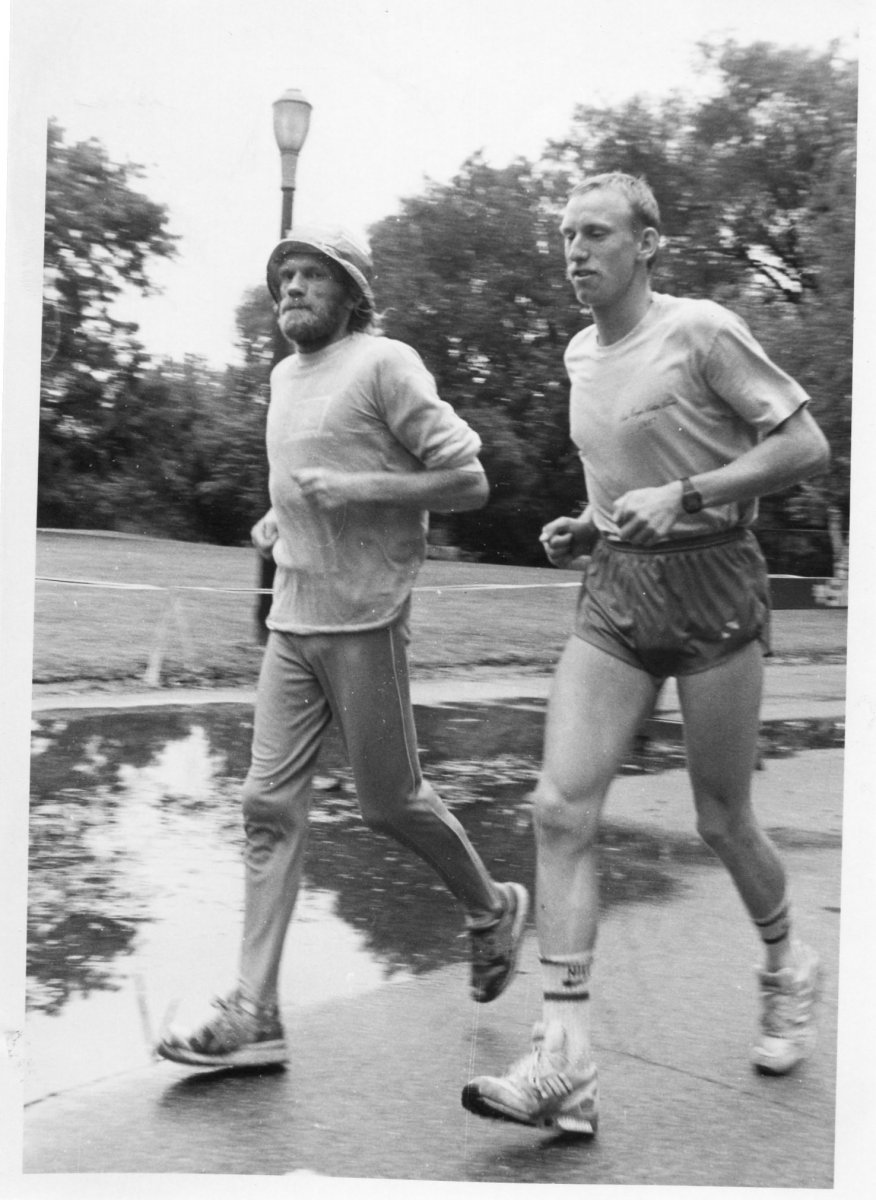
HowieSchlett.jpgAl Howie stood among those reaching for the highest. The taut Scotsman, who three years ago refused death in the form of a brain tumor, intended to do what had been considered impossible by many – complete the 1,300 mile race in the allotted 18 days. His competitors: Stefan Schlett, professional adventurer whose live-volcano climbing and bicycle trips across the Sahara had left him hungry for more. Australian Ian Javes of the impenetrable will, Trishul Cherns, and other near-conquerors of the distance in the past. On equal footing was the poignant figure of Christel Vollmerhausen, a 55 year old West German who had also fought cancer, and whose celebration of life in the form of running included ceaseless prayer (rosary). So potent were her prayers and yogic breathing that rarely would she be seen in heavier attire than a cotton singlet, in the nippy, rainy span of a New York fall, even while sleeping under a thin blanket beneath the stars.

Ten of them stood under the banner on September 18 to commence the 1,300 mile division. Sri Chinmoy shook hands with each. They were off! Al Howie took the immediate lead (never to give it up) at just over a 7 minute pace. Moving into third place was Christel, pouring it on like a steam engine with her audible exhalations. Marty Sprengelmeyer’s gentle lope, Tom ‘Keep Smiling’ Grace’s cheerful jog, Stefan Schlett’s grin of bravado, Emil Laharraque’s rocklike silence; all were anticipating the eternity of 18 days, each of which would require 3 marathons to keep afloat.

New York weather opened up with the onslaught of 15 hours of rain on Day 2. Al aced his first day with 113 miles, Ian Javes of Australia with 102 miles and Marty at 100 miles. Schlett, who had completed the double Ironman triathlon two weeks before, settled for 88 miles, just two miles behind Christel, who had never done more than 48 hours before.
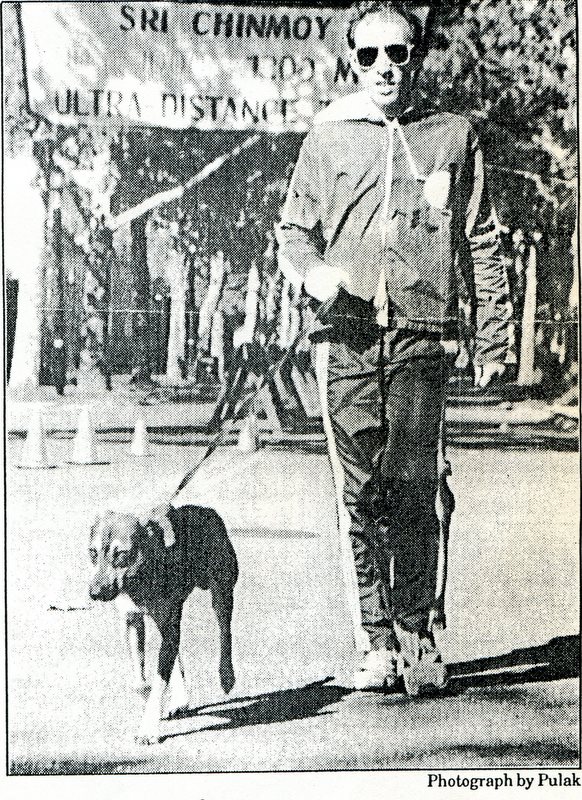
trishul and dharma.jpgTrishul Cherns also did 90 miles, following his extremely precise plans for the race which were soon to be blown sky-high by the companionship of Dharma the Dog. Dharma, who shortly became the most televised runner in the race, was an elegant mutt who stayed around the race before attaching himself to Trishul. By Day 3 Dharma had loyally run 111 miles at Trishul’s side, but the dog was starting to moan a little. Trishul tried to explain that everyone’s feet were hurting. After two more days (61 and 41 more miles), Dharma the Dog would lift his sore paw and whimper to Trishul, ‘Carry on.’

Al was sailing on top of the field, his wiry frame in constant motion, blond lion’s mane never drooping. In an age of high-tech gear and psychological studies of visualization techniques, Al was in the process of raising the banner for just plain running. No plans, no schedules. Al ran as he felt and rested as he felt. ‘No p’int in savin’ y’rself,’ he explained in his thick Scottish brogue. ‘Y’r goin t’ get tired anyhow.’ A 2:26 marathoner who has won most of the ultras he has ever entered, he had no special secret except his ability to run, and run, and run. ‘I’ve learned to be a survivor. I guess that’s what most of us are. That’s really what it’s all about.’ He would rarely visit the medical tent. His legs weren’t sore and he had no complaints, no handler, and no doubts about this race. Slightly down the field was Christel. The Sri Chinmoy Marathon Team has hosted many a unique character, but never such a one as Christel. She had heard of this race a few months ago. ‘Do you realize what you will have to cover each day?’ asked an incredulous friend, Wolfgang, whom she would eventually talk into joining her. ‘I’m not going to think about that,’ was her reply. She could be heard now, as she clung to the front pack, whistling with each exhalation, a shock of hair bent over her prayers in a gentle tilt. She would not sleep at all for the first six days and nights, and her prayers would be answered as she ran ceaselessly, achieving a German record for six days and the fourth fastest woman’s world mark for 1,000 miles.
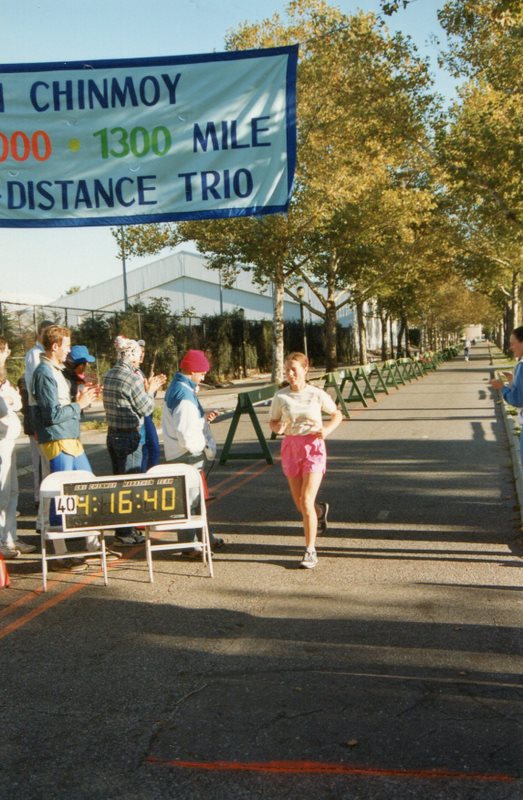
Antana finishes.jpgIn the staggered start pattern which would allow for simultaneous finishes for all three distances, the 1,000 mile women began on September 20. A field of two, Suprabha Schechter and Antana Locs, trotted off from the start that noon, blithely waving to the applause. Their cheerfulness was sheer bravado, in the face of the discipline which would be required. Antana, holder of several Canadian records, stuck to an hour-by-hour schedule of great severity, while Suprabha, holder of world records, stuck mainly to the track. Within hours the downpour would begin once again, in honour of the predicted hurricane Hugo, while Suprabha would turn in 99 miles and Antana 88 miles for the first day.

The 1,000 mile men began the next day. The field of five, which would be whittled down to one by the end, featured the intrepid Scottish Reverend Laurie Dexter, Tsuruo Kobayashi from Japan, the inimitable Bob Wise of Georgia, Jean-Claude Czaja of France, and the former school principle of Ludington, Michigan, the relentless John Wallis.

The weather was abating, although news reports said the hurricane was imminent. Australian Ian Javes, a phantom whose face rarely emerged from his expedition hat, was slowing dangerously with blisters, injuries, and hurricane phobia, and would return to the drawing board after a six day split of 426 miles. Wolfgang Ettwig had dropped out of the race only to become a permanent fixture; as the German handler he would surpass the runners in frazzled distraction.

On September 23 the 700 mile women and walker started; September 24 marked the last start, the 700 mile men, accompanied by brilliant blue skies as Hugo had slipped by to the west. Al already had 495 for six days, 33 miles over Stefan. This lead would continue as a link between them, pushing from behind and pulling from ahead, helping both to hold their pace. Jesse Dale Riley, the abundantly cheerful walker who was now running, just made the six day cutoff with 350 miles.

Monday’s weather held and Al finished off 7 days with 573 as compared with 511 in this spring’s 7 day race. Winds began to build and during the night the rain began again. 1,000 miler John Wallis, veteran of many a rainy event, stuck to the track with his measured regularity. Tuesday dawned in the downpour, while the 1,000 mile women recorded splits for six days of 429 miles (Suprabha) and 400 miles (Antana, for a Canadian record). In the 700 mile division Nirjhari DeLong, a veteran of this course, was moving up on Essie Garret, while Noviedya Brower, in the men’s division, spent a few sleepless nights building up the mileage that would keep him in the race.

Among the 1,300 milers, Trishul was beginning to drop off pace and the Dog was claiming most of his handler’s time. Christel was sticking to the road with no other thoughts. Someone forgot to wake her and she slept for 5 hours. She declared furiously in German ‘I did not come here to sleep for 5 hours, I came to run!’ Much of her remaining sleep would be during her foot-soaks, 10 minutes at a time.

Tuesday cleared with a constant wind to remind us of how cold the nights can be. Laurie Dexter, who came to this race to see what physical limits really are, will be disappointed in his quest, because the blisters on his feet will not let him go on much longer. He is unable to walk to the medical tent and Jesse Dale Riley, having completed close to 500 miles, announces ‘No problem,’ and picks him up in his arms and carries him. Tuesday evening marks my penultimate bout with a health problem which will not let me run anymore. The night grows cold as Al hits the 700 mile mark, at 8 ½ days. Ian is on a schedule of 80 miles a day with no leeway, but picking up hope. John Wallis, ubiquitous like a small human running machine, is about to hit a 6 day split of 410 miles.

September 27 – like the 27th of every month, the Sri Chinmoy Marathon Team was holding a marathon, on the same course as the Ultra Trio. On a brilliantly cold day which evolved out of a bitterly cold night, some 60 marathoners took off.
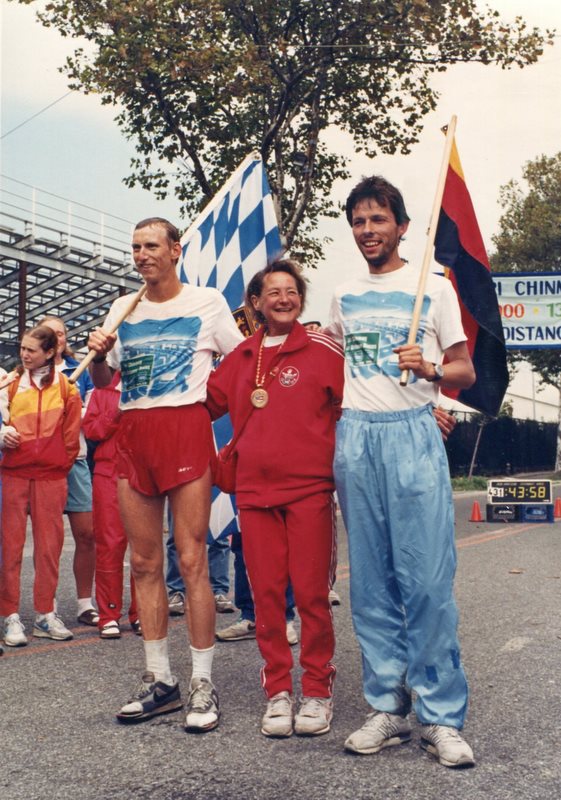
germanfinishers.jpgJapanese TV arrived in the afternoon, and the 1,000 miler, Tsuro Kobayashi, who had dropped considerably off pace, became inspired. Day and night he began to whirl around the course, the small Samurai, at 11-13 minute per mile, with no breaks. He did not stop to change from his t-shirt and black pants, and no one could persuade him to relent. He had entered the race because of the notice in Ultrarunning, but could not read English, except for the numbers. A spirited marathoner, his previous longest distance was the Western States course which took him 33 hours.

Laurie Dexter, finally sidelined at 400 miles, realized that of all the exploits he has attempted, it was the first time he had failed to meet his objective. And he didn’t mind – ‘Every step was a new personal best.’

Al Howie was very near 1,000 miles. He was tempted to push for under 13 days, but his survival instinct prevailed. Despite his wild druid-like demeanor and high output, he was perhaps the most relaxed of all the runners; he reasoned that the whole trick was not to think of splits at all, but to realize one has to cover 1,300 miles. But ‘It’ll be a lot easier t’ gut it out on a decent amount of sleep. I’ll definitely g’t at least 4 hours fr’ m now on. I can’t understand why nobody else has thought o’ that,’ he said in his lilting brogue. ‘That’s why everyone seems to end up losin’ it.’

October 1 – Howie finished 1,000 miles in just over 13 days – the fourth fastest time ever. He phoned his wife and assured her that he’s eating properly (‘Just a few chocolates. Little bebby ones’), and that he would sleep five hours a night from then on. ‘What I want to do is g’t it done Thursday night, then I could help out Stefan,’ he explained. ‘The sad thing is, somethin’s wrong with his feet. His commitment and his strength and courage are at least equal to mine. It’s a shame that somethin’ with y’r feet would let you down.’

Al Howie is a very competitive runner, and yet he would say at the end of the race, ‘Stefan and Ian will be my friends forever.’

He betrayed little strain, as he frequently sat for a few moments between laps on a folding chair by the counters, then got up, without ado, to go again. His weight loss was dramatic, thought he ate steadily and was on a daily diet of cheesecake, and his sharp eyes quivered a little under the blond tangle of hair and beard and eyebrows.

October 3 – Antana’s 32nd birthday and she’d done 827 miles in 13 days, behind Suprabha’s 871 miles. A strong, fast runner who never dropped her form, her feet were killing her with every step. In three days she would reach 1,000 miles in the third fastest time for women.

John Wallis, the solo male survivor in the 1,000 (since the valiant Kobayashi was now on crutches with a stress fracture) was approaching his goal, thanks to his technique of perpetual motion. He was also getting foot problems so serious that his future was in the balance.

Stefan was under great strain. Every pebble was killing him. And he was also at his limit – the mileage he finished with last year. When asked how he felt, he replied, ‘Do you know what a .38 pistol is?’

Ian has set his mind like a vice and maintained the highest daily average of any runner in the last part of the race. His injuries, which include severe sciatica, were only slightly abated, and yet he was about to pass Stefan with 24 hours to go. (Ian’s 1,000 mile split, measured from the beginning, ends up 12 hours slower than his 1,000 mile split measured from the end, and his second half was about 100 miles faster than his first).

October 4 – Christel, whose strength transcends all logic, achieved her 1,000 miles at 11 p.m. and for a few hours would hold the second fastest women’s 1,000 mile time in the world.
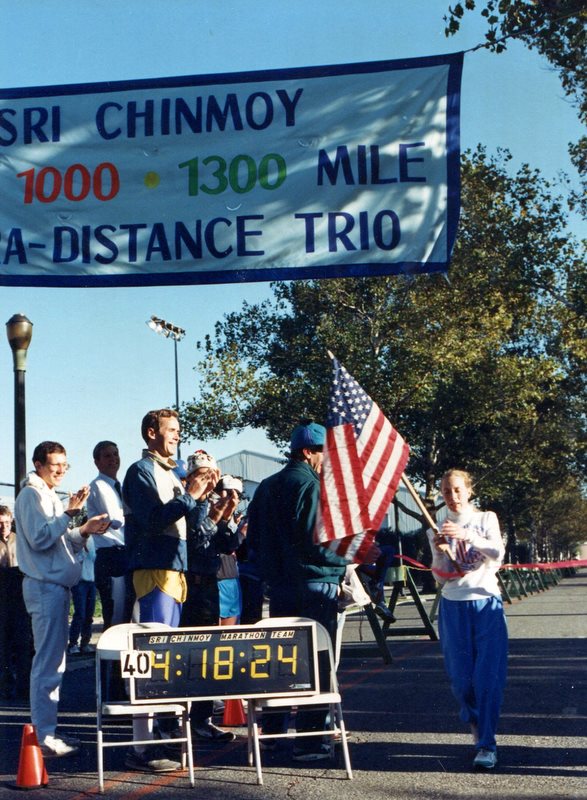
suprabhafinish.jpgDuring the morning it was realized that Suprabha had a shot at the world record. The weary wish of a tired but relentless runner, who had stuck to the track for 14 days, would have to pass the next 24 hours without any break. The very thought of it sent her to the medical tent – ‘Just a short break,’ she sighed. Through the beautiful night she ran in her conservative, unbroken gait. She reached 1,000 miles at 8:40 the next morning, a blond-haired wraith focusing upon a far-off world. She has the world record, beating Sandy Barwick’s mark of 14 days plus 20:45:16 by just 27 minutes. ’I want say one thing,’ she breathes. ‘This has been a joint effort by the Sri Chinmoy Marathon Team.’

Just moments before Ian and Stefan had been on the same lap, at 1,205 miles. Al had 1,250 miles, Marty Springlemeyer’s record for the race. He was ‘livin’ lots of hell, and then I’ll be in heaven.’ Nirjhari and Essie, who had been napping near each other, and could hardly get up without knowing the other would also, were within 3 miles of each other, with 641 miles and 644 miles. And Noivedya and Michael, in the men’s 700, have been sharing the lead the whole race. There were only 27 hours to go.
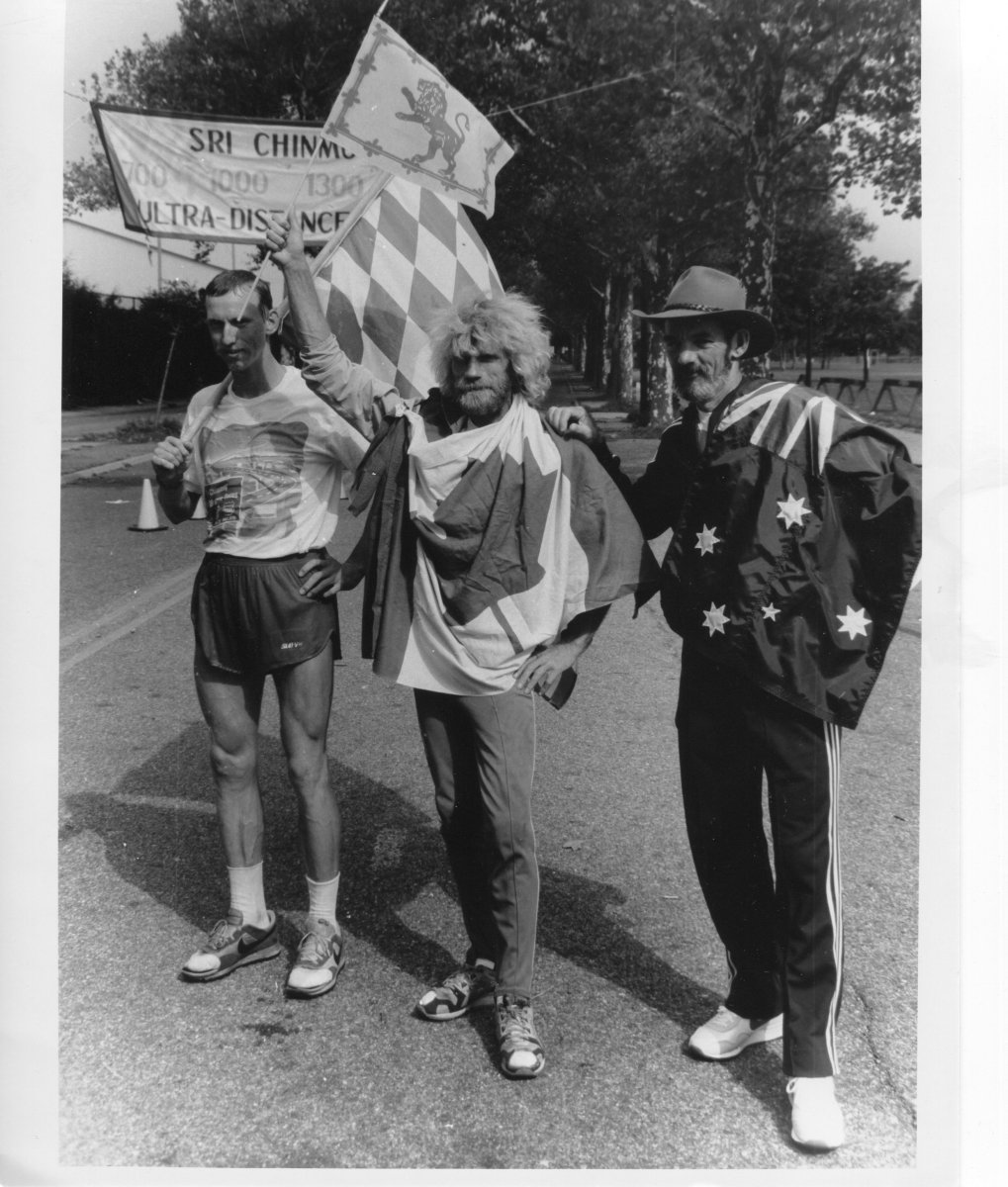
3finishers.jpgThe evening of October 5 Al reached 1,300 miles, holding aloft the Rampant Lion, one of Scotland’s more esoteric flags. Pretty rampant, and definitely a lion, Al did not pause before doing an additional lap to reverse around the course, phoning his wife, and finally collapsing on his folding chair amidst the applause. His adrenalin was still pumping, and he later called it the most exciting moment of his life. Ian, whose back was in a perfect sideways curve by this time, stopped to congratulate him. ‘Time to clean up now! quipped the high school teacher. ‘Looked at you grubby face for 18 days now!’

John Wallis, with 40 miles to go, had been advised by the medical crew that his foot was so bad that if he took another break he might not get back out again. He ran his last 10 hours without a break, using the side of his hurt foot as a get leg and basically running on the other. His back started to go. On his last lap he paused for his characteristic walk around the curve, and took the American flag. Wallis finished 1,000 miles in 14 days, 9 hours – 12th fastest time for men, with the vet’s world record. He turned down the invitation to do a victory lap, and collapsed on Al Howie’s lap while congratulating him.

Antana reached 1,000 miles during the night. New York skies smiled gently on October 6, fleeced with snow-white clouds, innocent of their cruel tricks of the past weeks. The entire field of 700 milers finished in the morning, and would eventually thank the close competition for getting them through. Ian Javes; quiet but tremendously courageous performance made him the second man to reach 1,300 miles in a certified race, less than an hour before the cutoff. Stefan became the third and youngest. Veteran of many a life and death exploit, Stefan declared without hesitation: ‘This was the toughest race of my life!’

This has been the first year that everyone who has survived the cutoffs reached their goal. It has been a tremendous effort, with results beyond expectation. In the words of John Wallis: ‘It’s like, the more that make it, the prouder we’ll be.’
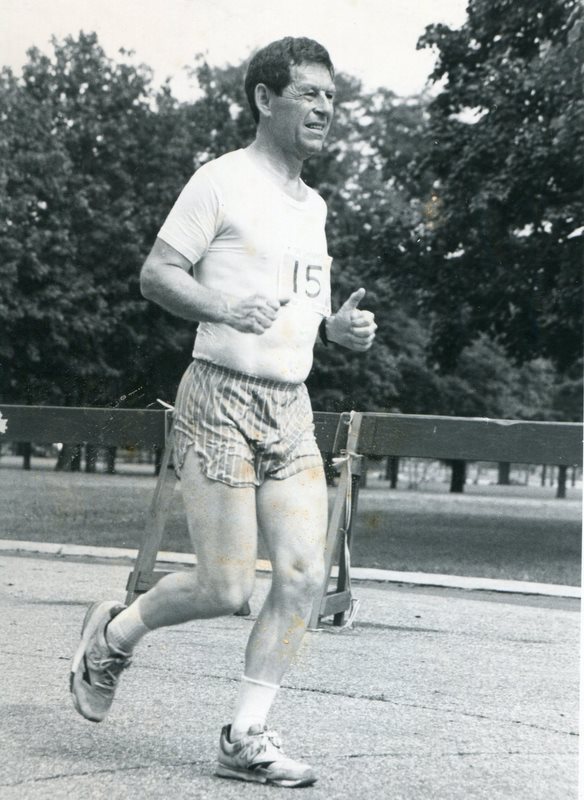
wallis_0.jpgSri Chinmoy handed out the awards, and national anthems were sung for each of the winners. After many rounds of applause the runners were invited to speak. Everyone agreed that the mutual support, not only from the crews but among the runners, had been phenomenal. John Wallis: ‘An incredible experience for me, and I am shaken by it.’ Ian Javes: ‘Without all of you I couldn’t have done it.’ The tough Stefan Schlett: ‘I am very inspired. I speak for all the runners. I say thank you very much and I love you all together.’ Yes, the impossible had been achieved. And everyone who was part of the 1989 Ultra Trio could take the credit.

“Sri Chinmoy Ultra Trio – A Triumph of the Survivors.” Ultrarunning. December 1989. Reprinted with permission.



View full article »

Women Who Win: Ann Trason's 1989 world record

By Rupantar LaRusso author bio »
1 September

About the author:

Rupantar has been the race director of the Sri Chinmoy Marathon Team since 1985, having been asked by Sri Chinmoy to serve in that capacity. As well as working on the big races the US Marathon Team organise each year - the 3100 Mile Race and the Six and 10 Day Race - he also spends a considerable amount of time archiving the Marathon Team's 40 year history on this website.

Nathan Whiting, who ran in the historic 24 Hour Race in 1989 (and completed 107 miles), puts Ann Trason’s victory in context with the prevailing views of the running community during the 1980s.

Whiting, Nathan. “From the Big Apple: Women Who Win." September 1989. Reprinted with permission from the author.

Trapprunng.jpg"In January of 1981 Sue Ellen Trapp won a 100 kilometer race in Miami with a time of 8:05:26, beating the first man by over 50 minutes and setting a new American women’s record. Her record was soon broken, but the event was memorable. Those of us who heard took notice. Women were relatively new to distance running, but were asserting themselves. Feminists in New York, who I passed on this information to, were excited and proud. A myth of male dominance was being threatened. We had known that elite women had times capable of winning some local races...From time to time women have continued to win races, but two recent, local events have definitely proven women can reach men’s level.

This year’s TAC 24 Hour National Championship, sponsored by Sri Chinmoy, certainly couldn’t be said to have a weak field. Four men who had gone over 140 miles were present, plus two other sub 14 hour 100 milers. Add three of four more 130+ mile 24 hour runners and you have a formidable crowd. Yet, on a day of uneven weather featuring many kinds of rain, Ann Trason won by four miles. It wasn’t many hours before none were able to challenge her fluid, unyielding motion. Her statement was only beginning. We assume male athletes beat females. Women are told they are weaker. Don’t compete. America’s salary structure and other institutions depend on this belief. Imagine a woman hitting 50 home runs in the major leagues or gaining 100 to yards to lead an NFL team to a big win. This is the order of Ann Trason’s achievement.

trason.jpgWhat is a hero? A fast, well trained center fielder makes a diving catch in a World Series. He is paid $2 million to do this. Boys remember the catch into old age. A TV camera shows his face close up in slow motion register pain as he strikes the ground, then a brief grimace before he rises jubilantly with the ball. A telephoto lens captures a wide receiver reaching a ball the moment he is hit. We are impressed. At 13 hours, 55 minutes Ann set the women’s world record for 100 miles, an exhausting effort of great efficiency and concentration. We would have understood her entering intensive care for some rest. She kept going. She still had a national championship to win. For the remaining 10 hours she averaged 4.3 miles an hour to reach 143 miles. If you don’t think that’s a lot you have never run a 24 hour race. With 9 hours to go she gasped in a whisper, as if by a wind blown though her, ‘it’s hard’. The echo seemed to cover all of New York City ‘please stop’. She defeated it. Imagine the outfielder sliding across the turf for 10 hours. What camera angle, what trick of slow-motion or sensitive fast-motion could possibly reveal her glory of pain and courage torn apart and reassembled too tightly around exhausted, nauseous gut? None has been invented. We had thunderstorms for three hours that forced half the field including Ray Krolewicz, muscular veteran of over 70 100 mile runs, to shelter. She continued like a light ghost. The world could not feel her weight, but each of her steps pushed the world’s entire mass. I do not wish to repeat how much ultra running needs better publicity but Ann Trason’s run must not be kept a secret.

Sitting.jpgWhat were Scott DeMaree and Tom Possert, the top two men doing? Making a hopeless charge? Feeling bitter and humiliated? Of course not. They are very civilized men in a very civilized sport. They ran and walked lyrically together the last few hours, now and then looking over their shoulders to avoid being overtaken by Sue Ellen Trapp. Now 43, modest, smiling into the endless unknown of a hard night, her thin, long legs matched their thin, long legs to finish a strong, close 4th.

Photo: "It was a hard race, well fought...Scott DeMaree (2nd from left), the new Men's USA/TAC 24 Hour Champion, and 2nd place men's winner Tom Possert (r) finally get to sit! Photo: Adarini.

The other race I won’t forget is Christine Avin’s victory in the Joe Kleinerman 12 hour Run, over a year ago in July. At least four of the men had run over 80 miles in 12 hours, but steamy, 96 degrees heat made that distance unlikely for anyone. Chris Avin, while one of the best local ultra women, was not the elite, world class runner Ann Trason is. She was not even the woman’s favorite; that honor going to the faster Christine Gibbons. What was impressive was that she was closely challenged by a strong male and able to beat him. As the morning temperature rose Chris took care of herself, painting on water with sponges, drinking, and keeping a light, even pace. She quietly took the lead. (12 hour races tend to be quiet and dignified.) Only Frank DeLeo (America’s 5th fastest 100 miler in 1988) was able to keep close. By the last hour they were together, taking a rest before the struggle to the finish perhaps, but also testing each other, looking for the advantage. Chris did not decide that this is a man, he has more muscle, he has some right to win. She simply picked her lighter knees up a little higher and outsprinted him, winning by 40 yards, a mere 100 yards from 80 miles. Chris Gibbons finished 5th. I suppose in a city where a million women compete every day in the male dominated offices, her victory was merely another event in the struggle of modern life, or perhaps the men who rule on legends didn’t think it was important. At least it went unnoticed. It is also unforgettable. Frank DeLeo was criticized for letting a woman beat him. No other man was within 9 miles of him. I think he ran as hard as he could. It is a new year.

trapp weygandt trason.jpgIn these two races women comprised between an 8th and an 11th of the field, which is typical of the sport. I don’t know what would happen if women became interested in long distances in large numbers. I have noticed well trained women do better in hard weather, surviving cold with wise clothing (and a little body fat?), overcoming heat with patience (and less body mass?). I do know I am very humbled by these achievements. It is the best thing that can happen to me.”

Photo: Sue Ellen Trapp (l), Neil Weygandt (c), and Ann Trason (r). Photo: Adarini.

View full article »

Sri Chinmoy's inauguration remarks at the first Seven Day Race, 1988

By Rupantar LaRusso author bio »
14 October

About the author:

Rupantar has been the race director of the Sri Chinmoy Marathon Team since 1985, having been asked by Sri Chinmoy to serve in that capacity. As well as working on the big races the US Marathon Team organise each year - the 3100 Mile Race and the Six and 10 Day Race - he also spends a considerable amount of time archiving the Marathon Team's 40 year history on this website.

ckg greets runners.jpg

Sri Chinmoy’s remarks to the runners prior to the start of the Sri Chinmoy 7 Day Race, October 14, 1988, Flushing Meadows Corona Park, NY:

"My dear Seven Day Race Runners,

You are brave – very brave, exceptionally brave, divinely brave, supremely brave. Only the brave can and shall win the ultimate goal, which is birthless and deathless satisfaction. This birthless and deathless satisfaction you already have in the very depths of your souls. Now you are bringing it to the fore through your adamantine will power and your sleepless self-giving to the outer world of running and to the inner world of becoming. Being a truth-lover and a seeker of the ultimate truth, I wish to tell you that you are doing something most significant not only for yourself and your own life but also for those who love the outer running and the inner becoming.

You are the pioneer runners. You are the brave soldiers. You are tomorrow’s pathfinders. You are supremely courageous in virtue of your divine self-giving to the running world. I am very, very proud of you and very, very grateful to you all. My heart of joy and my life of infinite gratitude I am offering to each of you as you start on your way.

This is a seven-day race. The number ‘seven’ has a very special significance for those who study spirituality. According to the Indian way of thinking, there are seven higher worlds and seven lower worlds. Since we are human beings, we have already passed beyond the boundaries of the seven lower worlds. Now we are climbing up high, higher, highest in the seven higher worlds. Each of the seven higher worlds has some very special kind of delight – oneness-delight and fulfillment-delight – to give us. Each time we step into a higher world, we enter into a world of ecstasies. Each time we climb higher, this ecstasy increases. All the time we are dealing with a boundless and limitless ocean of ecstasy; but although it is an ocean, still it increases. For God the Supreme Runner at every moment is increasing His own Capacities, His own Light and His own Delight.

img129_1.jpg

Although this is a seven-day race, please don’t think of all seven days while you are running. Think of only one day at a time. Then, do not even think of one day; think of only seven hours. Then, for a few minutes think of only one hour. If you can mentally divide the race and break it down into separate parts, you will get much more energy and much more joy while running. Every time your mind decreases the amount of time you have to run, you will get tremendous inner strength and vigor. So do not keep in mind seven days. Go at your own pace, but mentally divide the race to make the distance as short as possible. In this way you will all the time have inner strength and be able to run throughout."

View full article »

The Race of the Century, May 20-June 7, 1988

By Rupantar LaRusso author bio »
7 June

About the author:

Rupantar has been the race director of the Sri Chinmoy Marathon Team since 1985, having been asked by Sri Chinmoy to serve in that capacity. As well as working on the big races the US Marathon Team organise each year - the 3100 Mile Race and the Six and 10 Day Race - he also spends a considerable amount of time archiving the Marathon Team's 40 year history on this website.

The following is the complete brochure (scanned) from this historic event including a history of the 1,000 mile race, a short biography of Sri Chinmoy, the rosters of the three races, and the world rankings for 5 days and all important distances up to 1,300 miles...

brochure1.jpgbrochure2.jpg


brochure3.jpg

brochure4.jpg

brochure5.jpgbrochure6.jpgbrochure7.jpgbrochure8.jpgbrochure9.jpgbrochure10.jpgbrochure11.jpgbrochure12.jpgbrochure13.jpgbrochure14.jpgbrochure15.jpgbrochure16.jpgbrochure17.jpgbrochure18.jpgbrochure19.jpgbrochure20.jpg

View full article »
  • ‹ previous
  • 11 of 13
  • next ›
More articles under Sri Chinmoy Marathon Team articles »

Books you might find interesting

Guru Marathon Sri Chinmoy
A life and teachings on meditation and athletics
more »

Sri Chinmoy Marathon Team articles

main page »

More in this section

main page »
Sights and Sounds from the 6 and 10-Day Races 2013
List of Runners and Brochure: 6 and 10 Day Races

Stories from around the world

United Kingdom
SRI CHINMOY 5K - Scottish Championship 2026
Worldwide
First Sub-Two Hour Marathon
Latest News
3, 6 and 10 Day Race 2026 Results
New Zealand
28th Sri Chinmoy 6-12-24 Hour Track Races - AUT Millennium Stadium, Auckland
Worldwide
Swimming for Peace
3100 Mile Race
Highlights of 3100 Mile Race 2025
Channel & Open Water Swimming
Swimming 20 Bridges around Manhattan for Peace

About us

  • About the Marathon Team
  • Sri Chinmoy, Team Founder

Our races

  • View all events

Results

  • Previous races
  • Worldwide results
Global homepage »

Country Websites

  • W.Europe
    • Austria
    • Finland
    • France
    • Germany
    • Great Britain
    • Iceland
    • Ireland
    • Italy
    • Netherlands
    • Norway
    • Portugal
    • Switzerland
  • Central & E. Europe
    • Belarus
    • Bulgaria
    • Croatia
    • Czech Republic
    • Hungary
    • Latvia
    • Macedonia
    • Moldova
    • Russia
    • Serbia
    • Slovenia
    • Slovakia
    • Ukraine
  • N. & S. America
    • Brazil
    • Canada
    • Guatemala
    • United States
  • Asia
    • Japan
    • Mongolia
  • Oceania
    • Australia
    • New Zealand

Other sites

  • Sri Chinmoy Cycling Team
  • SCMT Channel Swimming
  • SCMT Climbing
  • 3100 Mile Race

Popular Pages

  • Sport and Meditation - a guide
  • Recent media coverage
  • History 1977-Present
  • 7-step marathon training
  • Our members
  • Books by SCMT members
  • Privacy policy
  • Cookie settings
  • Log in

Contact Information

Sri Chinmoy Marathon Team
New York • 718 297 2556 • Email us
Creative Commons License

Except where explicitly stated otherwise, the contents of this site are licensed under a Creative Commons Attribution-NonCommercial-NoDerivs 3.0 Unported License read more »

SriChinmoyRaces.org is a Vasudeva Server project.