United StatesSri Chinmoy Marathon Team

  • About us
  • Our races
  • Results

Search form

Founded by Sri Chinmoy in 1977, the Marathon Team is one of the world's largest organisers of endurance events.
read more »

Media Coverage

Articles & TV clips

History

From 2 to 3100 miles

Sri Chinmoy

Marathon Team Founder

Marathon Training

Our seven-step guide

Next Event:

6 June - Seattle
Self-Transcendence 2-mile race Seattle, Race 6
Details »

More events:

New York
San Diego
Seattle
View all events »

Worldwide:

View full list »

Latest results:

23 May - Seattle
Results for the Sri Chinmoy 7 & 13-Hour Races May 23, 2026
Details »

Previous races

View all results »

Worldwide results

Full list »

Galleries and Video from 3100 Mile Race

By Anonymous
7 September
Photo Galleries Video
Finish Galleries:
Asprihanal, Michael, Smarana, Madhupran, Arpan
 
Day 37 - July 19 Asprihanal final 24 hr
Day 22 - July 4 Oleg Chat with Matt
Day 18 - June 30 Sri Chinmoy meditates
Day 10 - June 23
Stefan Abichal
Day 2 - June 14 Smarana and Michael Music video
Day 1 - June 13 Matt July 3
Abakash's photos from the start Arpan Video of the Start
  Virendra Abichal Matt
   

Sri Chinmoy Marathon Team articles - more articles

A History of Multi Day Racing in the 1980s - by Malcolm Campbell

By Rupantar LaRusso author bio »
1 May

About the author:

Rupantar has been the race director of the Sri Chinmoy Marathon Team since 1985, having been asked by Sri Chinmoy to serve in that capacity. As well as working on the big races the US Marathon Team organise each year - the 3100 Mile Race and the Six and 10 Day Race - he also spends a considerable amount of time archiving the Marathon Team's 40 year history on this website.

In the 1988 IAU newsletter, Malcolm Campbell gives the following detailed history of multiday running in the 1980s.

cherns choi.jpg

Trishul Cherns (l) and Don Choi in the 1985 Sri Chinmoy 1,000 Mile Race

"In a recent publication the last three words of a quotation by Jim Shapiro were omitted. The full quotation is:

‘It is not pain I feel but sinking.
My involvement with the world grows dimmer.
It occurs to me that it would be nice to keel over.
A barely audible whisper says it would be a way out.
It seems almost impossible to bother any more...
But I do!’

The words appeared in Jim’s book ‘Ultramarathon’ which was published in 1980, and tells the story of Ultrarunning up to the end of the 1970s. The multi day event was just about to take off and Jim had noticed this when he wrote ‘In 1979, Don Choi organized two 48 hour runs in California. Mutterings are occasionally heard from Tom Osler in New Jersey about possibly staging a 6 day wobble.’ I very much hope that Jim will write another book because the events of the 1980s are well worth recording. The first 6 day race of modern times took place in Woodside, California in July of 1980, and was won by Don Choi with 401 miles. The first Edward Payson Six Day Track Race took place a few weeks later in Pennsauken, Philadelphia. Don Choi was the winner again with 425 miles. The following year in Pennsauken, Park Barner completed 430 miles.

The development of the sport depended on the willingness of the runners to participate and the willingness of organizers to stage these very demanding events. Sponsors were available but they had to be educated concerning the athletic possibilities of modern day runners. To some extent the growth of the sport sprang from chance remarks or accidental meetings of interested parties. One runner in the 1981 Pennsauken Race who played a vital part in the growth was Geoff Richardson, a Scot working in America. Shortly after the race finished he returned to England determined to stage a similar event, and with the aid of three good friends, the first Nottingham Six Day race was organized. The winner was Mike Newton who became the first runner of modern times to pass the 500 mile mark. Multi day racing owes much to Mike Newton. Most established ultra runners in England were reluctant to take chances on a new event and many thought the race was doomed to failure. How wrong they were. Don Choi, Jim Shapiro and Wes Emmons came over from America. The Canadian, and Olympian, Paul Collins entered and Joe Record from Australia took part. The media loved the event and sponsorship was assured for a number of years.

brown kousos campbell.jpg

(l to r) Richard Brown, Yiannis Kouros and author Malcolm Campbell prior to 1988 Ultra Trio

In 1982, the Nottingham race was won by Tom O’Reilly with 576 miles and a new modern day record. At this point, students of ultra distance running were noting that in the 1980s there were a number of performances over 600 miles and that George Littlewood’s record of 623 miles and 320 yards, set at Madison Square Garden in 1880 was far beyond the capabilities of modern day runners. The race was now on to be the first to beat this record and the subject aroused worldwide interest. News of the event had spread to France, a country with a long standing tradition of distance running, and a Six Day Indoor Race was staged at la Rochelle in 1982; the race winner was Ramon Zabalo with 537 miles. The Nottingham Six Day Race was held annually from 1981 to 1985. The La Rochelle Race has been held annually from 1980. The Six Day Race is also firmly established at Colac in Australia where some outstanding performances have been achieved.

BauerMittleman.jpgFred Lebow took an interests in the Six Day Race and became determined that the first man to best Littlewood's record would do so in New York. The New York Road Runners club organized two Six Day Races and the first of these was held in 1983. The race winner, Siegfried Bauer, completed 511 miles which was a better performance than the mileage indicates. The temperature during the entire race was particularly hot.

The following year, Lebow signed up Kouros and Ramon Zabalo and the ancient record (Littlewood's record) was finally beaten when Kouros added a few yards to his World Record and Zabalo completed 593 miles.

In many ways, 1984 marked the end of an era. There would be other good performances over six days, but no other runner would pass Littlewood’s mark, and only two runners would pass the 600 mile mark. Stu Mittleman ran 577 miles at Boulder County, and Patrick Macke ran 579miles at La Rochelle. The great French runner, John Gilles Boussiquet, ran 605 miles at La Rochelle in 1984, and the following year his fellow countryman, Gilbert Mainnix ran 609miles at the same venue. The highlight of Eleanor Adam’s career came at Colac in 1987 when she beat her own World Record with 521 miles.

After Littlewood’s record was beaten a number of major sponsors lost interest in the event. It became difficult to justify the considerable travelling expenses involved for competitors who, at their best, would be unable to complete distances that had been achieved over 100 years ago. In 1982 Cliff Young, a 62 year old farmer, won the inaugural Sydney to Melbourne foot race. He achieved worldwide publicity and became a National Hero, and the race was assured of a place in Australian history. Westfields Corporation realized the publicity value of the race, and it has become the most costly event on the ultra running calendar.

The Westfield run was dominated, as the six day race had been dominated, by Kouros and in 1987 he completed the 1060 KMs between Sydney and Melbourne in a time of 5 days, 14 hours and 47 minutes; he was nearly 26 hours in front of the second place runner. Quite clearly, the sponsors of other runners could be forgiven for wondering if they were getting value for their investment. 1988 was Australia’s Bi-Centenary Year and the Westfield organizers were determined to make maximum use of the publicity for the event. The course was altered slightly and the new distance was measured as 1015 KMs. Yiannis Kouros was persuaded to accept a 12 hours handicap and started at 23.00 hours, whilst the rest of the field started beforehand at 11.00 hours. A number of runners expressed some concern at the arrangements, but in fact Kouros was paying them a great compliment in only giving them 12 hours start. In any event, he overhauled the entire field and finished about 4 hours ahead of second place Richard Tout. The handicap made his race time 6 days, 7 hours, 14 minutes. Richard Tout’s time was 6 days, 11 hours, 18 minutes. Although there are no serious challengers to Kouros over six days, it seems likely that Richard Tout presents the greatest threat to the supremacy of this great Greek athlete.

Start1000.jpgMeanwhile, a new event had emerged on the multi day calendar. The 1,000 mile race! In the 1970s there had been a two-man challenge between John Ball of South Africa and Siegfried Bauer from New Zealand. Bauer won this race which took place in South Africa and he was to win over the same distance in Colac (Australia) in 1983 with a time of 12 days, 12 hours, 36 minutes. This race started in Melbourne and the competitors ran to Colac, a distance of about 92 miles, where they continued around an accurately marked circuit in the Memorial Square of the Town. In 1985, the Sri Chinmoy Marathon Team in New York organized a 1,000 mile road race in Flushing Meadows Park, Queens, New York. That great pioneer of multi day racing, Don Choi, was still around and it seemed most appropriate that he should win this inaugural event. His winning time was 15 days, 6 hours, 24 minutes. In the same year, a 1,000 mile track race at Gateshead in England was won by Malcolm Campbell with a time of 15 days, 21 hours, 7 minutes. This had been the first 1,000 mile track race for nearly a century and, unlike the old 6 day records, the old 1,000 mile track times were quite modest. The Australian runner, Tony Rafferty, won a 1,000 mile road race in England in 1986 with a time of 14 days, 16 hours, 45 minutes. An outstanding 1,000 mile run was produced by the American, Stu Mittleman, at Flushing Meadow (a Sri Chinmoy Marathon Team race) in 1986 when he finished 25 hours in front of the second place runner with a time of 11 days, 20 hours, 37 minutes. Mittleman’s record for 1,000 miles seemed secure against all known competitors over the distance, and posed certain questions for outstanding performers over lesser distances.

In six day races there are competitors who run quite slowly to achieve great distances by not sleeping very much. Others run quite briskly but rest more often. There are a few exceptional performers who are able to manage with very little sleep and are still able to run well. These are, of course, the Champions. However, their ability to manage with virtually no real sleeping periods has only been tested over 6 days. They are not certain to manage for 10 days without a ‘trade off’ – and thereby lies the interest of the 1,000 mile race.

Eleanor Adams won a 1,000 mile stage race in England in 1987 with an overall time of 16 days, 23 hours, 9 minutes, and this was the best time ever recorded by a lady over the distance. One can only imagine the time Eleanor Adams might achieve in a ‘go as you please’ event and she  has done much to encourage the increase in standards of lady multi day runners, and like Don Choi, must be considered one of the truly great pioneers of the sport.

img118.jpgThis article was started before the Sri Chinmoy 1,000 mile race took place in New York. The race started on 20th May 1988 and Yiannis Kouros was to become the IAU World Champion with the incredible World Record time of 10 days, 10 hours, 30 minutes, 35 seconds. The second place finisher in that race was the Canadian veteran, Michel Careau, who now has his sights firmly set on a Six Day Race. Third in the race was Sandy Barwick from New Zealand, who set a ladies' World Record of 14 days, 20 hours, 45 minutes, 16 seconds.

It really is difficult to identify where multi day racing in modern times began in earnest. America, France, England and Australia have all been the venues for events of great significance.  When the Nottingham Six Day Race was held for the last time in 1985 it seemed likely that ultra distance running would revert to more standard events. The 24 hour race had become popular and this race is without doubt one of the most demanding of ultra distance races. Perhaps we are to see a revival of multi distance running in England and perhaps this time the top runners might get it right. In the early part of November there is to be a 48 hour track race at the Blackpool International Stadium. Organized by Stan Jewell, a most experienced Race Director, it promises to be an event of great significance.

Later in November, at the Gateshead International Stadium, we shall see the return of the Six Day Track Race. This event will be held to celebrate the British Record of 623 miles set by George Littlewood a century earlier, a race which may also be of some significance in future years.

There is perhaps a preoccupation with records where sponsorship of events is concerned and it is sometimes forgotten that the event is, above all, for the enjoyment of the competitors. But it is appropriate to finish this article as it started, with a quote from Jim Shapiro:

‘Without limits, boundaries or definition, there is no sense to any of it.’"

Campbell, Malcolm. “Multi Day Racing.” IAU Newsletter, September 1988. The following article is reprinted with permission of the author. 

View full article »

What is it like to run a multi day road race for the first time?

By Rupantar LaRusso author bio »
12 November

About the author:

Rupantar has been the race director of the Sri Chinmoy Marathon Team since 1985, having been asked by Sri Chinmoy to serve in that capacity. As well as working on the big races the US Marathon Team organise each year - the 3100 Mile Race and the Six and 10 Day Race - he also spends a considerable amount of time archiving the Marathon Team's 40 year history on this website.

What is it like to run a multi day road race for the first time? Laurie Staton-Carter found out when she ran in the Sri Chinmoy 5 Day Race in Flushing Meadow Corona Park, November 7-12, 1987.

The following is taken from the January-February 1988 issue of UltraRunning and reprinted by permission from the Publisher, John Medinger, titled "A McDonald's Cheeseburger Never Tasted So Good", by Laurie Staton-Carter.

img187.jpgI had wanted to run a multi-day race for a long time, ever since I had read about Marcy Schwam, Ed Dodd, Park Barner, and Wes Emmons running in the second Edward Payson Weston Six-Day Race in 1981. The book I had, written by Ed Dodd, was mostly pictures. There were pictures of people running, eating, sleeping, being cared for; they were taken at night, in the early morning in the heat of day; the runners were alone on the track, or with handlers at the aid stations, or, at the end, running with everyone else in the race on the final lap. There was a short text; but the pictures of their faces told the story, not the words.

Photo: "He may not be the youngest or the slimmest, but Malcolm Campbell is certainly among the best at multi-day racing - just six weeks earlier he had won a 15-day race in Texas." Photo by Ranjit

I had long dismissed multi-day running as too far, too long, too crazy. Yes, I run 100-milers, but I'll never do something like that. Mostly they were too scary, I discovered in the days before I flew to New York.

Sheer terror drove me through the first fifty miles in under ten hours. I was on the edge of tears the entire first day, overwhelmed by the tremendous support we received from the race staff and the other runners, overwhelmed by all of the legendary people that I was running with, overwhelmed that I was doing something that I had wanted to do for years. Multi-day runners have given  me much inspiration, especially Marcy Schwam, and also Don Choi, Park Parmer, Malcolm Campbell, and Marvin Skagerberg. I have also been inspired by the nineteenth-century pedestrians Sir John Astley, Edward Payson Weston, and Daniel O'Leary. But it wasn't until I had been running in Flushing Meadows Park for a couple of days that I realized the significance of those multi-day races of old. People kept asking me if this was my first ultra. "Oh, no," I would say. "I've done seven 100-milers and a 24-hour and lots of 50 milers and..." They would smile as they realized my perspective. To people associated with multi-day running, multi-day races are ultras. I had my sense of historical perspective radically altered that day.

img188.jpgPippa Davis, a British woman of 40 now residing near Boston, is a talented multi-day runner. She is very talkative, unassuming, and great to spend time with. We became friends sometime shortly before the race started, when she came over to my tent - I was trying to neatly organize five days worth of clothing, shoes, and gear into a two-person backpacking tent - to introduce herself and give me a little advice to start the race with. I don't take advice too seriously, and didn't at this time either, but as the days wore on, I welcomed a ten-minute lecture on blisters or swollen feet or anything that Pippa would tell me about this totally foreign kind of running we were doing. She was very helpful, always, and very encouraging, especially when she knew I was having a rough time of it. Pippa was with me as I completed my 200th mile. We were also kindred fashion spirits, as practically everything she owned was purple.

The first day had blissfully wonderful running weather. The temperature was near 60, but with a strong wind that never stopped during the entire five days. I was shooting for 60-75 miles in the first 24 hours, but took a sleep break after covering 65 miles. I awoke feeling good and covered 17 more miles in the first 24 hours. I felt great. I kept remembering what I thought I had heard Pippa say at some point early in the race, perhaps not all that seriously: "After the race you will be changed forever". I hadn't asked her to elaborate.

About 36 hours into the race, my hamstrings got so tight that I couldn't run any more. My quads were also shot, and my movement along the course became very slow. This was Sunday night and the race wasn't even going to be over until Thursday. Now I was overwhelmed by the fear that I was injuring myself permanently and that I would never run again. I went off the track for a sleep with not many miles covered that day, the wind blowing relentlessly across the park, my neatly folded piles of gear untouched in my tent. When I told my lap counter I was going to sleep she asked, again, if I wanted to be awakened. No, I didn't. As I slowly hobbled to my tent, I told myself that I would quit. After all, I'd trained hard and had a good year. A little rest would be a fitting reward. It would feel so good to lie down and not have to get up and run any more.

I awoke to the tapping sound that a Chronomix makes as the seconds advance. My tent was 25 feet directly behind the women's medical hut. It was dark, except for the lights of the aid station and the park street lamps. In a couple of minutes I heard a lap counter say, "Malcolm, that's 153. Gotcha." Then, a minute later, "Marty, that's 145. Gotcha." Then, "Malcolm, that's 154. Gotcha. Pippa, 126. Malcolm, 155. Gotcha." I drifted off again, dreaming that I was still running, but not sure if I was dreaming it or it was for real.

When I woke up Monday morning at about 4:30, I couldn't stand it any more. I had to get out and at least see if I could move around. I took my first lap of the day in absolute agony and saw fellow Wasatch Alpine Strider and multi-day aspirant Fred Riemer as I came into the aid station. "How's it going," he asked, sounding tired but genuinely interested. I burst into tears, unable to hide my disappointment in not being able to run any more, the pain and fear of being injured, and the vague possibility that all of my worst nightmares were coming true. He comforted me as best he could. He was having problems too, but he had just had a massage and was going to give it a go. I headed for the women's medical tent for extensive chiropractic and massage. In the second 24 hours, I managed to cover only 42 more miles.

I spent all day Monday in and out of the medical hut. I'd get a chiropractic treatment that would work wonders and I'd walk in relative comfort for a few laps. Then, everything would hurt again and I'd go back for another massage. I ended up doing acupressure on myself for several hours. I was pleased that it seemed to be working and that there was something that I could do to sort of revive myself.

Sometime in the afternoon, after I had come around another lap, I was over at the water stop checking out the various drinks and OWWWW! I had just stepped down on my left foot and it felt like a searing coal. I limped directly to the medical hut where I was given a lance to drain my blisters. But they wouldn't be drained, somehow inaccessible to my jabbing lance. We constructed foam doughnuts to cushion them. They still hurt a lot, but at least I could stand on them and move around.

The blisters, deep and painful, right on the ball of my left foot, soon developed on my right foot. It seemed they were caused by fluid accumulating around the metatarsal joints, due to the swelling of my feet, and had somehow developed from the inside of my foot. By Monday night, I was slowed to a lurching, painful walk, taking about 20-25 minutes per mile. Every mile was a major accomplishment. I saluted my lap counter after every lap, waiting to hear her confirm that I had completed one more mile. Fred was having problems with his knee and ankle and was going at about the same speed. As darkness fell, little drops of rain began falling.

The wind picked up and it started to rain. On one of the few laps that Fred and I ran/walked together, we were telling each other what had gone wrong and that we weren't even half-way through until 10:00 that night, and about how, if either one of us had looked this bad one day earlier, we would have been tempted to shoot ourselves. After a while Yves Pol came strolling by. Yves is a short, tiny Frenchman who amused us with his singing what sounded like opera or various national anthems, in falsetto, in French. Yves, not knowing our harrowing predicament, came up behind us, walking, and we somehow managed to scurry along at our best 3 mph pace to stay with him. Soon, we were laughing so hard that tears were rolling down our checks.

img189.jpgI got into this routine starting Tuesday. It was still raining, but I'd get up and get out of the tent whenever I felt like it. Sometimes it was 5:00 am, sometimes it was almost 7:00. I would go straight to the medical tent to get ready to roll. After my feet were prepared and my legs were massaged I would get out and move around. Then I'd hit the kitchen for this wonderful oatmeal that a woman named Ghelahti would fix up. There was usually either French toast or scrambled eggs too.

Somehow I got to know Marv Skagerberg, the guy who had raced across the country with Malcolm Campbell. It was Tuesday night and it had been raining hard all day. Fred and I had miraculously managed to get someone to bring us each a slice of cheese pizza (Sri Chinmoy folks are very vegetarian) and we started to crave something for dinner other than pasta pinwheels. I had been walking around with Marv for a while when he mentioned something about burgers. "Yeah," he said, "McDonald's cheeseburgers. I had a guy bring me a couple of them last year. You can put them in your tent and stick them in the microwave when the kitchen staff goes home, between midnight and six in the morning. They keep, you know." I was crazed. Real cheeseburgers? I'd give anything for a cheeseburger. It took me a lap to come to my senses and form a plan, and the very next time I saw Marv I made him promise to cut me in on any cheeseburger deals. A few laps later he informed me that he'd be meeting his ladyfriend down at the far end of the straightaway (away from the aid station) to discuss burgers. In the pouring rain and the dim light of a street lamp, we met to close the deal. We kept an eye out for anyone who would leak the info about us and the burgers. I said that I wanted one, and Fred would want one, so make it two. Several laps later, Marv's ladyfriend returned and met us on the dark side of the aid station. She pulled a bag of burgers from under her trenchcoat (really and truly) and we quickly slipped them into our Gore-Tex jackets. The next morning, at about five o'clock before the kitchen staff arrived, I had a sumptuous breakfast of a McDonald's cheeseburger. It was heavenly.

I went into the medical hut again after covering my 200th mile. As I was lying there on the massage table I heard the pouring rain stop. People were yelling and hollering and sure enough it had started to snow. It was beautiful. The pinkish glow from the street lamps was reflected off the pavement by the rapidly forming ice, and everything was light and quiet. I was back to walking again, but I was having a ball. I will never forget seeing Fred coming around the end of the straightaway - wearing his silver Gore-Tex pants, a red Gore-Tex anorak, and a grey knit cap; he was slowly, ever so slowly, making his way down the track. He was running. He was absolutely focused on something far, far away, because he didn't notice that we were passing each other. His cheeks were rosy and his breaths came out in puffs. Everybody was out on the course on Wednesday night, putting in the miles, even if it meant stopping every two miles for breaks. Wednesday night was like magic. It seemed like the time had gone so fast and in the morning it would be over. We had gotten very close, all of us, and we kept each other going. It was a very special evening.

After 203 miles I rewarded myself with a shower at the Tennis Center. Then I went to sleep not caring when I woke up.

I awoke just before dawn to a gorgeous, clear morning. Everyone was out running their brains out. I suddenly hustled to be out there. I got my oatmeal and the best waffles I have ever tasted, to go. My right ankle had started to swell and was now very painful to walk on. I put ice bags in my sock and was off. I began limping around the track, so happy that the race was still on, that all of my race-mates were still out there going around. We were in twos and threes and groups, trading stories and talking about anything and everything, from our last birthday gifts to family holiday traditions. The sun was shining brightly as the days dwindled to hours and the hours to minutes and seconds. Malcolm finally reached 400 miles, and Pippa was headed for a PR of 334, 17 miles shy of first place among women, which went to Suprabha Schecter. Suprabha had been in a trance for days, finally slowing to a walk toward the end. As the last hour approached I figured out how many miles I could cover at my ungainly 19-minute pace. Instead of going out for partial laps in the last 15 minutes, everybody started to congregate around the Chronomix, waiting for the last of us to finish our final laps. I scurried as fast as I could, swinging my arms and throwing my entire soul into the final lap. I turned onto the straightaway and went for it. I couldn't run, but I was moving. I was squinting to see the seconds on the Chronomix. Would I be able to finish the lap before the clock turned over 120 hours? As I got closer, I could see the numbers, 43, 44, 45, 46...; then 52, 53, 54 seconds. I really wasn't sure I was going to make it! I was the only one left out on the track. Then the seconds turned to 55 and I had to run. I lurched past the clock with three seconds to spare.

Everybody was cheering - the runners, the lap counters, the masseuses, the cooks, the winos in the park. Had we really been out there for five days? Couldn't have been. It seemed like it went so fast...

Fred and I got to the awards ceremony a little late. Everybody was clean, in regular clothes, sitting around tables. It was quiet. Some gave short speeches. We all got our awards, each with a big color photograph of us all, posed at the start, only five days ago. As my name was called I went up to the front of the room and was handed a bouquet of fresh flowers and my framed award. I couldn't say anything, so just whispered thank-you.

At the airport, Fred and I headed for the bar to wait for our flight. We treated ourselves to some Beck's beer in frosty mugs and toasted our experiences of that week. We also had our pictures next to us; we couldn't stop looking at them. I will look at that picture with fondness for a long time. Fred is absolutely right; the New York road racing scene is the greatest.

View full article »

The 1300 Mile Race: A Counter's Reflection

By Rupantar LaRusso author bio »
22 June

About the author:

Rupantar has been the race director of the Sri Chinmoy Marathon Team since 1985, having been asked by Sri Chinmoy to serve in that capacity. As well as working on the big races the US Marathon Team organise each year - the 3100 Mile Race and the Six and 10 Day Race - he also spends a considerable amount of time archiving the Marathon Team's 40 year history on this website.

by Bhikshuni Weisbrot

img175.jpgDay 12: One builds a 700, 1,000 or 1,300 miles race the same way those high risers in New York go up - one step at a time. By 272 hours 17 minutes and 57 seconds into the run, the leaders in their respective races have racked up miles that look like this: 700 mile race - Antana Locs, 596 miles; 1,000 mile race - Pippa Davis, 594 miles; 1,300 mile race - Marty Sprengelmeyer, 819 miles.

Contrary to the popular opinion of the wear and tear of time, race leader Marty looks limber, cheerful and about as good as he did on Day 1. He has maintained the lead since Day 2, when Yiannis Kouros dropped out to have knee surgery after completing 150 miles in 24 hours...Dan Coffey at 786 miles  in the 1,300 miler and now second place holder, is a veteran and one of only 14 people in the world to have completed 1,000 miles in a race - in last year's Sri Chinmoy Marathon Team's 1,000 miler. He has returned to compete for 1,300 miles and maintains only a 32 mile lead over Canadian Masters champion Michel Careau.

img174.jpgThe 1,300 mile goal indicates a new challenge over last year's 1,000 miler, with the novel twist of three races being run simultaneously. This race is innovative and unique and has drawn an international field who belie the definition of an "ultramarathon runner". There are chaps like Dan Coffey, in a very British-style Nottingham Running Club T-shirt; and the steel-tough Gaulic running greats Bernard Gaudin and Arlette Touchard, who together with the diplomatic French-Canadian Michel Careau, two other French entrants and Bernard's handler Yves Pol (world record holder for the backwards marathon - 4:38) make this an event francaise. There is the mad sportsman Ray Krolewicz, the practical and earthy Pippa Davis and local favorites like the diminutive, graceful Izumi Yamamoto, the humble Tom Grace and the ageless 70-year old Willie Rios. The Sri Chinmoy Marathon Team is represented in the running ranks by 7 women and one man, all ultrarunning veterans. This runner's village is a blend of the homespun & the exotic!

Photo: Chanakhya Jakovic rests in the pool at the foot of the Unisphere.

The support for an 18 day race is extensive. NYRRC president Fred Lebow drops in from the Shea Stadium 100 miler across the street, surveys the scene and asks: "You've got a small town here! Who's mayor?" Again the SCMT provides 24 hour medical, counting shifts and race personnel; sleeping quarters and a kitchen fully equipped with stove, potholders and a slightly shorter than wall-to-wall linoleum floor. The menu is bland, vegetarian and high in carbohydrates - widely agreed to be almost perfect for most. Occasional vats of Baskin Robbins ice cream are the signal for Bruce McNeely to serve as town crier, circling the 1 mile loop while enthusiastically announcing "ice cream! to every runner he passes. Bruce is a hang-loose Californian, now teaching in Spain. This is his first multiday, as it is also for Marty Sprengelmeyer, who is an accomplished 24 hour runner.

Day 13: Midnight, June 16 - 12 hours before the close of the women's segment of the 700 mile race. The scoreboard shows checkmarks next to 9 men who did not make the 12 day/700 mile cut off: 4 remain. Izumi's mileage is 678, Pippa's 675. Izumi is having her finest race ever and maintains a brisk pace whenever out on the course. Pippa, in her indomitably spirited way, just keeps going. Arlette is having problems, but with the heart of the true champion that she is, she keeps moving on.

Time ticks by and the clock reads 303:01:47. Antana Locs needs 33 miles by noon to complete her 700. A buzzer rings endlessly as a 3 am wake-up for Sulochana Kallia fails the first time. Counters agree to nudge again at 3:30. The night air is tinged with expectancy as the first race is nearly finished, respective cutoffs are being met and other goals ahead are still in the realm of possibility. One can only express gratitude and wonder during this run as history is made, shins heal and runners for the most part arise alert from their tents after mere catnaps in weeks of no-sleep.

A multi-day race puts life in perspective by simplifying things to running and the tasks that surround it. Take away the complexities, the hustle and hassle of the outside world and it's surprising how many heartfelt experiences can be had in a moment or an hour. In such a lengthy race, the excitement lies in the consistent air of transcendence that the runners lay down layer upon layer each time they go one more mile into personally uncharted realms.

img178.jpg

Photo: With a twist here, and a poke there, Pradhan Balter helps keep the runners on the track during the Sri Chinmoy 1,300 Mile Race

Under a half moon, race leader Marty Sprengelmeyer begins at 303:50:00, at mile 894, 25 miles ahead of Coffey. From the floodlights of the Unisphere, counters can make out the shadowy forms of runners as they near the counting table. Bernard Gaudin's style is unique: he never walks  but runs in an upright patter and politely thanks his counters each time. When attempts are made to call out his mileage in French, he is delighted and responds "Good French!".

As the rose-tinged dawn appears, the most often asked question by both onlookers and the runners themselves comes to mind: Why run? For Sri Chinmoy, the founder of the Sri Chinmoy Marathon Team and athlete extraordinaire, the answer lies in the fundamental philosophy of the team - self-transcendence. Sri Chinmoy defines self-transcendence as man's natural evolutionary struggle for perfection. In a race, by competing with oneself and going beyond a previous achievement even by one mile, an individual gets tremendous joy and the inspiration to go one step farther towards his own perfection. An event like this 1,300 mile race creates the opportunities for self-transcendence to take place.

For those who are familiar with Sri Chinmoy and his own activities, it is clear that self-transcendence is his own personal credo. When he one-arm lifted 7063 3/4 pounds on January 30, 1987 - the heaviest lift ever achieved in history - the English language failed his students. In watching the miles increase here, the same feeling permeates the air. One wonders if, in this new age of transcendence, Sri Chinmoy's own method of word hyphenation, will replace more paltry expressions - "aspiration-mountain-achievement" instead of "incredible" or "awesome" to describe what these runners are doing.

Early morning philosophy is interrupted by the emergence of Dan Coffey from medical. He sees Marty Sprengelmeyer - who has not yet, and never will, grace the medical tent with his presence. Marty is running slowly by, in his eternally zen-like calm. Dan: "You didn't get much rest, did you?" Marty: "Well, after 900 I'm going to sleep a little more - I believe in moderation." Dan: "Yes, moderation. That's why I never run more than 100 miles a day."

The women's cut off arrives. Antana Locs is lead woman in the 700 mile division, with 691 miles. She leads the race holding the Canadian women's ultradistance records from 48 hours up. Only Izumi and Pippa have made the cut off and will continue on to the 1,000 mile mark.

img177.jpgDay 15: Only three men remain: Marty Sprengelmeyer, with 1050 miles; Michel Careau in 2nd place with 1007 miles and Dan Coffey in third with 1002 miles. The number of people who have run a 1,000 mile race has increased to 16 - Marty now in 6th place with 14+04:45:44. Michel in 9th with 14+18:54:57 and Dan's last year's record maintaining him in 7th place. Marty's wife Donna has flown in from Iowa, encouraging him as he keeps moving forward into uncharted territory, the reason why he should continue running now lost to numb weariness. He keeps logging the miles that are taking him into history as the person who has run the most miles in a certified race.

Photo: Marty Sprengelmeyer, winner of the Sri Chinmoy 1,300 Mile Race.

img176.jpgDay 16: Pippa Davis and Izumi Yamamoto bow out, at 832 miles and 825 miles respectively. But in the process, Pippa has logged the most  miles ever run by a woman in a certified race and Izumi has established new Japanese women's records from 48 hours up.

Day 18: It is over. Marty Sprengelmeyer has run 1250 miles, Michel Careau 1152 and Dan Coffey 1125. Marty has set the world record for 2,000 k (17+17:59:27) and for the most distance ever run in a certified race; Michel now holds all Canadian Masters records from 24 hours up; and Dan several British and world age category records.

Photo: Pippa Davis (l), women's winner of the Sri Chinmoy 1,300 Mile Race.

Tom Grace jokes and calls it the race nobody finished. But from the opening day, when each runner ran a lap with a lit peace torch, in the spirit of the Sri Chinmoy Oneness-Home Peace Run (history's longest relay), to the exuberant float ride of the awards ceremonies, it was the happiest event anyone ever has seen. In all, over 22 national and world records are set - and over 100 helpers learn how to count in French! As Pragati Pascale, the  American women's record holder for this race, says: "It was a oneness-home-family-affair." Y'all come back now, y'hear!


View full article »

"Government Runner" - Profile of 1300 Mile Runner Michel Careau in Saturday Night magazine, Toronto

By Rupantar LaRusso author bio »
15 June

About the author:

Rupantar has been the race director of the Sri Chinmoy Marathon Team since 1985, having been asked by Sri Chinmoy to serve in that capacity. As well as working on the big races the US Marathon Team organise each year - the 3100 Mile Race and the Six and 10 Day Race - he also spends a considerable amount of time archiving the Marathon Team's 40 year history on this website.

Davidson, James. "Government Runner." Saturday Night magazine [Toronto,Canada]. March 11, 1988. Passions. (exceprts from the article)

"A senior Ottawa civil servant, Michel Careau breaks loose by running-and running and running. Last year he came second in New York's 1,152-mile ultramarathon.

Careau.jpgIf it were, say midnight, things would be calm at the corner of Metcalfe and Sparks, but it's 7 a.m. on a Friday and civil servants crowd Ottawa's downtown sidewalks. The day is a splendid one, as pale light the color of new corn provides a backdrop to the Parliament Buildings. No one seems to notice, though, as the armies of the morning march to the Hill with eyes cast downward. From the driver's seat of his Volkswagen Westfalia camper, Michel Careau, passes whimsical judgment. 'These people,' he says ' they all look important with newspapers and lunches in their briefcases.' Then lowering his voice in a tone of mock seriousness, he adds, 'Today they are going to take care of the nation.' Careau is one of 'these people' himself - his job title is director of International and Inter-governmental Affairs, Health and Welfare Canada. That's senior civil servant for short...

Photo: Michel Careau (r) receives a visit at the 1987 Sri Chinmoy 1,300 Mile Race in New York from Rene Marleau, Delegate General of Quebec in New York (l) and Gaston Harvey, Quebec's Consular for Public Affairs (ctr).

'It's like I have some kind of dual personality,' Careau explains. 'Part of me is a civil servant and part of me is a distance runner...'

Careau doesn't consider himself physically gifted and his compact, five-foot-seven inch, 142-pound frame is unusual in a sport dominated by willowy, loose-limbed athletes. Careau's special ability is mental discipline, which springs from his schooling, first by nuns and then by Jesuit fathers. Life as a child meant waking at 6 a.m. for Mass at 6:30 and studies beginning at 7:15. When running, that ingrained discipline allows him to keep the body moving long after it first groans for rest. Just three months after he began the sport, Careau finished a marathon. From there, the distances increased to ultramarathons of 552 kilometres over five days in 1985, then 665 kilometers in five days in 1986, and then the 1,854 kilometres over eighteen days last year. Careau admits that not all his friends and co-workers understand. Some consider him pleasantly eccentric, others think he's daffy.

In fact, there aren’t many who can truly understand. Only about two hundred Canadians participate in ultramarathoning. An Ultramarathon is any race beyond the marathon standard of forty-two kilometers…

Careau thinks the most difficult part (of the 1987 Sri Chinmoy 1,300 Mile Road Race in New York) came when the race was over and he had to stop. ‘I was so happy, but I also felt a bit sad,’ he says. ‘It’s a strange feeling when the life you’ve been living for so long – eighteen days – comes to an end. It wasn’t easy for me when I got home. I was still on the wave of my big run. It took some time to mentally come back to real life. Well, I wouldn’t call it real life, but my civil service life.’

Careau plans to make running a full-time venture in about five years...But today, he must be a civil servant once again. After breakfast, he trades a blue jogging suit for a blue business suit, hops in the camper, and drives back across the bridge to Ottawa, At 10 a.m. Careau pulls into a grey cement office complex called Tunney’s Pasture. Out of the corner of his eye he spots a man jogging along the sidewalk. ‘Look at that chap,’ he says, once again affecting a stern government employee’s voice. ‘He should be working.’"

View full article »

Sri Chinmoy Addresses the 1,300 Mile Runners, 1987

By Rupantar LaRusso author bio »
8 June

About the author:

Rupantar has been the race director of the Sri Chinmoy Marathon Team since 1985, having been asked by Sri Chinmoy to serve in that capacity. As well as working on the big races the US Marathon Team organise each year - the 3100 Mile Race and the Six and 10 Day Race - he also spends a considerable amount of time archiving the Marathon Team's 40 year history on this website.

img153.jpgSri Chinmoy gave the following address to the runners at the start of the 1300 mile race in Flushing Meadow Park on June 5 1987:

"Brave runners, my heart is all gratitude to you. The English dictionary houses the word "impossibility", but your life-history-book does not include the word "impossibility". You live not only in the world of possibility, but also in the world of inevitability. This race is new, unique and unprecedented. Only your heroic hearts can accept the challenge and become victorious in every possible way, inwardly and outwardly.

When we think of 700, 1,000 or 1,300 miles, we are reminded of Eternity. We all are running along Eternity's road, which is at once birthless and deathless. You are the pioneer hero-runners who will be running along Eternity's road. Today humanity is loving your hearts and treasuring your lives with utmost joy and utmost pride.

Once more, to each runner, on behalf of the Sri Chinmoy Marathon Team, I wish to offer my most humble and most soulful gratitude and gratitude. Each runner is marking the beginning of a new dawn that transcends at every moment its beauty, its light and its divinity. This divinity is embodying world joy and world peace. You are the true and perfect embodiments of world peace. For that, to each of you my heart bows with boundless love and gratitude."

View full article »

America's First World Ultra Title Set in 1,000 Mile Race

By Rupantar LaRusso author bio »
11 May

About the author:

Rupantar has been the race director of the Sri Chinmoy Marathon Team since 1985, having been asked by Sri Chinmoy to serve in that capacity. As well as working on the big races the US Marathon Team organise each year - the 3100 Mile Race and the Six and 10 Day Race - he also spends a considerable amount of time archiving the Marathon Team's 40 year history on this website.

America's first world ultra title of the century and three national records were won at the second annual Sri Chinmoy 1,000 Mile World Championship, held April 26 - May 11 in Queens, NY.

BauerMittleman_0.jpgShattering the previous world mark by 16 hours, New York's Stu Mittleman, 34, bested former record holder Siegfried Bauer of New Zealand, who finished runnerup. Mittleman ran the distance in 11 days 20:37. Bauer, age 44, ran ten hours over his 1983 record, clocking 12 hours, 22 minutes and 36 seconds.

Photo: Bauer (l) and Mittleman (r) raced neck and neck during most of the 1986 Sri Chinmoy 1,000 Mile Race.

Mittleman is the first American to secure a world ultra-distance record since 1896, when George Littlewood established the world 6-day record. Praising Mittleman's achievement, Race Director Sri Chinmoy told the large finish-line crowd: "Now America has the record for the shortest distance - 100 meters - and the longest distance - 1,000 miles. America is in full command!"

Speaking of his victory, Mittleman said that more than in a shorter ultra race, this was an event in which the support team makes the difference. Mittleman offered high praises to Bauer, who held the lead through day 6 of the event. He could not have achieved his victory, Mittleman said, had it not been for the unrelenting pace set by the great runner, and the emotional support of the other runners during the race's inevitable "down periods." "This was not the accomplishment of one individual's will," Mittleman observed. "It is the collective accomplishment of my handlers, my friends, the Sri Chinmoy people and the runners who helped me."

Chernsfinishes.jpgCanadian Trishul Cherns, 29, lowered his own national record by more than two days, running 13+7:51 to finish third over Britain's Alan Fairbrother, 49, and Dan Coffey, 54. Both Englishmen set new national marks; Fairbrother first with 13+22:49, Coffey following with 14+10:45.

Photo: Trishul Cherns becomes only the second two time finisher of 1,000 miles.

The five runners completing the distance make this the largest field ever to finish a 1,000 mile race. The winners were part of an elite group of 13 ultra distance runners who began the race April 26 on a one-mile looped course in Flushing Meadows Park, Queens. Running and walking up to 21 hours a day, the athletes attempted to cover the equivalent of over 39 marathons by race's close 15 days later, on May 11th at 1pm. Only two of the original 13 competitors dropped out.

MittlemanSriChinmoy.jpg

Photo: Sri Chinmoy (r) congratulates Stu Mittleman (l), winner and world record holder at the 1986 Sri Chinmoy 1,000 Mile Race.

The sole female competitor at race's close was Sulochana Kallai, a 56 year old Saks Fifth Avenue beauty consultant who logged 595 miles. Sixty-nine year old Willie Rios, the oldest contestant, ran 751 miles. Joe Michaels, former heart attack patient and now president of Cardiac Runners Assoc., ran 569 miles.

This was the fifth 1,000 mile race held in modern racing history. Out of several dozen starters, there are now nine ultra athletes who have completed this distance. Bauer and Cherns are the only athletes who have completed the distance more than once...


The Results with Daily Mileage of the Runners
 

results.jpg

View full article »

The historic 1000 Mile duel between Stu Mittleman and Siegfreid Bauer (1986)

By Nirbhasa Magee author bio »
11 May

About the author:

Nirbhasa is from Ireland. He is an enthusiastic multi-day runner, having completed four times the Sri Chinmoy Self-Transcendence 3100 Mile Race - the longest race in the world.

In our 1986 1000 Mile Race, Stu Mittleman set a world record after battling legendary ultrarunner Siegfied Bauer for 12 days. This account came from Martin Skagerberg, who completed 700 miles during the race.

(From the 1986 July-August issue of UltraRunning.  Reproduced by permission from the Publisher, John Medinger. Article written by Marvin Skagerberg)

BauerMittleman.jpg

Photo:only a few miles separated  Bauer (l) and Mittleman (r) during the first 7 days of the 1986 Sri Chinmoy 1,000 Mile Road Race.

"The Sri Chinmoy Marathon Team created a long ultra that had everything: a world record lowered by 16 hours; a level of competition that was exciting at every level; and a support effort that no other organization in the world could have provided for 15 days of running in the middle of New York City. The race opened in a light drizzle with the cherry trees in full bloom, and continued through a time change and a change of season as the trees were green by the race's end.

The course was the familiar one-mile loop out-and-back; certified. It was modified slightly from the inaugural 1,000 mile in 1985 so that the course could be completely barricaded to separate the thousands of park users from the 13 competitors. The new arrangement worked like a dream. Although two of the three weekends had the kind of weather that brings thousands into New York City  parks,  the Sri Chinmoy marshals not only kept the course open at all times, but practiced an infectious courtesy and respect for the onlookers that tames the difficult New York public. The atmosphere surrounding the event was a large part of the experience. It was impossible to become grumpy or discouraged for any length of time. At every corner of the course, at every hour, day or night, there was always a friendly and encouraging word. It was a wonderful antidote to the "bad patches" that inevitably overtake us on every long run. The Sri Chinmoy (Marathon Team) support did not eliminate what is probably a very sensible reaction of the body, but they could bring one out of a bad patch in record time.


Scoreboard.jpg

Photo: Members of the Sri Chinmoy Marathon Team man the scoreboard at night during the race.

Physical therapy, massage, kinesiology, and blister treatment were available in warm medical areas. I was never necessary to go more than a few steps for any needed support, always given with encouragement and great understanding of the runner's needs.

A better competition could not have been organized. Siegfried Bauer was ready not only to defend his outstanding world record, but also to lower it by all he could. Don Choi meant to defend his American record and his win of 1985. Stu Mittleman, always fit and ready to compete at the highest level, had outdone himself with high mileage during the previous months. The English contingent of Alan Fairbrother and Dan Coffey would be tough competitors, and Trishul Cherns would be ready to move on the leaders by spending a lot of time on the course.

The first few hours saw Don Choi take off like a shot; he was determined to lead for as long as possible. Bauer, Fairbrother, and Mittleman went out fast too, but after 10 miles a lot of sensible backing-off occurred. Perhaps the figure "10" was a sobering reminder of the number of zeros to be added to a mile at a time.

By the end of the first day Bauer led with 120 miles; Mittleman had 116 and Choi 111.

The second 24 hours was the second most interesting day of the race. Bauer with 95 miles and 215 for 48 hours, served notice that he was seriously after his mark of 12 1/2 days. Choi and Fairbrother stayed close at 188 and 185 miles for 48 hours. Mittleman, with no signs of distress and running steadily, had only the sixth-best second day at 66 miles, and dropped to fourth place.

On day three Fairbrother began having problems with shin inflammation and slowly dropped from the leaders. He tried to stick with it, running 4 consecutive 65-mile days followed by 75 and 80, but it all caught up with him on day ten. He ended up with a British best of 13 days and 22:48:08.

The fifth day was the beginning of the finest ultramarathon by an American since George Littlewood in 1888. Stu Mittleman's charge from 4th place to 2nd with 88 miles wasn't all that exciting at the time. Most of us were far more conscious of Bauer's 25-mile lead and his progress toward a new world record. Yet Stu's day was the first of the best six-day performance of the race.

At the end of the first six days Bauer led Stu 513 to 503, but Stu's 5th through 10th days added up to 530 miles. Looked at another way, Stu warmed up with 327 in the first four days and then turned a 530-mile six-day. At the end of that stint he was 38 miles in the lead. He ended up a full day ahead after 1,000 miles, lowering Bauer's record by 16 hours.

Stu did it by establishing a marvelous pattern of steady running. He walked occasionally, rarely for as long as an hour, and he wasted virtually no time. He was down for rests of 4 hours at about the same time each night. During the other 20 hours he was nearly always making forward progress, usually in excellent running form.

It is a tribute to Bauer's great competitiveness that he was not finished racing when passed by Stu in the last hours of day 7. Though Stu's lead was built to the 30-mile range through the 8th night, Siggy ran steadily on, staying within 30-odd miles through the 8th, 9th and 10th days. The 9th and 10th days saw both men with 80+ mileage, a wonderful display as they approached 800 miles of running. During this period it seemed that Siggy was working harder and that Stu was more worried. But both hammered out mile after mile until the 11th night when Stu's relentless pace finally sat Bauer down for a short extra meal in the middle of the night. Just before, Stu had been forced to walk for most of several hours, but he was able to walk at a 15-17 minute pace compared to Bauer's 16 minute running pace. Bauer stayed in the chase, but after a final effort to close the gap he took an afternoon off, and the race was finally over.

Mittleman and Bauer have made 80 and 90 miles a day commonplace, and they are probably the forerunners to a 10x100 mile performance.

Trishul Cherns, whose lack of sleep caught up with him last year, made adjustments, rationing sleep perfectly. He slept about 2 hours out of every 12, and finished two days sooner than in '85. Trishul and Colin Dixon of England are the world masters in the art of getting maximum performance from minimum rest. Their approach forces other runners to reevaluate what they think is the minimum amount of rest they must have.

DanCoffey.jpg

Photo: Dan Coffey enjoys a short rest during the race.

Dan Coffey had crashed in the David Niven 1,000 mile at Gateshead, England, last year, and he too rationed sleep successfully to finish well under the 15 day limit.

The five runners who finished were special, and they were placed atop the wonderful flower-bedecked float on which we all rode during the extraordinary closing ceremonies. But there were many noteworthy  stories among the other entrants. Joe Michaels, who had double bypass heart surgery in 1980, covered twice his previous longest distance, completing 624 miles. His efforts continue to provide incentive for heart patients to achieve fitness and overcome their "disability." Sulochana Kallai, who started the race with the modest goal of maintaining 35 miles a day, ran and smiled her way around the course for 12 days before dropping below that figure. Willie Rios, 69, made 806 miles. His performance will give statistician Andy Milroy a field day, as Willy established world age bests for any number of mile and kilometer marks.

The festival that was the awards ceremony included a ride around the course on a float as each competitor was honored by his or her own song composed by Sri Chinmoy and sung joyfully by his several hundred disciples gathered at the race. There were lots of gifts and food for everyone, even for the runners' mothers as the race ended on Mother's Day. The celebrations capped a moving experience for all of us who had enjoyed this special 15 days.

- Marvin Skagerberg (700 mi)

View full article »

1000 Mile Race 1986 - press release

By Nirbhasa Magee author bio »
29 April

About the author:

Nirbhasa is from Ireland. He is an enthusiastic multi-day runner, having completed four times the Sri Chinmoy Self-Transcendence 3100 Mile Race - the longest race in the world.

"1000 Mile Race Sees Title Battle - Event Goes Back-To-Back with 24 Hour Race

Start1000.jpg

New Zealander Siggy Bauer, 44, the first man to conquer 1,000 miles, travels halfway around the world to defend his title. His time for the event is 12 days, 36 hours and 20 minutes. Pitted against the world record holder is reigning American champion Don Choi, winner of last year's event; and Trishul Cherns, the Canadian 1,000 mile champion. An unknown factor is Stu Mittleman, 1985 Ultrarunner of the Year and holder of the American 100 mile road and 6-day records.

Going back to back with the 1,000 mile event is the 7th annual Sri Chinmoy 24-Hour Road Race, to be held on the same course one day earlier. Last year's race saw Yiannis Kouros set a world record of 178 miles, despite the fury of Hurricane Gloria. Among this year's field of 40 runners is Don Jewell, who set a North American record in the 1984 event; and 1983 winner Luis Rios. The 24 hour event runs 8am to 8am, April 25 - 26.

There is no prize money for either race. They are being run as pure amateur events, for the love of the sport itself.

img210.jpg

Photo: pioneer ultra runner and race director Don Choi (l) grabs a snack at the 1986 Sri Chinmoy 1,000 Mile Road Race.

The 1,000 mile contenders are well known to area runners. In 1983 Bauer won the NYRRC 6 day race. Choi, a San Francisco postman, pioneered the re-emergence of American multi-day running, organizing then running in and winning the first 48 hour and 6 day races. Cherns, a flower store manager, holds every Canadian multi-day record from 48 hours to 1,000 miles. Mittleman, a native New Yorker, is one of America's most popular and well-known multi-day runners.

 JoeMichaels.jpg

Joe Michaels, Cardiac Runners founder. Photo: Arthur L. Field

The deep and colorful field of multi-day veterans also includes Marvin Skagerberg, who last year raced Englishman Malcolm Campbell 4,000 miles across America; and 69 year old Willie Rios, holder of America senior ultra records from 24 hours to 6 days. Two runners travel from Britain: Alan Fairbrother, a veteran 6-day runner and record holder; and Dan Coffey, 54, holder of world ultra  records for age 50 and over. Joe Michaels, the "Cardiac Runner" who suffered five heart attacks before recuperating by starting to jog, will take part as well. He is the founder and president of Cardiac Runners Inc. The one woman accepted thus far is Francoise Lamothe, 62, from France. She holds numerous world ultra records. (Editor's note: although Francoise Lamothe was unable to attend the race, two other women were later accepted, Kim Cavanagh and Sulochana Kallai).

There is a 15-day cut off for the race.

Pivoting around the competitors, in a "Runners' Village" constructed on the race site, over 100 support team members provide a 24-hour kaleidoscope of action. It is a carnival of sights and sounds along the one-mile loop that skirts the Carousel and Children's Zoo. Cooks serve up flapjacks and stroganoff, midnight soup and banana smoothies. And all the while, the counting crew meticulously logs the passing miles."

View full article »

The History of the 1,000 Mile Race - from 1758 to 1986

By Rupantar LaRusso author bio »
1 April

About the author:

Rupantar has been the race director of the Sri Chinmoy Marathon Team since 1985, having been asked by Sri Chinmoy to serve in that capacity. As well as working on the big races the US Marathon Team organise each year - the 3100 Mile Race and the Six and 10 Day Race - he also spends a considerable amount of time archiving the Marathon Team's 40 year history on this website.

Milroy, Andy. "The History of the 1,000 Mile Race." 1989. Ultrarunning. Printed with permission from the publisher.

"It is in the nature of the ultra marathoner runner to seek new challenges. In recent years the ambition of many runners became to tackle a six-day race. Veterans of such races have now moved on to face perhaps the ultimate standard event: the 1,000 mile race. This event has a pedigree stretching back at least two hundred years, making the six day race look a more upstart in comparison.

The earliest 1,000 miler that I have discovered was put on in Birmingham, England, in the depths of the winter of 1758. The local pedestrian or professional walker, George Guest, wagered that he could cover 1,000 miles in 28 days. He finished his walk in February, 1758, with five hours to spare, covering six miles in the last hour.

Fifty years later, in the heyday of pedestrianism in the time of the Napoleonic Wars, such 1,000 mile matches were commonplace. Pedestrians like Stokes, Jones, Eaton, Crisp, and Wilson specialized in doing 1,000 miles in 20 days. However, it was the last two, Daniel Crisp and George Wilson, who were to improve on the average of 50 miles a day.

George Wilson, in 1815, was involved in one of the most controversial incidents in sport in the early nineteenth century. Whilst in the middle of one of his 20 day/1,000 mile wagers at Blackhearth, he was stopped by the police and charged with causing a public disturbance. He lost the bet and the subsequent court case. In debtor’s prison, Wilson, a pedestrian to the last, walked 50 miles in 12 hours in a small 11 yard by 8 yard area, making 9.026 turns.

This was not the end of Wilson’s 1,000 mile efforts. In November, 1816, he covered the distance in 17 days, 23 hours, 19 minutes, 10 seconds at Hull. The following year Daniel Crisp walked 1,134 miles in 21 days on the Uxbridge road, drawing an audience of some 10,000 people. And a year later on the same road, he completed 1,037 miles in 16 days, 23 hours, and 8 minutes, despite floods. The Thames River overflowed its banks onto the road during his walk, and five times he had to wade through a quarter of a mile of water.

Crisp’s mark stood for some sixty years until the American Edward Payton Weston came to Britain. Weston is well known as the pioneer of the six day race, but he undertook a variety of wagers in his various trips to Britain. As well as five day matches, 1,500 mile and 5,000 mile walks, he also agreed to walk 1,000 miles in 400 consecutive hours. This feat took place at the Northumberland Cricket Ground, Newcastle-Upon-Tyne, in 1877, and was competed in 16 days, 15 hours, 41 minutes. Weston didn’t walk on the two intervening Sundays and altogether took 150 hours, 38 ½ minutes rest.

The nineteenth century was also renowned for another type of athletic contest, known as the Barclay Match. The reason for the title is that this type of endurance feat was popularized by Captain Robert Barclay. In October, 1808, he made a match with Mr. Wedderburn Webster for one thousand guineas to walk 1,000 miles in 1,000 consecutive hours. This may not seem a very arduous undertaking, but there was one condition that made it very difficult – Barclay had to walk one mile in each and every hour. Several famous pedestrians had attempted this exploit only to be defeated not only by the distance and the exertion, but also by the lack of sleep and rest which forced them to retire with swollen legs and loss of weight.

Captain Barclay started the walk on June 1, 1809, on Newmarket Heath. The first eleven or twelve days went without problems, but he began to get pains in his legs on the thirteenth day, slight at first but gradually worsening. These pains were augmented on the twenty-third day by toothache and by the twenty-sixth day he was very ill and stiff. He found great difficulty in walking, and complained much about the pain. By the thirty-second day he could rise after resting only with help, and he needed so much time to complete the walk he had little opportunity to rest. Two days later he could not move without crying out and ‘walked in a shuffling manner’. By the thirty-fifth day such was his fatigue and agony that it was thought it was probably impossible for him to continue. ‘The spasmodic affections in his legs were particularly distressing.’

By the forth-first day (1,000 hours equals 41 days and 16 hours) it was clear that he couldn’t continue much longer. Fortunately his ordeal was to end the following day. A huge crowd was at the finish to see him successfully complete the one-thousandth mile in the one-thousandth hour. The crowd was so large that it was necessary to rope off the ground, and several pugilists who had been supported by Barclay in their fights assisted to keep off roughs. His first mile had taken him 12 minutes, his last took 22. He lost over 35 pounds in weight, but won 16,000 pounds in wagers (which would be getting on for a quarter of a million in today’s currency). After the finish he had a bath, and then slept for 17 hours, after which he got up in perfect health, free from pain, and went for a long walk about Newmarket including four miles on the race course.

Barclay’s feat was copied by many pedestrians in the later years of the nineteenth century. Richard Manks walked one mile every half hour for one thousand miles. Peter van Ness did half a mile every half an hour for two thousand successive half hours, and William Gale did one and a half miles every hour for one thousand successive hours.

Bauer and Mittleman.jpgThe record for the straight-forward 1,000 miles remained with
 

Edward Weston’s 16 days, 15 hours for the better part of a century, although several claims to have bettered it were made. Then in 1975 a unique race was set up in South Africa, a 1,000 mile race from Pretoria to Cape Town. Siegfried Bauer, a Czech who had become a naturalized New Zealander and who specialized in solo multiday journey runs, was invited. He faced John Ball, a runner with a similar athletic background. These two men battled it out all the way to the finish. By the end of the fifth day Ball led the New Zealander by about three and a half hours, but by the seventh day Bauer had taken the lead with a mere 340 miles to go. He kept the lead to the finish, despite a late race surge from the South African. Both men finished over three days inside Weston’s mark, with Bauer the new record holder in 12 days, 21 hours, 46 minutes, 30 seconds.

That was the last 1,000 mile race until November 1983, when the small Australian town of Colac entered the business of promoting international multi-day races. Colac is the hometown of Cliff Young, the remarkable 60 year old who, that year, had won the Sydney to Melbourne race in record time. Young had made an attempt on the 1,000 mile best the previous year in a solo run, but had to stop at 500 miles with a back injury.

The 1,000 mile race started from the Parliament steps in Melbourne. Then followed a 92.3 mile run to Colac and thereafter the race was around a 538.06 meter circuit in Memorial Square. The race was a battle between Siegfried Bauer and Tony Rafferty, who also had thousand mile credentials. Rafferty led for the first 600 miles, but was eventually forced to retire. Bauer, the only finisher, set a new world best of 12 days, plus 12:36:20.

start 1000.jpg

In 1985 the Sri Chinmoy Organization put on an open 1,000 mile race on a one mile certified course in Queens, New York. Three men finished, Don Choi in 15 days plus 6:24, closely followed by Trishul Cherns and Emil Laharrague.

The Sri Chinmoy race is an annual one. When held in late April of this year it attracted an experienced field. Bauer lined up for his third 1,000 miler and was the obvious favorite. But he had some tough opposition, including Stu Mittleman who has better marks in ultra events from 100 miles to six days. Choi and Cherns renewed their rivalry, and were joined by British six day veterans Alan Fairbrother and Dan Coffey.

By the end of the first day Bauer had a four mile lead over Mittleman, 120 to 116, and he continued to pour on the pace for the next three days, setting a new road best for 48 hours of 215 miles. After 6 days the New Zealander had a narrow lead over the New Yorker, 513 miles to 503, with Cherns solidly in third. On the seventh day, after an extended battle, Mittleman pulled out a two mile lead, and the following day really put the pressure on. Bauer, hampered by an ankle injury, was unable to respond. From day five to day ten, Mittleman covered 532 miles, the best six day distance so far this year.

Mittleman went on the break Bauer’s mark by 16 hours with a time of 11 days plus 20:36:50. Despite obvious problems, Bauer battled on to finish in 12 days, 22 hours, motivated by the fear of the slowly closing Trishul Cherns, who cut two days off his best with a 13 day, 7 hour  time."

View full article »

Michel Careau's 1985 5 Day Race Diary

By Rupantar LaRusso author bio »
3 December

About the author:

Rupantar has been the race director of the Sri Chinmoy Marathon Team since 1985, having been asked by Sri Chinmoy to serve in that capacity. As well as working on the big races the US Marathon Team organise each year - the 3100 Mile Race and the Six and 10 Day Race - he also spends a considerable amount of time archiving the Marathon Team's 40 year history on this website.

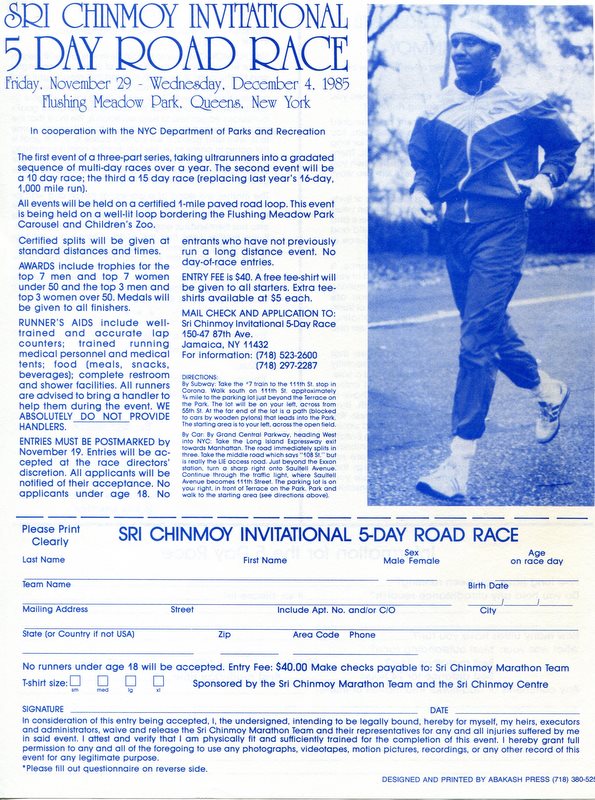
Before he became known as one of Canada’s greatest master’s ultra runners, Michel Careau ‘got his feet’ literally wet in multiday racing at the inaugural 1985 Sri Chinmoy 5 Day Race. Cold, rainy weather did not put a damper on his enthusiasm or his insights.

“Many ultra runners have managed to cover 50 miles, a much smaller number have gone on to 100 miles or 24 hours, and very few have run multi day events. What’s it like to run an ultra day after day? Canadian Michel Careau shares his experiences from the Sri Chinmoy 5 Day held last December in Queens, N.Y.
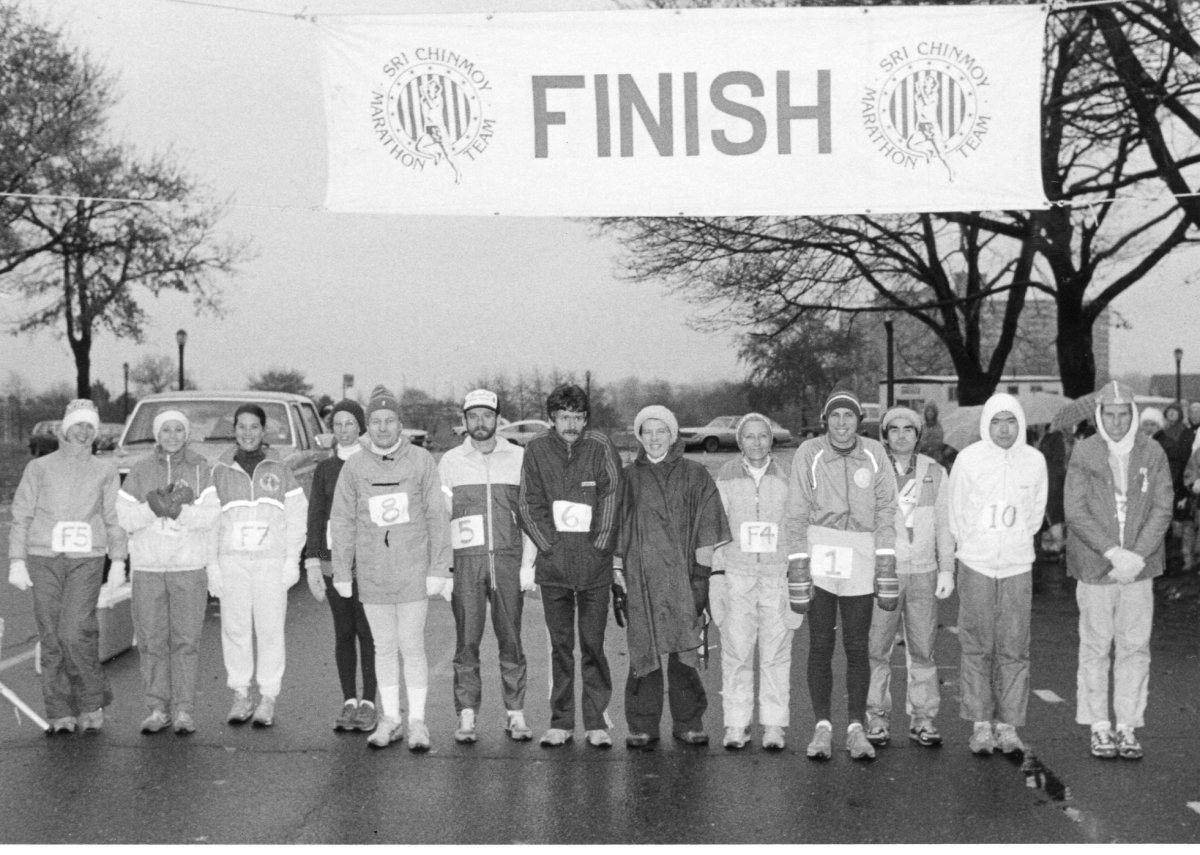
start5day85-1_0.jpgFriday, November 29th

8:15 am. Fifteen people are at the starting line for this 120 hour race. It is raining. It has been raining and it will continue to rain: might as well accept the inevitable. Who knows – start with rain and finish with sunshine. At least one can always hope! A quality field of ultra runners is gathered together on this damp morning. They are names, faces, and voices that will soon become familiar: smiles for the family album. I do not know who to look at and smile at. A mitigated smile – worried maybe. The photographers complete their task. One hundred and twenty hours of running is no small task. My goal of 500 kilometers, or about 310 miles, is a big undertaking for a first attempt at a 5 day event. With umbrellas surrounding us and the counters under their shelter, Sri Chinmoy is on the track leading the way for us. A few moments of silence precedes the start of the race.
img470.jpg8:22 am. Ten, nine, ...two, one, GO! That’s it – no fireworks. A few scattered rounds of applause are lost in the sound of the falling rain. I am running along about 20 meters behind the leading pack of Sammukh, Kirit and Trishul. My first two miles are covered in 17:36. I accelerate to shake myself up and take the lead, which I hold until mile 8. ‘Michel, discipline yourself!’...’Sorry?...‘I said, discipline yourself. Slow down, slow down!’ I am listening to my inner voice, the exhortations of common sense. I must not let myself be carried away by my enthusiasm. There are still so many hours to go. Sammukh and Trishul pass me. I feel more comfortable behind these two kings of the road and I take the opportunity to recall the merits of these two great gentlemen…

His friend, Trishul Cherns, is just as impressive. He is a 28 year old from Hamilton, Ontario, now living in New York. He holds the Canadian record for six days at 530.7 miles, 11th in the world. He’s done 1,000 miles in 15 days 9:37:35, third best in the world. Yes, I better let those two run ahead if I don’t want to die prematurely.

Noon. A bit of cheese, soup, peanut butter. The wind has picked up and the rain has ceased. The temperature has gone down. I am feeling good. This is no time to start feeling bad with only five hours gone and 115 still to go! So in order to keep my mind busy, I start doing some slight mental calculations. I had envisioned covering 500 km – that is my goal. This is not the time to start modifying it. An average of 62 miles per day is perfectly reasonable. To eat, rest, and avoid injuries is very important. Once I reach my goal for the first day then I can call it a day.

In the afternoon I stop in my plywood shelter, where everything is cold. The gas heater has not arrived yet. My co-sharers, Joe and Kirit, are still on the one mile loop. While I change into dry clothing, I pause to introduce myself to my ‘roommates’ when they run by. They actually use the shelter as a drop-off and changing facility since they live in the area and are able to go home at night and rest. Joe Michaels, a charming man 44 years of age from Bayside, N.Y. is president of the Cardiac Runners Association. To be part of that special group one has to have had at least one severe heart attack or one or more bypass operations or suffer from high blood pressure. Joe has proved to the medical and athletic world that seven heart attacks and two double bypass operations do no automatically put an end to an active life. He has completed 14 marathons and 17 ultras, including 86 miles for 24 hour and 300.9 for a six day…

How good it feels to be back on the road with warm and dry clothes on! The rain has stopped. On the menu for tonight’s meal is soup, a staple food of Sri Chinmoy’s disciples, and Macaroni. Once I reach 63 miles I decide to stop and rest, although I still feel like running. One must conserve one’s resources. Sleep...but where? In my shelter? Forget it, it is too cold. I find myself a little niche in a room next to the medical room. I fall asleep on a camp bed beside another ultra runner at rest, Louise Henry, 34, from Jamaica, N.Y.

The rest is short-lived, for ten minutes later the chiropractor wakes me up to tell me that this area is for women runners and therefore I cannot sleep there. He suggests I go to the medical room. But places in the medical room were very few. The lights were bright and the room was adjacent to the rather noisy counting station – noises. I must say, that were mainly the good-hearted encouragement of the counters towards the runners. I lie down and close my eyes anyway. Another ten minutes go by but I cannot sleep. So I get up and take my leave, while my hosts indicate that tomorrow I will be able to enjoy heat in my shelter. On those comforting words, I head towards my shelter and there, dressed in my Lifa underwear, cotton sweater and winter coat, I lie down in the cold late fall night. My eyelids get heavier and I fall asleep with the wind whistling through the shaky roof of my shelter.

A few hours later, a cold drop of water finds its way through an opening in the roof and ends up on my nose. I awaken and get up – it’s still night. I might as well return to the track. I greet my lap counter, who seems happy to see me back, and then I plunge into the dark night. By 8:22 am I have run another nine miles and completed my first day. I’m in 6th place with 72 miles.

Saturday, November 30th

The second day is going to be the low point for most of the runners. On the one hand, the humid weather was dampening our enthusiasm; on the other hand, the accumulate fatigue from battling the elements on the first was painfully felt. The first victim is Sammukh Sheridan – the first to reach 100 miles yesterday. Today he was forced to rest. Geoff Richardson would have to be satisfied with a meager 25 miles today and then would pull out completely – things were not going well for this 34 year old charming athlete, a native of Scotland who is now living in Columbia, South America. He lives at 9,000 feet and trains in hot weather, but it was not to serve him this time. Our conversations, sometimes in French (Geoff teaches French), sometimes in Spanish, indicated that this would not be his day. There are some days when you wonder why you just didn’t stay in bed.

Others had problems, too. Samara Minoli, the eldest of the group at 58, had to be content with 34 miles after covering 81 miles the first day. Stan Leventhal was struggling to stay on the road and could barely manage 40 miles after 86 yesterday.  As a group we averaged 45 miles, down from 65 on Friday.

It was a day when one had to draw motivation from one’s inner resources. As far as I was concerned, I had to suffer for a few hours, something that I did not want to show. In the early afternoon I started feeling pain on the top of my left foot, probably remnants of a broken bone suffered during a cross-country skiing accident in January, 1982. I kept going as best I could, trying to stay cheerful and even smile, although I was really discouraged with my slow progress. The idea was not to attract any attention and to prove to myself that I was not finished. I was glad I had done an extra 10 miles the first day; even if I couldn’t do my 62 miles today, I could at least reach 124 for the first two days.

It was on this last day of November that I met a true veteran of Ultrarunning – 53 year old Clarence Richey, a retired university professor from Milwaukee, Wisconsin. Clarence sports a thick and elegant beard and has bright eyes behind his dark-rimmed glasses. He is an ultrarunner of more than 30 years experience. He was a training companion of Ted Corbitt in the 1950s’s. Until recently he held the North American record for six days for his age group (376) miles. As a philosopher, linguist, polyglot and idealist, he is gifted with a profound and intense love for humanity, an extraordinary sense of humor, and a rich and delightful personality. He encourages me and, almost on a fatherly tone, admits to having studied and recognized in me the seed of a great ultra runner! (I note this with modesty, since I feel that his beliefs are based more on his friendly attitude towards me than on any scientific basis). I have learned some lessons from this veteran runner, hardened by years of efforts and experiences – stay on the track, go at your own rhythm, intelligently avoiding injuries and knowing when to rest. I listen intently. When I quietly admitted to him of suffering from a pain in my left foot, he suggested that I see the chiropractor in the medical tent.

The visit turned out to be a salvation. After examining me, the chiropractor told me that I had displaced a bone in my foot. After a few manipulations to my foot, leg, back, and neck, I am on my way to my now warm shelter for a 4 hour sleep and a chance for my swollen foot to regain its normal size.

I wake up in the middle of the night, well-rested and eager to get back on the road. Miraculously I finish my second 24 hours with 60 miles, or 132 in total so far.

Sunday, December 1st

I feel good. The air is fresh and I run freely, happy to be through with a day that could have been fatal. I am running so freely that I cover 49 miles in the first 12 hours (an average of 4.1 mph), without hardly noticing it. That is a very respectable total for this kind of race. At 8:22 PM we reach the halfway point of the race. Sixty hours of activity interspersed with short rest periods is behind us, sixty more hours ahead. I notify the race director that I am leaving to give my old 1974 Ford some exercise en route to a local hotel (of course, I first got the approval of my advisor Clarence). I make a brief stop at my shelter in order to put on some dry clothes and comb my hair. Then I go off with a smile in my old battered car with 123,500 miles to its credit. Metropole Hotel, here I come!

I take the opportunity to pay a visit to the washroom, check my teeth and then I stop at the bar. I catch a quick look in the mirror behind the counter to make sure that I still look human. The face is a bit pale, the eyes are somewhat lifeless, the face a little more lined than usual, but everything else seems to be in order. I sip a beer very slowly in order to prolong the pleasure. I feel as good as a high school student skipping classes. Suddenly, the other part of me is telling me that I should not drag on too much, that I had to take things seriously, I shouldn’t sit on my laurels, and that duty was calling. In any case, my not so well cushioned ‘laurels’ were not feeling very comfortable sitting on the hard bench. After two and a half days of running I had lost the habit of sitting down. ‘Come on lazy bones, let’s get back to work!’ A last visit to the washroom and then I am taking the stairs three at a time, coming out onto the sidewalk which is damp and cold from the drizzle that has now begun to fall. In the hotel I had felt like a fish out of water. I am now feeling part of a world different from the civilization of this big city. I feel a sudden urge to be back with my kin, on the track with my fellow runners and surrounded by the support and encouragement of the race crew.

Fifteen minutes later I am back on the track. The time allotted to sleep tonight will be reduced to a minimum – 1 ½ hours. But when morning comes, I am smiling despite the hardships of the day before. 81 more miles done, 213 for the three days so far. My little escapade to the Metropole has greatly refreshed me!

Monday, December 2nd

Another very special day for me. I am exploring new ground. I have never before run for more than 70 hours, an adventure I experienced in 1983 in my hometown of Hull, in the company of two great Canadian ultra runners, Phil Latulippe and Al Howie. I completed 234.5 miles (375 km) on a 1415 meter long course and the whole experience is engraved in my memory forever. This December 2nd would see me surpass my previous limit.

The day would also allow me to meet some more of the extraordinary participants in this race. The first of these was Vivian Corres, Clarence’s friend, also from Milwaukee. Although I can’t be sure, I suspect that Vivien was on the track more than any of the other women in the race. Warmly dressed, with a thick raincoat protecting her from the wind and rain, and wearing shoes, Vivien was walking at a brisk pace (she walked the entire race).  She was also keeping an eye on Clarence, who had lost the enthusiasm of the first hours. When he had to rest or was experiencing bad spells, Vivien knew how to encourage him and urge him on with her sweet, feminine psychology.

Another nice person I met was Kim Cavanagh, 34, from Winchester, Mass. Kim once held the North American record for 48 hours at 161 miles 75 yards. She had run 15 ultras before this. My discussions with her were mainly on the subject of Guru, Sri Chinmoy. We discussed the personality of the Master, his multiple talents, his spirit of determination, and the consistency of his moral and spiritual power which transcends all of his outer activities, giving these a dimension which might appear super-human to common mortals. Kim, once a disciple of Sri Chinmoy, talked at great length of the generosity, depth and intensity of the Master. She was putting as much effort into her talking as into running. But her warm, sweet voice showed no signs of exertion and her thin legs and elegant body were well suited to this gifted ultra runner who is enriched with penetrating intuition and a heart as big as the world.

Then there is Kanchan Scott, a 39 year old Canadian from Ottawa and the first woman to run across Canada, a distance of 3,800 miles. She holds the Canadian women’s record for 24 hours with 106 miles 313 yards. I had met her twice before, thought I’m sure I remember the occasions more than she does. Now, during the 5 day race, I was really in her clan as I was completing the Canadian trio of Trishul, Kanchan and myself. I couldn’t allow myself to blow this one!

During the second day of the run, when I had problems with my left foot and my general performance suffered, Kanchan had subtlety suggested that I take some rest. She was wondering, and rightly so, why I forced myself to stay on the track. I had told her that, despite appearances, everything was going fine; my spirits were good and I felt that everything would fall into place soon. When you talk with a disciple of the Guru and mention the word ‘spirits,’ the argument is already won! After all, doesn’t the Spiritual Master teach a philosophy of transcendence of oneself and of reaching for ever higher goals, often through the arduous road of going beyond the pain? Kanchan, who almost reproached me for staying on the track, often gave me looks in which I could feel some worry for my well-being. Forty-eight hours later, on this fourth day of the run, she didn’t miss the opportunity to tell me that I was running well and that I seemed to be at ease and relaxed. I returned the compliments as she also greatly deserved them.

I was so absorbed in this pleasant company that I didn't notice the fourth day and night go by. I was feeling better, happy that I would come out of this race with a feeling of having grown.

On a more athletic level, five runners had done at least fifty miles for this fourth consecutive 24 hours. I did 64, for a total of 277 miles for 4 days.

Tuesday, December 3

The fifth and last day is dawning. The rain has stopped and a reddish sun is taking its place in the sky – a good omen for the last 24 hours. My diet has changed. Oatmeal cookies, chocolate, sugar tarts and whole milk now constitute my nutritional intake. Last night I rejoiced over a plate of rice and mushrooms. I am virtually assured of reaching my objective, having a full day and night to cover the remaining 33 miles. I have decided to take things easy.

So, why not try to further deepen the already rich human experiences by strengthening the inner feelings that remain forever imprinted in our minds and hearts? The improvement in the weather has given rise to new incentive and inspiration. The long grinding hours on the track have had an effect on the athletes’ perceptions. The fatigue has made them more sensitive and communicative with each other...

The last night I actually rested. Yes, I slept well for a full five hours. When the day dawned on Wednesday the 4th there were no clouds to be seen. It was as if Mother Nature was trying to be forgiven for the past four days of cheerless weather. After a quick wash-up, I slipped into the running suit which I kept for special occasions. I then ran without much conviction since I had attained my set objective (I would end with 343+ miles).

During those last ultimate kilometers, the great moments of these five days went quickly through my mind; the rich encounters of human experience; my escapade to the Metropole Hotel at the halfway mark; the nights spent in the shelter lying under wet clothes strung on a line waiting to be put on again; those carefully prepared meals devoured so quickly; those devoted, benevolent helpers who kept coming all hours of the day and night without ever losing their good spirits; those runners, who were sometimes so full of energy and at other times trying to recover their motivation; those dull, grey, rainy and windy days; the sunrays of the last few hours which had followed the spring-like breeze of the lasts night.

A five day race is all this...and much more.”

Careau, Michel. “Life at the Sri Chinmoy 5 Day.” May 1986. Ultrarunning. Reprinted with permission of the publisher.

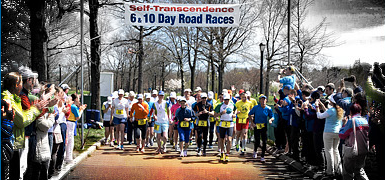


View full article »

The Sri Chinmoy 1,000 Mile Race, May 1-16, 1985 - America's first 1,000 Mile Race

By Rupantar LaRusso author bio »
16 May

About the author:

Rupantar has been the race director of the Sri Chinmoy Marathon Team since 1985, having been asked by Sri Chinmoy to serve in that capacity. As well as working on the big races the US Marathon Team organise each year - the 3100 Mile Race and the Six and 10 Day Race - he also spends a considerable amount of time archiving the Marathon Team's 40 year history on this website.

From our race brochure:
​

brochure.jpg"America's First 1,000 Mile Race" (Press Release). April 29, 1985. Retrieved 2012-05-23. Archive copy at Sri Chinmoy Marathon Team office, Queens, New York.

"America's first 1,000 mile footrace - 12 to 16 days of running - will take place in Flushing Meadow Park, Queens, New York starting May 1 at 8:00 am. This is only the third such race in history.

Winner of this premiere event will automatically establish the North American 1,000 mile record. There is a 16 day cut-off.

Runners are allowed to run, sleep, and eat at will during the race, bearing in mind they must average 62.5 miles per day to finish before the cut-off. The course is a one-mile loop in the zoo area of Flushing Meadow, near Terrace on the Park.

The world record for this event is currently held by Siegfried Bauer at 12 days, 12 hours, 36 minutes and 20 seconds. "Ziggy" Bauer is the only person in history to have completed the distance in either of the previous African and Australian races.

This American race will host an international field of ultra and multi-day race record holders including multi-day running pioneer Don Choi, Canadian Trishul Cherns, now residing in Queens, and Emil Laharraque of France. Five other New York ultra runners are starting. Entry is free.

Hosting the event will be the Sri Chinmoy Marathon Team, widely known for its excellence in organizing ultra distance events. This same team was host to Greek runner Yiannis Kouros' triple record run at the 1984 Sri Chinmoy 24-Hour Race in Flushing Meadow..."


start 1000_0.jpg

12 runners prepare for the start of America's first 1,000 mile race. (l) to (r): Sri Chinmoy, Nathan Whiting, Stan Leventhal, Don Choi, Emile Laharraque, Bob Wise, K. Makita, S. Sheridan, Trishul Cherns, Kim Cavanaugh, Sharon Yeter and Cahit Yeter. Bios of the 12 Runners.

choi walking.jpg

bob wise.jpg"Mailman Becomes America's First 1,000 Mile Runner" (Press Release). Atala Toy. May 16, 1985.Retrieved 2012-05-24. Archive copy at Sri Chinmoy Marathon Team office, Queens, New York

"San Francisco mailman Don Choi averaged 2-3/4 marathons a day to win America's first 1,000 mile race...Don's time of 15 days, 6 hours, 24 minutes and 43 seconds established a North American record for the event, which is the longest established race in American history. An international field of eleven multi-day runners competed in this premiere event which was hosted by the Sri Chinmoy Marathon Team and held on a one mile paved looped course in Flushing Meadow Park, Queens. New York.

Trailing by a slim 14 miles was Canadian Trishul Cherns who in turn was leading French adventurer Emile Laharraque by 21 miles when Choi crossed the line. Both runners will establish national records for 1,000 miles, as will race walker Bob Wise of Atlanta, Georgia.

Only one other man in history has completed thetrishul cherns.jpg grueling 1,000 mile race - the indomitable Siegfried Bauer, who first ran in Africa and then ran 12-1/2 days on a grass track in Australia to set the world record for the event. Previously, the longest accepted race distance in America was the 6 day race. The Sri Chinmoy event creates a new race category, one which, by all indications from the ultra distance community will prove to be popular in coming years."


"3 Runners Break 1,000 Mile Barrier" (Press Release). Atala Toy. May 20, 1985. Retrieved 2012-05-24.

Sri Chinmoy Marathon Team member Jogyata Dallas (l) congratulates 1,000 mile finisher Emile Laharraque.

"The 1,000 mile barrier was shattered three times in North America's first 1,000 mile footrace. First place was taken by 36 year old San Francisco mailman Don Choi, who ran 15 days, 6 hours, 24 minutes and 43 seconds. Second place went to a Jamaica florist, the 28 year old Canadian Trishul Cherns (15:9:37:35). Third place was won by French adventurer Emile Laharraque (15:17:58:30). The event, sponsored by the Queens based international Sri Chinmoy Marathon Team, took place on a one mile loop in Flushing Meadow Park, Queens, NY from May 1-17.

Jogyata Emile.jpg

Each runner averaged 2 3/4 marathons a day during the entire sixteen days of non-stop running. Each set his own country's national record. They became the second through fourth people in history to ever run a race of this distance. The only other runner to ever complete a 1,000 mile race is Siggy Bauer of New Zealand.
 
'We thought Bauer's 12 1/2 day record was easily reachable,' Cherns commented at the finish. 'Most of us had easily done 450-500 miles in the 6 day races.' Rubbing his aching legs, Trishul grimaced: 'By the seventh day we began to appreciate Bauer's achievement. A 1,000 mile race is in a new league altogether!'
 
Winner Don Choi nodded agreement: 'The immensity of this race is so great, I can't comprehend it yet.'
 
NYRRC President Fred Lebow presented trophies at the awards ceremony to the twelve multi day runners who competed in the event. Among them was the sponsoring Team's leader, running Guru Sri Chinmoy. Bob Wise, 46, a national race walking champion from Atlanta, Georgia, completed 903 miles during the event; Brooklyn running poet Nathan Whiting completed 817 miles.
 
Several part time runners completed high mileage, logging miles at night, returning to work at day..Bronx bus driver Cahit Yeter and his wife Sharon piled up 334 and 111 miles respectively.
 
The inspiration to run 1,000 miles came from Trishul Cherns, a veteran ultra runner looking to set a world record. Comparing his 6 day race daily totals of 80-84 miles to Siggy Bauer's 1,000 daily totals of 60-62 miles, he concluded the 1,000 mile record was attainable. 'Little did I realize!' he later commented.
fred and don.jpg

New York Road Runner's President Fred Lebow (l) congratulates 1,000 mile champion, Don Choi.

After day 6 of the race, runners reached territory explored before only by Bauer himself. Day 8 reportedly was the low point. 'We hit rock bottom,' Trishul recalls. 'We were shattered, emotionally and physically. Guess that's why God created the world in 7 days, not 8! We should have rested on the 7th day - we didn't, so were put to rest!'

Having finished 500 miles, with 500 more to go, the runners collected themselves, changed diet and sleep plans and kept running. All sugared junk food disappeared. In its place came vegetables, brown rice, pasta and yogurt. Sleep went from 2 to 3 hours a night to 5 or 6.

Don Choi led the entire race, although at one point Trishul was only 14 miles shy of him. On the last two days, with the goal in sight, runners eagerly pushed themselves..."


trishul counter.jpgWhat was it like during this historic race?

Two members of the 'graveyard' shift share their experiences during their 16 days on the overnight shift.

'One thousand miles. We couldn't conceive of it, but Trishul's vision coupled with Sri Chinmoy's enthusiastic support seeped into our bones and once more we found ourselves juggling jobs and  family to sign up for day and 'graveyard' shifts at the one mile asphalt course on the zoo grounds of Flushing Meadows Park, New York...' read more...

19850504 CKG in 1000 Mile Race_08_0.jpg

Sri Chinmoy, founder of the Marathon Team, was an official entrant in the race and completed 208 miles. Photo: Bhashwar

The Final Results...

results 1000 mile.jpg


View full article »

A helper's account of our first 1000 mile race

By Rupantar LaRusso author bio »
16 May

About the author:

Rupantar has been the race director of the Sri Chinmoy Marathon Team since 1985, having been asked by Sri Chinmoy to serve in that capacity. As well as working on the big races the US Marathon Team organise each year - the 3100 Mile Race and the Six and 10 Day Race - he also spends a considerable amount of time archiving the Marathon Team's 40 year history on this website.

fred and don_0.jpg‘Choi, Cherns and Laharraque Race 1,000 Miles In Sri Chinmoy 1,000 Mile Race, May 1 – 17, 1985’ (Press Release). Brummell, S. and Weisbrot, B. May 1985. Retrieved 2012-06-02. Archive copy at the Sri Chinmoy Marathon Team Office, New York.

Photo: (l to r) NYRRC President Fred Lebow, a frequent visitor to the race, congratulates 1,000 mile champion, Don Choi.

"One thousand miles. We couldn’t conceive of it, but Trishul’s vision coupled with Sri Chinmoy’s enthusiastic support seeped into our bones and once more we found ourselves juggling jobs and family to sign up for day and ‘graveyard’ shifts at the one mile asphalt course on the zoo grounds of Flushing Meadow Park, New York. Ziggy Bauer, the only man to successfully race this distance, had finished in 12 ½ days on a grass track in Colac, Australia in 1983. We had a sixteen day cutoff, but never really expected to be out there that long. Little did we realize!

Day One: The runners are off at 8:12 am under hot, sunny skies with Ted Corbitt giving the ‘go’ sign. Don jumps into the lead, cushioning himself with 107 miles over Trishul’s 88 – the highest daily total of the race. Cahit Yeter, who is camped with kids and wife Sharon, also a part-time runner, knocks of 8 minute miles for 10 hours then disappears to drive a bus for another 10…then the rains came.

emile blisters.jpgDay Two: Cold, drenching rain, 36 hours’ worth – drowning tents, food, handlers, runners, and spirits. Stan ‘The Leviathon’ Leventhal still pulls 81 miles out of a hat. Don stays happy running under an umbrella in a ‘Peanuts’ jacket – someone else has hands wrapped in foil, like baked potatoes. Emile’s feet, with a dropped metatarsal on one foot and unhealed blisters from the San Diego 6 day on the other, begin to trouble him.

Day Three: The rain stopped at 5:00 pm – thank God. Don has not slept for 48 hours and has racked up 36 miles on Trishul. The runners’ culinary tastes have begun to emerge – Bob goes for buttermilk, coffee, and more coffee. Nathan ends up on his ‘bread and water’ diet of grains and pasta – no dairy, but Tofutti makes his eyes shine. Don is the strictest, downing a mouthful of ‘chute’ each lap – a combination of vegetables, tofu and brown rice – no sugars. Trishul lavishes his brown rice with tamari for sodium. Emile finds club soda settles his stomach but Haagen-Dazs keeps him sane.

img053.jpgDay Four: Curious weekend park pedestrians dot the race. Bob rides the carousel – Nathan spots a duck nesting her eggs. Don puts in 86 miles; Trishul begins his comeback with 76 – ‘a strategic error. I should have run my own race.’ A sign appears near a razor and cream – ‘shave your handsome face’ – compliments Cahit Yeter’.

Photo (l to r): Nathan Whiting, Kim Cavanaugh and Sharon Yeter.

Day Six: The first of two back-to-back 6 day races ends. No one really notices – what is six days in the immensity of 1,000 miles? The magnitude of this race continues to steal over everyone. Race personnel replace precious Walkman batteries and make banana smoothies over words of encouragement. Sri Chinmoy makes multiple appearances daily to oversee the race, bolster spirits and log his own mileage, finishing 208 miles by the race’s end.

First casualty – Stan is out for good with shin splints but he sticks around to help. He’s done, 309 miles.

Day Seven: Strong day for top 3. Emile running steady 11 minute miles, despite flaming blisters which have by now corroded away into a gaping hole on the ball of his foot. Reliving his trail runs with the Mexican Indians seems to help.

chanakaya choi.jpgDay Eight: Crisis day – for everyone. ‘We shattered – physically, emotionally, mentally,’ recalls Trishul. ‘Even God rested on the seventh day!’ Only the heart is keeping the feet on the endless blue line. Don toys with quitting – the runners and handlers re-inspire him – ‘You’re the pioneer, you’ll set the standard!’ Emile seems the least affected, logging 65 miles, the highest mileage of the day. Bob walks 57.

Day Nine: Crisis over – back to business. New strategies emerge as runners digest the awesomeness of this task. Junk food is abandoned, replaced by yogurt, tofu, whole wheat pastas, bland vegetables and rice. Sleep lengthens from 1-2 hours a day to 5-6, climbing even higher as the days mount up.

Day Ten: Second casualty – Trishul leaves the track, seeking the aid of an acupuncturist for his ragged shins. Don meanwhile puts 77 miles on him and Emile moves into second. Bandaged like a thoroughbred on his return, Trishul rebounds with 64 miles the next day, reclaiming second and whittling Don’s lead down to 14 miles by the race’s close.

nathan balloon.jpgDay Twelve: Second fatigue zone seems to hit. Don and Bob both sick with stomach problems and sleep a full eight hours. Emile is in great pain, and although he maintains that 11 minute mile, he rests more and logs low mileage. Trishul is the only one with pep – he rested on his sojourn to the doctor. Fred Lebow pays a house call, toting sacks of fruit and snacks.

Day Thirteen: Runners wave goodbye to Ziggy’s 12 ½ day record, now held in awe by one and all. Runners are hyper-sensitive- race personnel talk to them gently and directly. Nathan runs and walks, singing loudly to himself in a rather pleasing, folksy way. Counter to Nathan, ‘Hey, Nath, that’s tiptoe through the tulips music!’ Nathan to counter, ‘But these tulips are cacti!’

bob wise bent over.jpgDay Fourteen: Bob is obsessed with the desire to break 1,000 miles by the 16 day cutoff, but remains delightfully cheerful, living on coffee and refusing to leave the track. Jogyata Dallas hits upon a partial solution of Emile’s cavernous, bone deep blisters. He cuts away the insert of Emile’s shoe beneath the wound to release the pressure on it, slathers on cold aloe vera gel, then pads the rim of the hot spot with lamb’s wool, making a ‘whoopee cushion’ of sorts. Emile manages his highest daily total – 71 miles.

Day Fifteen: Anticipation of the nearing 1,000 mile mark hangs in the air like the aroma of baking bread. Don, still weak from the flu, plans a conservative 3 miles/hour for his last 50 miles. He runs with a dandelion in his cap. Trishul, 42 miles behind, makes a final bid for the lead, logging 64 miles today, 71 tomorrow. As the Chinese Press films for points east, the two sprint three miles.

emile trishul don.jpgDay Sixteen: The goal is won: At 2:37 pm Don crosses the finish line, quietly happy and exhausted, hoisting a large American flag and larger grin for the TV cameras and the appreciative audience. It has taken him 15 days, 6 hours, 24 minutes and 43 seconds to become the America’s first and history’s second man ever to race 1,000 miles. Three hours later Trishul retraces Don’s steps and the two congratulate each other all over, smiling those smiles that people wear when they share a secret. Emile finishes at 2 am, stillness, dwarfing the distance with two 6:30 miles thrown around the familiar course for the last time. Nathan finishes with Trishul, 817 miles of personal best behind him. Bob walks alone through the dawn, fighting for 900 miles by the 8 am cutoff. Making it with change, he puts in three more miles until his handlers pull him off the course to get him ready for the award ceremony. Photo: three 1,000 mile finishers (left to right): Emile Laharraque, Trishul Cherns and Don Choi.

ranjana fred ckg.jpgA warm Fred Lebow honorarily hands out the awards as members of the Marathon Team sing a song written by Sri Chinmoy for the occasion. As we break camp, Bob is tooling around on his bicycle, the laurel wreath still circling his head like Caesar, happy as a kid off school. And the carousel keeps on playing." Photo: (left to right, foreground) Ranjana, Fred Lebow and Sri Chinmoy.


View full article »

Yiannis Kouros sets 3 world records at the 1984 Sri Chinmoy 24-Hour Race

By Rupantar LaRusso author bio »
8 November

About the author:

Rupantar has been the race director of the Sri Chinmoy Marathon Team since 1985, having been asked by Sri Chinmoy to serve in that capacity. As well as working on the big races the US Marathon Team organise each year - the 3100 Mile Race and the Six and 10 Day Race - he also spends a considerable amount of time archiving the Marathon Team's 40 year history on this website.

"Greek Runner Topples Three World Road Records" (Press Release). November 8, 1984. Retrieved 2012-09-17. Archive copy at the Sri Chinmoy Marathon Team Office, Queens, New York.

App24.jpeg"Three world road records fell at the feet of Greek distance runner, Yiannis Kouros, in the Sri Chinmoy 24-Hour Race, November 7-8 in Flushing Meadows Park, Queens, NY.

Kouros' 177 mile run shattered the standing mark of 170 miles, 231 yards; his 200K time of 15:11:48 eliminated the previous record of 16:40:00 and his 100 mile time of 11:46:36 bested Don Ritchie's longstanding record of 11:51:12. These marks, along with the 16 records he set during the 1984 NYRRC's 6-Day Race on Randall's Island, bring to nineteen his total world records.

Sri Chinmoy, sports philosopher and race director, said to Kouros, 'You are not only a Greek; you have become a universal figure. This is just the beginning. You will do many miracles on earth. Long distance running and your name will go together.'


moore.jpeg

Other records set during the race included second place Don Jewell's run of 145 miles, 1115.28 yards, besting the North American road record of 140 miles, 229 yards.

First woman, Kay Moore, of Colorado, ran 122 miles, 190.95 yards to better the woman's world age category (40-44) record of 118 miles 1380 yards.

Pausing to savor the victory of the new world record mark set 21 hours, 11 minutes and 45 seconds into the 24-hour race, Yiannis shyly accepted words of encouragement from team founder Sri Chinmoy and listened attentively as members of the host team sang a song written in his honor by Sri Chinmoy. Kouros then generously reciprocated by offering Greek sweets to the entire host team and celebrating bystanders.


ckgackerman.jpeg

The field of 56, the largest field ever assembled for a 24-hour road race, ran on a one-mile loop passing near the zoo grounds of Flushing Meadows Park. Entrants included New York's 68-year-old Willie Rios, who ran a personal best of 90 miles for the 24-hour event despite a back injury sustained while lifting weights. Willie upped his PR by 23 miles. 'Cardiac Runner' Joe Michaels, now well known to both ultra and middle-distance local runners, logged over 81 miles in the third leg of his 'Marathon Grand-Slam' - an attempt to run 3 marathons and 1 ultra marathon in less than one month's time. Sarama Minoli, 54, of the host Sri Chinmoy Marathon Team, logged a commendable 80 miles 729 yards, after having completed the Team's 47-mile run in August. (Photo: Sri Chinmoy (l) and NY State Senator Gary Ackerman (r) at the race start). This was the 6th running of the Sri Chinmoy 24-Hour-Race, which is considered by many to be the premiere 24-hour race in the country."

Selections from the media...

  • Coyle, Eddie. "World mark falls as Kouros wins Sri Chinmoy Run." Daily News (New York), November 9, 1984. "Braving the chill night air and the first touch of real fall weather, Yiannis Kouros of Greece added to his living-legend status when he shattered the world's record for 24 hours in winning the Sri Chinmoy 24-Hour Run yesterday at Flushing Meadow Park..."

  • Wiener, Caryn Eve. "Bayside Man Runs His Races From - and for - the Heart." New York Newsday, November 12, 1984. "Joe Michaels did not finish first in the Sri Chinmoy 24-Hour run in Flushing Meadows Corona Park. But victory was his, nonetheless. He savored it Thursday morning, relaxing at home after running 81 miles, circling repeatedly the route from the park's zoo to the science building. True, the 43-year-old Bayside man did not cross the finish line ahead of the race's victor, the record-holding Yiannis Kouros of Greece, who ran 177 miles. But Michaels, who has suffered seven heart attacks and a double pulmonary embolism, won by simply being able to compete..."
  • Nick Marshall: 1984 Ultradistance Summary, p71. "Martin Yecies, in 9th place with a PR 120.62 commented, 'Yiannis was a thing of beauty. His form was magnificent, with no wasted motion. The only person I really feel sorry for was Don Jewell. Imagine running 145 miles and being 32 miles behind the winner!' Actually, I imagine Jewell was not too unhappy with his day. While all the attention may have been focused on the headline attraction, Don cranked out a distance that was the best by any American during the year, and surpassed George Gardiner's 1982 U.S. road best by almost 4 miles. The competition spurred on others as well. Luis Rios' 135.40 was a typically solid run by him, but tying with him was Michael Fedak, and that was unexpected. In 7th place, Kay Moore was at it again, with an outstanding 122.10 miles this time. Robyn Hanscom PR'ed behind her at 112.25, as did Pippa Davis with 105 miles.'

Scanned Results...


Photos from the Race...

ckgjewel.jpeg

kouroscounter.jpeg

Sri Chinmoy (r) congratulates local running star and second place finisher, Don Jewell. Ultra great Yiannis Kouros (l) thanks the counting crew upon completion of his record breaking 24 hour run.


mochales.jpeg

rios.jpeg

Joe Michaels, 'The Cardiac Runner'.

 Willie Rios, holder of numerous veteran world and national records.


View full article »

The start of our 2 mile 'Runners are Smilers' races

By Rupantar LaRusso author bio »
1 August

About the author:

Rupantar has been the race director of the Sri Chinmoy Marathon Team since 1985, having been asked by Sri Chinmoy to serve in that capacity. As well as working on the big races the US Marathon Team organise each year - the 3100 Mile Race and the Six and 10 Day Race - he also spends a considerable amount of time archiving the Marathon Team's 40 year history on this website.

(Eidtor's note: The Sri Chinmoy Marathon had been sponsoring 2-mile races throughout the metropolitan area for several years. However,  in was in 1984 at Flushing Meadow Park that the 2-mile race series, run on a one-mile loop, became a permanent fixture in the New York area. The weekly 2-mile race has been held every week since that summer in 1984, and is now run around Jamaica High School on a .87 mile loop.)

runnersaresmilers.jpg

What the press had to say about some of our first 2-mile races...


"Gauthier, Grasso and Nichels Win". The New York Tribune. New York. August 6, 1984.

"Roff Grasso won his fourth consecutive 50 and over age division title in the Runners are Smilers two mile race series with a 12:22 clocking, Tuesday evening...Virendra Gauthier won the event in 9:37."

"D'Anauto Wins Two Miler: Nicholas Tops". The New York Tribune. New York. September 10, 1984.

"Don D'Anauto broke Virendra Gauthier's ten week hold on the Sri Chinmoy Two mile races, Tuesday, by winning in 9:20 over the Flushing Meadow course. Gauthier was second in 9:33."


View full article »

The One-Mile Loop

By Rupantar LaRusso author bio »
7 July

About the author:

Rupantar has been the race director of the Sri Chinmoy Marathon Team since 1985, having been asked by Sri Chinmoy to serve in that capacity. As well as working on the big races the US Marathon Team organise each year - the 3100 Mile Race and the Six and 10 Day Race - he also spends a considerable amount of time archiving the Marathon Team's 40 year history on this website.

When the Sri Chinmoy Marathon Team started using the one-mile loop not only for ultra races but for all of our races many runners were upset and refused to run our races. However, today, the loop is a common practice for many races, for both shorter races and ultra races. Hear what Roger Callahan had to say about the one-mile loop during the 1984 Sri Chinmoy 24-Hour Race.

Kouros.jpgNick Marshall: 1984 Ultradistance Summary, p71. "Roger Colahan did 115.10 miles and said, 'It was fascinating to watch Kouros running by himself. Since we were on an enclosed mile loop, you were constantly aware that he was moving at an incredible pace, never appearing to slack off and totally within himself, never acknowledging anyone else. It seemed I spent the entire 24 hours with him passing me. I was only vaguely aware of the other runners who would ultimately cover 20 or 30 more miles than me, because Kouros was passing everyone with such regularity.'"

View full article »

1982: Not One, But Two Races

By Sahishnu Szczesiul
31 October

start24francis.jpgReminisces from Sahishnu Sczesiul...

The third running of the Sri Chinmoy 24-Hour Race took place on September 25-26, 1982 on the same cinder and dirt Havenmeyer Track located behind the current town hall of the affluent city of Greenwich, CT. The field that year was limited to 40 very good runners, seeking their fortunes in an ultra pursuit that was gaining a bit of popularity in the country. The list of attendees was filled three months before the start. At that time new full day adventures were popping up in the Midwest, Southwest and west coast, so we were fortunate to have another great group of athletes take the challenge.

The two main principles in the 1981 race were back for more adventure. Cahit Yeter from the Bronx was focused on advancing his North American title with even higher mileage. Silver medalist Ron Bomberger from Mannheim, PA was finely trained and looking to chase Mr. Yeter all the way this time. Jim Roser, 51, from Beaver Falls, PA had his sights set on at least a podium finish, his age-group record would subsequently be transcended. Sterling, Virginia native Ed Foley, 33, had considered the race a perfect spot to contend for a 150- mile episode. And newly crowned world record holder Sue Medaglia, 47, Bronx, NY was even in better shape than she thought possible. 

The cool morning start gave way to late summer warmth and periodic clouds as the field stayed in tact for the first several hours. Cahit Yeter made a move to stay out in front in his focused pursuit. Jim Roser tried to match the leaders with reasonable lap splits but found himself weak and unable to handle the deceptive heat and humidity. After 38+ miles, the masters juggernaut gave up and drove home. Apparently his wife was later shocked to see him home a day earlier than expected. But, as some often say, there is always another day.

The depth of the field was striking. There were many runners attempting a 24-hour race for the first time, yet they brought such solid credentials from testing themselves up to 100 miles that the possibility of equaling the record of 24 runners past 100 miles was virtually in play.   

As the sun began its decent into night, the race picked up intensity. Mr Yeter kept a brilliant pace, working his way around the remaining 33 runners after a few defected from the race.  Just before 2:00am Cahit Yeter reached 200km in 17:44:27, knocking nearly 25 minutes off his previous national record. Soon after that he pulled off the track and went into his tent for a long rest. At this time Ed Foley had moved into second place, Ron Bomberger held third, and Paul Soskind from Brooklyn and Neil Weygandt from Ardmore, PA came close at fourth and fifth position. All four men eventually reached Yeter’s mileage totals and assumed positions one through four. Sue Medaglia resembled a machine, smooth strides and continual movement showing a tremendous steadiness. She passed her own national record at the 200 km mark by just over four minutes, reaching it in 23:36:42.

1982-1.jpgWhen the whistle blew, the sand bags were dropped, and the courageous athletes came to halt. Whether exhilaration or disappointment or shear pain showed on their faces, once again great triumphs had occurred by being there, on the track, for a whole day. Fully 20 runners had clicked past 100 miles. At least 15 people had set personal bests, at least 3 national records at various distances were created. 

Ed Foley, in his first 24-hour, finished first with 143 miles, 238 yards. His steadiness and good speed for nearly all the race were a pleasant surprise to him as well as us. Ed’s run became the top US performance for the year at 24 hours. Ed had moved from sixth place at halfway to first at the end. Ron Bomberger again finished second with 135 miles, 255 yards, but you had to admire his focus and consistency, especially during the late afternoon heat. Paul Soskind finished third with 134 miles, 81 yards, a great redemption from last year’s dropout after a few miles.

Sue Medaglia missed her national and former world 24-hour record by less than 500 yards, reaching the whistle-blow with 126 miles, 256 yards. And Marvin Skagerberg reached 118 miles, 471 yards to cop a national mark for age group 40-44. 

*****

It was not exactly clear when a second Sri Chinmoy 24-Hour Race for the following month was announced, but Sri Chinmoy and the organizers from the SCMT gave runners another chance, since some runners were not able to attend the September race due to space limitations. Eighteen athletes came to the cinder track at Francis Lewis High School on a cool morning in Springfield Gardens, Queens. Within the field of 18, eleven runners had run the previous month’s event, some at an especially hard effort. One would think that it would be remarkable to toe the line again so soon after such a difficult race- just 5 weeks prior.

Jim Roser, the Beaver Falls, PA native, was a prime suspect. He had pointed to the September race in Greenwich as the prime target for the year, and had even taken vacation time to accommodate the race in his family and work lives. His problem with that 24-hour was intense afternoon heat and dehydration. He barely made it 38 miles, the first dropout of three ‘favorites’. 

The October race was a different story. Moderate temps in the early going allowed good paced running sections for many people in the morning and afternoon. And having two or three ‘fast’ athletes at the head of the group would set an honest pace, or better. Arguably one of the fleetest ultra runners in the four-state area was Stu Mittleman, the NYRRC 100 Mile Champ and record holder. Stu hammered out a 6:27:02 for the 50 miles. Some will recall that Stu won our inaugural Sri Chinmoy 70 Mile Race in early November 1981, beating a strong field around the nearly 3-mile road course at Rockland Lake State Park in upstate NY. Cahit Yeter was also doing the back-to-back 24-hour journey, having run all three previous Sri Chinmoy 24-Hour runs. Cahit was 12 minutes arrears of Stu Mittleman at the 50-mile split. Former world and current American 24-hour and 200km champ Sue Medaglia was also on the track, with three runners total representing the ladies. She was over an hour behind Stu, still dressed in singlet and shorts as the late fall chill started to creep into the area. Cahit Yeter was only five minutes behind Stu at 100 km. Stu Mittlemen stopped just before 100 miles to change clothes, but then went into his tent for nearly two hours. Cahit reached the 100-mile time in a careful 16:29:34. He took a long break, affected by the cold air and the effort put forth.

1982-2.jpgJim Roser had paced himself well and somehow assumed first place on the scoreboard. He reached 100 miles in 17:44:54, scarcely 70 seconds ahead of Sue Medaglia, with both of them now ahead of the faster Mittleman and Yeter.  Sue tried hard to stay close to Jim Roser, but the veteran felt this was the race he really had inside. With less than an hour to go he hit 200k(23:00:08), and held on for the victory. Sue could not maintain good momentum as a frost had come into the area, with the many helpers chilled almost as much as the runners. 

When the horn sounded, Jim Roser had won the race with personal best marks, his 128 miles 531 yards being a 50-54 age-group record, as well as his 200km mark. 

Trishul Cherns, 25, the Canadian runner living locally, slipped passed Sue for second place, pushing hard to try to get to 200km. He reached 123 miles, 535 miles to set his own new best. Sue Medaglia hit 122 miles 789 yards, winning the women’s championship and her third straight 24-hour race. John Kenul added another 24 hour to his resume with 119 miles 1562 yards. Howard Poupko ran his best one-day race with 112 miles 832 yards, and Canadian Kanchan Stott set a new national record with her 106 miles 320 yards. 

Jim Roser talks about his race as he was interviewed by Nick Marshall. 

“ I had to run a long time while he (Mittleman) was sleeping in his tent, just to catch up. About the time my name went into first on the scoreboard, Stu came out to give it another try, but it was futile.

“What a difference a month makes. From last to first. Some strange things happen in ultras, as you well know by now. Sri Chinmoy was thrilled that I won because we’re both the same age, 51.”

*****

This was our fourth 24-hour race in the slightly more than two year journey of sponsoring ultras. Our schedule of having the 70 Mile race, added in 1981, gave more momentum to the longer event, and particularly the September 1981 and 1982 editions were almost like de-facto championships for runners in the US. The future also looked brighter, as there were more and more runners testing the longer races, and bringing attention to the running world. I was excited for the runners coming into the sport, as there seemed to be avenues to express their talent. Meanwhile, in Europe and in Oceana the event was gathering steam. 

Sri Chinmoy seemed to really like the ultras and the people associated with them. His philosophy of self-transcendence had found a home in the ultra-marathon world. He also wanted us to keep the ultras in Queens, nearby where many of the helpers lived. Indeed, the September 1982 24-hour event was the last one SCMT ever sponsored in Connecticut. 


View full article »

World and North American Records set in Second Annual Sri Chinmoy 24 Hour Run

By Rupantar LaRusso author bio »
25 September

About the author:

Rupantar has been the race director of the Sri Chinmoy Marathon Team since 1985, having been asked by Sri Chinmoy to serve in that capacity. As well as working on the big races the US Marathon Team organise each year - the 3100 Mile Race and the Six and 10 Day Race - he also spends a considerable amount of time archiving the Marathon Team's 40 year history on this website.

"Around the Country." Runner's World. December 1981.

"Two of America's finest masters runners set new 24-hour track records at the Sri Chinmoy Run on September 26-27 in Greenwich, Conn. Sue Medaglia became the first woman to break 200-K, reaching that mark in 23:41:08 en route to a world record total of 126 miles, 749 yards. Meanwhile, the overall winner, Cahit Yeter, like Sue a 46-year old resident of the Bronx, N.Y., set a new North American record of 155 miles, 1182 yards. The previous record belonged to Canadian Al Howie (149 miles, 706 yards). Yeter, a naturalized citizen born in Turkey, also set a new U.S. 200-K record of 18:10:56, bettering the previous best of 19:40:59 of Bob Van Deusen who also owned the accepted American 24-hour record of 145 miles, 408 yards."

flyer 24 hour.jpgMarshall, Bob. "Medaglia Passes 200 Km for 24 Hour World Record." Ultrarunning. November 1981.

(Greenwich, CT, September 26-27, 1981)

"There is a special quality abut a 24 hour race; a completeness in the full circle of time; an obligation to ration energy per hour rather than per mile. For a journeyman hundred miler, both the 24 hour and the 100 mile races seem to be, at the outset, nearly identical. But really they are two different tests. Milestones are measured in hours completed or hours remaining. The end is not reached cleanly or concisely at a finish line. The final relief approaches not in numbers of laps, but in minutes. There seems to be an interminable time lapse in the last few seconds. The last lap sprint of the hundred miler becomes, in the 24 hour, a sprint, a sag, maybe a half lap to go, another sprint, a half lap or so, can I keep it going? - finally, the end and the drop of the marker. We are deposited around the track like rag dolls scattered in a child's room. The earth has rotated once since we started.

There is also something very special about Sri Chinmoy and his group. Through ultramarathoning I have found what I consider to be an unparalleled inner contentment, yet I can only wonder in awe at the peace and love radiating from each of the Sri Chinmoy followers. At a far corner of the track two young women sang beautiful lyric songs about running and living. On nearly every lap, I was greeted and cheered by name. When it was dark, the track was lighted with dozens of candles in white bags which cast a mystical glow around the far turns. The group provided food: delicious homemade soup, fruits and bread, ERG, coke, water and coffee. A welcome respite for some of us was the first aid tent where one could receive an expert massage, blister treatment, or just a rest and a kind word.

yeter.jpg Cahit Yeter en route to his record breaking run. Photo: Bhashwar

The combination of the 24 hour event and Sri's race support group produced an unforgettable event, and fitting surroundings for the world class performances which resulted. Cahit Yeter and Su Medaglia provided classic examples of how to run an ultra - smooth, steady, knowing one's limits and staying just inside them. On my last laps, when I was locked in a friendly but desperate struggle to stay one lap ahead of Bob Sweetgall (the Delaware Madman of the Six-Day Race), I was unable to run with Yeter. It boggles my mind to think that he had run 50 miles further than I, a whole ultra further, yet I couldn't stay with him. Awesome!

There were some early front-runners who set a terrific pace George Gardiner hit 50 miles in just over 6 hours, and 24-hour veteran Bob Van Deusen ran well in the early going. But as the day wore on they faded, and by 100 miles, Yeter had a lead of over an hour on the rest of the field. Ron Berby, Ron Bomberger, Jim Sheridan and Ysau Shimizu turned in tremendous performances as well. I particularly remember Kim Cavanaugh's very gutsy race. She never quit, and kept moving for the whole 24 hours.

A most vivid impression of mine is that ultramarathoners, particularly those who run 100 miles and beyond, are the most unlikely of group of athletes in the world. The gaunt, sleek, smooth-striding look of the 10 km runner or marathoner is not to be applied to the group I ran with here. Physical appearances ranged from weightlifters to the plump middle-aged to the skinny. Running styles were even more bizarre - charging, flatfooted, shuffling, knock-kneed, pigeon-toed, race walking, upright and hunched. The one common denominator is the mental toughness, the strength and desire to drive one's body through a twenty-four hour endurance test.

ckg corbitt at 24 hour race_0.jpg Sri Chinmoy (l) with ultra legend Ted Corbitt at the awards ceremony of the Sri Chinmoy 24-Hour Run. Photo: Shraddha Howard

At the award ceremony I felt as though we were all winners; it was tremendous!! We sat in a circle of friendship and shared the moment - perhaps the first time that 24 runners bested 100 miles in a 24 hour race. World and national records were set by masters and junior performers. Sri Composed a song which the group sand to us. Van Deusen and Yeter shook hands; Cahit had broken his American record for 200 km, lowering it from 19:40 to 18:10:56, as well as his national 24 hour record. Race director Tarak Kauff announced the awards and Sri Chinmoy presented them. I had my brief moment, barely able to stand and accept Sri's hand. Suddenly it was over - the greatest 24 hour race ever held on American soil. I'll be back."

medaglia.jpg

Sue Medaglia, in her first 24 hour race, sets new world 24 hour track record and becomes the first women to break the 200K barrier in 24 hours. Photo: Bhashwar

Ultrarunning adds:

Sue Medaglia and Cahit Yeter, both 46, both from the Bronx and both running in their first 24 hour event each took home two records in winning the Sri Chinmoy race. Yeter, a well-known veteran ultramarathoner who ran two excellent 100 mile times this summer, took over the U.S. lead in the 24 hour and 200 km events, taking both marks away from Bob Van Deusen. Medaglia captured the same two records, held by March Schwam and Sue Ellen Trapp, respectively, but her performance was good for two world records. By running 126 miles, 749 yards (203.462 km), she became the first woman to surpass the 200 km mark in one day.

At age 46, Sue hopes that she can inspire other older women, who might feel that such an age is too advanced for competitive running. Though she has run many, many ultras, including a win at the 1980 Old Dominion 100 Miler, she wasn't aiming for a record in this race. An injury hampered her summer training, and she began specific training for the 24 hour only in September, putting in one stretch of six 20 mile days. During the race itself, she cruised easily through the first 100 miles without walking, but then, like most other 24 hour runners, experienced a loss of energy. She took a walking break, but then continued on, hitting the 200 km mark in 23:41:08. Future plans? Sue will continue to run ultras, but breaking 3 hours in the marathon is a major goal.

results 24 hour.jpg


View full article »

Sri Chinmoy Half-Marathon: November 16, 1980

By Rupantar LaRusso author bio »
16 November

About the author:

Rupantar has been the race director of the Sri Chinmoy Marathon Team since 1985, having been asked by Sri Chinmoy to serve in that capacity. As well as working on the big races the US Marathon Team organise each year - the 3100 Mile Race and the Six and 10 Day Race - he also spends a considerable amount of time archiving the Marathon Team's 40 year history on this website.

brochure 1980 half marathon.jpgToy, Atala. "Sri Chinmoy Half-Marathon". Runner Gazette December 1980.

"The Sri Chinmoy Half-Marathon was held in Flushing Meadow Park, Queens, NY on Sunday, November 16,1980.

Despite the chilly weather it was a Caribbean weekend for the Sri Chinmoy Marathon Team. While leader Sri Chinmoy was in Puerto Rico, being honored by the San Juan government for his contributions to running, the Sri Chinmoy Half-Marathon was being won by Jesus Figueroa (1:07:51) who had recently moved from Puerto Rico to the Bronx. Figueroa also headed the winning NY Track and Field Circuit combine that won the Team Trophy Division with a low 10 points (first, second and seventh place winners).

One of those who traveled farthest just to attend the run was 67-year old Canadian Ray Deschambault, winner of the oldest runner award. Ray divides his time between Montreal and DeWitt, NY; and won in his age division just the week before at the Montreal Sri Chinmoy 13K. He traveled to New York to run the Half-Marathon because, he said, Sri Chinmoy makes him happy.

Winner in the 55-60 division was sportswriter Mort Kail of the Westchester Rockland Newspapers. Mort began running two years ago - to keep up with the running column he had begun writing."

half marathon 1980.jpg

Runners pass the Unisphere during the Sri Chinmoy Half-Marathon on November 16 at Flushing Meadow Park, Queens, New York. Photo: Bhashwar Hart

View full article »

Our first 24 hour race - reminiscences from Sahishnu Sczecziul

By Sahishnu Szczesiul
2 November

lastimport-1of1.jpgOur first 24-Hour event was held in 1980 on a cinder track in Greenwich, CT, an affluent hamlet outside the boundaries of New York City, and a world apart from our home and enclave in Queens, NY.  It was perhaps a twist of fate that this event became reality. A 24-hour race to be held on the East coast of the US was cancelled. Some local runners of whom the Marathon Team had befriended were sad that had happened. Sri Chinmoy got word of this situation and suggested we offer a 24-Hour race to fill the hole left by cancellation. I remember three of us officials heading to Greenwich, CT a day or two later after the decision was made.  A disciple whose local business was willing to sponsor the event, procured permission from Greenwich City Hall to clean and rake the grounds behind it and make measurement of the inner ring around the track. It was measured just slightly less than a standard 440-yard track at that time (before tracks were designed at 400 meters, the current worldwide standard). The Athletics Congress (TAC) and our friend Ted Corbitt approved of the work, and distance splits were recorded and marked. Official marks were to be given at 50 miles,100 km, 100 miles and of course, total distance. We found out later the track had a name - the Havenmeyer Track. (Photo above: the 6 runners at the start of the first 24-Hour Race sponsored by the Sri Chinmoy Marathon Team. Far right, Ted Corbitt. Third from right Sri Chinmoy.)

The athletes were informed of the opportunity, and five stalwarts promised participation. We looked to add one more male participant just to even the ranks of gender. 

With the preparation of the track and the construction of a few tents for counting, food, and medical supervision, we welcomed the runners to the track on November 1, 1980.  The most heralded runner was Marcy Schwam, 27, from Queens, who had dazzled ultras on the east and west coasts, and was hoping for a fast 100 miles. She had reached 113 miles in 24 hours running in a 24 hour in 1979, but her record had been broken by Sue Ellen Trapp, who reached 123 miles, 596 yards. Her training partner Jackie Stack, 30, had been a consistent runner who was looking for new abilities at longer distances. She was rumored to be the niece of famous fitness figure Walt Stack, who caught the fancy of sports enthusiasts in the San Francisco area with his daily exploits of swimming, biking and running, bare-chested, near Golden Gate Bridge and Park- at age 50+.

The third female was Sharon Yeter, a member of Cahits Pacers, a Bronx, NY running club led by the irrepressible Cahit Yeter, her husband, a Turkish ex-pat turned Bronx bus driver who was a very good local runner and former 2:13 marathoner. Wes Emmons, 52, from Pennsylvania, was the senior runner of the group who was willing to push himself to new distances in a long fitness career. The third male was 19 year-old Yasu Shimisu, a courier, working inter-agency for the UN, who had never run more than 14 miles at a time!

Sri Chinmoy, in his traditional style, meditated with the athletes and assembled helpers just before the start at 9:00am on a crisp, fall morning. This was our first ultra-marathon for the public, and the Marathon Team was hoping to meet the challenge just as much as the athletes.  Six runners answered the command from American Olympian and the fabled ‘Father of Ultrarunning,’ Ted Corbitt, to begin.

Marcy Schwam left no doubt of her fitness level by ripping through the 50 mile split in 6:43:23, a new world female track best, reducing the previous best by mere seconds (6:44:43 by Judy Ikenbery in 1977). Cahit Yeter was behind her by over 20 minutes, marveling at her speed and determination. At the 100 km split, Marcy passed a second world best in 8:46:35, nearly an hour faster than any mark known at that time.

Undaunted, she moved towards the female all-time 100-mile mark, set by American Natalie Cullimore in 1971, at 16:11:01. Marcy, ignoring intestinal issues and stiffening legs, reached deep down to pass the world best with a sterling run in 15:44:27.  Her World, American, and course records would last for a few years until a new generation of female runners who graduated from the marathon moved up to ultras to test their abilities.

But there were still over eight hours left in the race, and the irony and agony of this ordeal had not fully played out.  Marcy rested and grabbed some downtime in a tent while helpers massaged tired, cramping legs. With the primary inspiration-engine off the track, the other runners’ efforts became less constant. Except for one competitor. Young, inexperienced Yasu Shimizu had jogged past his first marathon in 4:40, and somehow reached 100 km in 11:28:43. At 3:00am on the track, he was the only one still moving, trying to unlock every bit of energy from his thin, shocked frame and muscles. Perhaps his meditation practices or his genetic disposition as a suspected samurai helped his forward movement.  He reached 100 miles in 21:21:22, running confidently if not competently. Marcy emerged from her tent again with three hours to go and dragged her body along, hoping to hold off the young Japanese stalwart. Alas, in an epic effort, Yasu Shimizu held on for the overall win with 111miles 1462yds.

Marcy, three records in her pocket, reached 111 miles, happy, exhausted, but surely amused and bewildered by the 24-hour time frame.  She was about 12 miles away from the womens’ 24-hour record.  I think it was proven in this race that the 24-hour event separates itself from a competitive 100 mile in so many ways. They appear to be two separate kinds of events. Running through the night is a puzzle that must be solved by the athlete.  Even more remarkable is the determination by the athlete to face difficult barriers, and to cross them, without undue damage, injury or harm to their psyche. Having optimal conditions and dedicated support from friends and the race helpers contributed immensely.  

After returning to New York from the race after the clean-up, I met up with fellow helpers and shared a common thread- it was much more inspiring helping out at ultras than our shorter events. The inner satisfaction we received, while not even running a step, was worth all the planning, helping and working for hours and hours. It was not adulation that we were seeking,  it was something deeper. I am sure Sri Chinmoy was delighted by the outcome.  In the months and years that followed, we began to muse - ‘what might be next?’

Sri Chinmoy 24-Hour Race   November 1-2, 1980 Greenwich,CT   cinder track                                             

1 Yasumasa Shimizu, 19, Tokyo Japan    111 mi 1462yd   Overall winner,  first ultra (11:28:43 100km, 21:21:22 100 miles)
2 Marcy Schwam, 27, Jamaica,NY   111 mi  WWR,NR,CR: 50 mi-6:43:23, 100km 8:46:35, 100 miles 15:44:27  
3 Jackie Stack, 30, Queens,NY    80 mi 1320yd (100km 11:20:38 )
4 Sharon Yeter, 38, Bronx,NY   78 mi   577yd (100km 13:16:19)
5 Wes Emmons, 52, PA  70 mi 1702yd (12:37:52 )
6 Cahit Yeter, 45, Bronx,NY  62 mi   241yd (100km  9:35:20)

Marcy Schwam recalls the ordeal of this 24-hour adventure:

Quotes taken from an article by ultra-marathon historian Nick Marshall, himself a respected ultra-runner for over four decades. His words are in italics.

(Marcy)    “At 75 miles I had to make a decision about whether to concentrate on the 24 hours or throw what I had left into getting a good 100-mile time. I was in a great position to break 16 hours. Even feeling so bad, I thought I could last to 100 miles OK.  It felt like it was going to be rough past there no matter what I did, so I just concentrated on breaking the 100-mile record.
Then it happened. As soon as I reached 100 miles I stopped. Immediately. In a split second- instant, instant pain…The pain ended it right there. The 24-hour record was out…I tried walking with blankets around me, just trying to move around the track, but it was nothing I could control.”

(Nick Marshall)    The remaining eight hours to the official end of the race were an uncomfortable blur of resting, sleeping, and stumbling around the track, always cold, always cold. When the full 24 hours had expired, Schwam had a total distance of 111 miles.

Six months later Marcy tried a six-day event.
(Nick Marshall)    Marcy Schwam….. became the first woman in the 20th century to try a six-day raceThe Edward Payson Weston Six Day in Pennsauken,NJ was strictly a modern athletic endurance contest. All 13 starters had at least 100-miler under their belt. Twelve of them were men...Hampered by a sore tendon the last two days, and facing a hot summer sun every day, Schwam nonetheless logged a total of 384 miles by the expiration of the sixth day. Park Barner’s winning total was 430 miles but the second-place man wound up more than 40 miles behind Schwam

Indeed, Marcy Schwam was a tough, dedicated runner who pushed herself through 140-mile training weeks, testing herself and setting a great example to female runners invested in the marathon to try longer races.

View full article »

Arpan DeAngelo's Introuction to the First Sri Chinmoy Inspiration Marathon

By Rupantar LaRusso author bio »
1 February

About the author:

Rupantar has been the race director of the Sri Chinmoy Marathon Team since 1985, having been asked by Sri Chinmoy to serve in that capacity. As well as working on the big races the US Marathon Team organise each year - the 3100 Mile Race and the Six and 10 Day Race - he also spends a considerable amount of time archiving the Marathon Team's 40 year history on this website.

The Inspiration Marathon: A Jewel of the Marathon World

By Arpan DeAngelo


In 1980 Sri Chinmoy was personally fully immersed in long-distance running, which he had just begun in June of 1978. He had trained seriously for the rest of 1978 and into 1979 to run his first marathon on March 3, 1979 in Chico, California. Even though he had not been running for many years prior to 1978, he had a very good athletic background when he was growing up. He was a top track and field athlete in his youth, excelling in short sprints and track races, and for two years he was decathlon champion in his spiritual community. He was an excellent soccer and volleyball player as well.


But fitness can be lost quite rapidly if an athlete does not keep up the training into middle age. Sri Chinmoy decided to bring back that fitness and even go beyond the endurance and strength he had in his youth by beginning his training seriously again at the age of 46. By doing this he inspired many younger students of his to start getting into shape, whether they had previously been athletic or not.


Training for a marathon was a serious and arduous undertaking which most of the younger students of Sri Chinmoy had not attempted up to this point. Seeing how serious and enthusiastic Sri Chinmoy was in training himself inspired many of those who either had not yet run a marathon or wanted to improve their previous marathon times. In his first year of training Sri Chinmoy ran 7 marathons within 10 months. After his first marathon of 4:31:34 he ran another marathon three weeks later in 3:55:07! That's an improvement of 36 minutes in less than a month. That was not only an inspiration to all of his students, but almost miraculous for a 47-year-old spiritual Master and former sprinter.


By 1980 Sri Chinmoy felt that his students needed more inspiration to train and race seriously, especially in the cold winter months of the Northeast when one can easily lose fitness with the excuse that it is too cold out to train or race. That lethargic notion was soon to be shattered when Sri Chinmoy sprang a marathon on his students in January 1980 in the subfreezing weather of Vermont. He travelled up to Vermont from New York to give a concert and decided that everyone could draw much inspiration from running in the beautiful countryside. Many of his students had made the long trip up north and were used to bringing their running clothes on overnight trips. But little did anyone know that they would be running a full 26.2-mile marathon! Those of us who were prepared to run took the challenge and ran the marathon. Others helped with the administration of the race.


It was an incredibly energizing and inspiring experience for those who had not even dreamed of running a marathon in subfreezing weather. Sri Chinmoy was helping the runners conquer not only lethargy but also unfounded fear and apprehension of something as harmless as a little cold weather. It also inspired everyone to also train in the winter and to be in shape for marathons scheduled early in the year, before the summer months.


After that event, Sri Chinmoy instituted this race on a regular basis in the first week of February for the next three years in nearby Hampton, New Hampshire. He himself ran this cold but scenic race twice, in 1981 and 1983, when it followed the beautiful shoreline of the Atlantic Ocean in southern New Hampshire.


For a few years this iconic race was popular among serious local marathoners who wanted to qualify for the famous Boston Marathon. It was one of the last marathons available to potential qualifiers for Boston, which was a difficult race to get into at that time. The Boston Marathon, inaugurated in 1896, was the oldest annual running marathon. It became so popular by the 1970s that runners had to achieve qualifying times for their age groups to get in. Since Boston is always held in April, a serious marathoner has to train throughout the winter months to prepare properly for it. Sri Chinmoy's Inspiration Marathon was a perfect race to encourage and inspire those runners who wanted to compete in Boston, which also was not too far away from Hampton, New Hampshire.


For many reasons the Inspiration Marathon was truly a jewel of a race and a gift to all those serious runners who, at least during that time in the early ’80s, wanted to derive not only fitness but also inspiring motivation and joy in their marathoning pursuits, and thus in life as well. I am grateful to be one of those runners who still benefit from that experience. I owe a debt of gratitude to Sri Chinmoy for that race as well as many, many other races, short and long, that he inspired over the decades through his involvement in the running world.


(Arpan is a veteran of over 300 marathons and ultra-marathons including the world’s longest certified foot race, the Sri Chinmoy Self-Transcendence 3,100-Mile Race. He has been a member of the Sri Chinmoy Marathon Team since its inception in 1977. Above photo of Sri Chinmoy runnning in the 1980 Inspiraiton Marathon by Bhashwar.)

View full article »
  • ‹ previous
  • 12 of 13
  • next ›
More articles under Sri Chinmoy Marathon Team articles »

Books you might find interesting

Sport and Meditation
Inner secrets to get the most out of training and competing
more »

Sri Chinmoy Marathon Team articles

main page »

More in this section

main page »
Sights and Sounds from the 6 and 10-Day Races 2013
List of Runners and Brochure: 6 and 10 Day Races

Stories from around the world

United Kingdom
SRI CHINMOY 5K - Scottish Championship 2026
Worldwide
First Sub-Two Hour Marathon
Latest News
3, 6 and 10 Day Race 2026 Results
New Zealand
28th Sri Chinmoy 6-12-24 Hour Track Races - AUT Millennium Stadium, Auckland
Worldwide
Swimming for Peace
3100 Mile Race
Highlights of 3100 Mile Race 2025
Channel & Open Water Swimming
Swimming 20 Bridges around Manhattan for Peace

About us

  • About the Marathon Team
  • Sri Chinmoy, Team Founder

Our races

  • View all events

Results

  • Previous races
  • Worldwide results
Global homepage »

Country Websites

  • W.Europe
    • Austria
    • Finland
    • France
    • Germany
    • Great Britain
    • Iceland
    • Ireland
    • Italy
    • Netherlands
    • Norway
    • Portugal
    • Switzerland
  • Central & E. Europe
    • Belarus
    • Bulgaria
    • Croatia
    • Czech Republic
    • Hungary
    • Latvia
    • Macedonia
    • Moldova
    • Russia
    • Serbia
    • Slovenia
    • Slovakia
    • Ukraine
  • N. & S. America
    • Brazil
    • Canada
    • Guatemala
    • United States
  • Asia
    • Japan
    • Mongolia
  • Oceania
    • Australia
    • New Zealand

Other sites

  • Sri Chinmoy Cycling Team
  • SCMT Channel Swimming
  • SCMT Climbing
  • 3100 Mile Race

Popular Pages

  • Sport and Meditation - a guide
  • Recent media coverage
  • History 1977-Present
  • 7-step marathon training
  • Our members
  • Books by SCMT members
  • Privacy policy
  • Cookie settings
  • Log in

Contact Information

Sri Chinmoy Marathon Team
New York • 718 297 2556 • Email us
Creative Commons License

Except where explicitly stated otherwise, the contents of this site are licensed under a Creative Commons Attribution-NonCommercial-NoDerivs 3.0 Unported License read more »

SriChinmoyRaces.org is a Vasudeva Server project.